


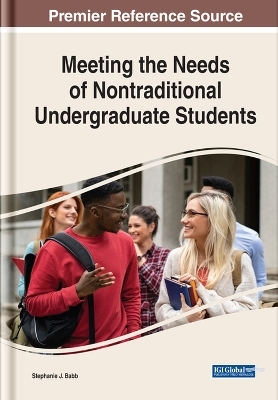
Meeting the Needs of Nontraditional Undergraduate Students
Seiten
2022
Business Science Reference (Verlag)
978-1-7998-8323-4 (ISBN)
Business Science Reference (Verlag)
978-1-7998-8323-4 (ISBN)
Advances work on already identified differences between nontraditional and traditional students. Further study is needed to truly comprehend this population's needs and challenges, and to develop and implement institutional-level changes to reduce their rate of attrition and increase their academic success.
Nontraditional students are the fastest-growing population of college undergraduates and range from a variety of definitions including first-generation students or veterans, individuals 25 years or older, single parents, part-time college students, independently financed individuals, or even full-time working individuals attending college at the same time. Compared with traditional students, who typically live on campus and enroll in college immediately after finishing high school, nontraditional students face a variety of challenges being enrolled in a system that is geared towards traditional students. These nontraditional characteristics can create barriers and a rift between personal responsibilities, such as family, work, culture, or finance, and the student's education.
However, the outlook for nontraditional students is not always bleak. Nontraditional students also possess characteristics that make them more likely to succeed when compared with traditional students. These students can display less academic entitlement and higher levels of mental health resilience, having dealt with "real-world" life experiences that can create a mature and successful student such as prior work experience or caring for a family.
This book will impact the field of adult higher education and nontraditional students by advancing and further honing already identified differences between nontraditional and traditional students. Further study is needed to truly comprehend this population's needs and challenges, and to develop and implement institutional-level changes to reduce their rate of attrition and increase their academic success. This publication of original research and a comprehensive book on adult education will absolutely benefit the student population at minority- and Hispanic-serving institutions, as well as institutions with a large proportion of nontraditional students. This book is a tool to address these students' requirements to meet their educational goals.
Nontraditional students are the fastest-growing population of college undergraduates and range from a variety of definitions including first-generation students or veterans, individuals 25 years or older, single parents, part-time college students, independently financed individuals, or even full-time working individuals attending college at the same time. Compared with traditional students, who typically live on campus and enroll in college immediately after finishing high school, nontraditional students face a variety of challenges being enrolled in a system that is geared towards traditional students. These nontraditional characteristics can create barriers and a rift between personal responsibilities, such as family, work, culture, or finance, and the student's education.
However, the outlook for nontraditional students is not always bleak. Nontraditional students also possess characteristics that make them more likely to succeed when compared with traditional students. These students can display less academic entitlement and higher levels of mental health resilience, having dealt with "real-world" life experiences that can create a mature and successful student such as prior work experience or caring for a family.
This book will impact the field of adult higher education and nontraditional students by advancing and further honing already identified differences between nontraditional and traditional students. Further study is needed to truly comprehend this population's needs and challenges, and to develop and implement institutional-level changes to reduce their rate of attrition and increase their academic success. This publication of original research and a comprehensive book on adult education will absolutely benefit the student population at minority- and Hispanic-serving institutions, as well as institutions with a large proportion of nontraditional students. This book is a tool to address these students' requirements to meet their educational goals.
Stephanie Babb, University of Houston, Downtown, USA
| Erscheinungsdatum | 01.12.2021 |
|---|---|
| Sprache | englisch |
| Maße | 178 x 254 mm |
| Gewicht | 287 g |
| Themenwelt | Sozialwissenschaften ► Pädagogik ► Didaktik |
| Sozialwissenschaften ► Pädagogik ► Erwachsenenbildung | |
| ISBN-10 | 1-7998-8323-X / 179988323X |
| ISBN-13 | 978-1-7998-8323-4 / 9781799883234 |
| Zustand | Neuware |
| Informationen gemäß Produktsicherheitsverordnung (GPSR) | |
| Haben Sie eine Frage zum Produkt? |
Mehr entdecken
aus dem Bereich



aus dem Bereich
Ein Unterrichtsprogramm zur Vermittlung von Lesestrategien. …
Buch | Softcover (2024)
Vandenhoeck & Ruprecht (Verlag)
CHF 25,20
29 Regeln für eine kluge Lehre – Das LENA-Modell
Buch | Softcover (2024)
Carl-Auer Verlag
CHF 34,90
Grundlagen und Konzepte
Buch | Softcover (2024)
UTB (Verlag)
CHF 55,85


