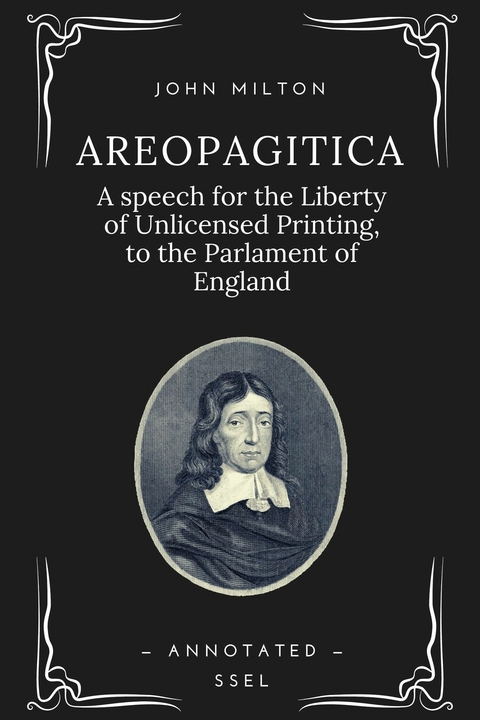
Areopagitica (eBook)
128 Seiten
Ssel (Verlag)
979-10-299-1293-1 (ISBN)
John Milton was an English poet and intellectual who served as a civil servant for the Commonwealth of England under its Council of State and later under Oliver Cromwell.
John Milton was an English poet and intellectual who served as a civil servant for the Commonwealth of England under its Council of State and later under Oliver Cromwell.
Introduction
IN June, 1643, came forth an Order of the Lords and Commons for the Regulating of Printing. In November, 1644, Milton’s Areopagitica was published as a protest against this Order.
It is a pamphlet in the form of a speech supposed to be addressed to the Parliament. Near the beginning, Milton says—“I could name him who from his private house wrote that discourse to the Parliament of Athens that perswades them to change the forme of Democraty which was then establisht.” The Areopagiticus of Isokrates (355 BC ) is a speech, supposed to be made in the ekklesia, about the Areiopagos—urging the restoration of its old powers. The Areopagitica of Milton is a speech to the English Areiopagos—the Parliament of the Commonwealth.
1471—1557. From the introduction of printing into England, the liberty of the press had been modified from time to time by royal proclamations.
1557. In 1557 the Stationers’ Company of London was formed. The exclusive privilege of printing and publishing in the English dominions was given to 97 London stationers and their successors by regular apprenticeship. All printing was thus centralised in London under the immediate inspection of the Government. No one could legally print, without special license, who did not belong to the Stationers’ Company. The Company had power to search for and to seize publications which infringed their privilege.
1558. In the next year Elizabeth came to the throne. It was resolved to continue the restrictions on the freedom of printing; but, as the Stationers’ Company, incorporated in Mary’s reign, was not thought a fit body to decide, under a Protestant Queen, what should or should not be published, it was determined to put the licensing power in other hands.
1559. In 1559 the 51st of the Injunctions Concerning Religion provided that no book in any language—schoolbooks and certain classics excepted—should be printed without license from one of the following persons or bodies: (i) the Queen: (ii) Six Members of the Privy Council: (iii) the Chancellor of the University of Oxford: (iv) the Chancellor of the University of Cambridge: (v) the Archbishop of Canterbury: (vi) the Archbishop of York: (vii) the Bishop of London: (viii) the Bishop, being Ordinary, and the Archdeacon, of the place of publication.
1566. In 1566 this order was ratified by a decree of the Star-Chamber.
1586. In 1586 a new decree of the Star-Chamber provided: 1. That, in addition to the presses under the control of the London Company of Stationers, there should be one press at Oxford and another at Cambridge. (Hitherto the privilege claimed, through their Chancellors, by the Universities had sometimes been disputed by the London printers.) 2. That the power of licensing, formerly shared by eight different persons or bodies, should belong to two persons only, viz. the Archbishop of Canterbury and the Bishop of London, jointly or severally. Certain papers and books, however, were excepted from their censorship; viz. (1) official documents sent to the Queen’s printer: (2) law-books, which were to be licensed by the Chief Justices and the Chief Baron.
It was part of the duty of the Archbishop’s and the Bishop’s Chaplains to examine books intended for printing. If the book was approved, the licenser endorsed it, and the printing then began. Before the book was published, the publisher registered it, for 6 d., in the books of the Stationers’ Company. He then had the copyright; or, in other phrase, the book was his “copy.” The book appeared with the words cum privilegio on the title-page, or with a copy of the licenser’s certificate. This is a translation of the Latin certificate prefixed to a book by Lord Herbert of Cherbury, printed in England in 1632: “I have read through the Treatise entitled ‘On Truth, as distinguished from Revelation, from the Probable, the Possible and the False.’ The book contains 227 pages already printed, and about 17 in MS.; in which I find nothing contrary to morals or to the truth of the Faith, to hinder it from being printed to the public advantage. William Haywood, Domestic Chaplain to the Bishop of London, Dec. 31, 1632.” [The book must have been licensed before one of the 227 pages could have been printed; though this formal certificate was not written until the printing was nearly completed.]
1603—1637. During the reign of James I and the earlier part of the reign of Charles I, the Archbishop of Canterbury and the Bishop of London continued to be the sole licensers. From about 1627 to 1632 Laud, then Bishop of London, appears to have done almost all the work of the censorship, leaving little of it to Archbishop Abbot. About 1632 a division of the work seems to have been admitted. At that time books to be printed at the University presses were licensed by the Vice-Chancellors of Oxford and Cambridge; in certain cases, licenses were granted by the Judges or the Secretary of State; plays and poems could be licensed by Sir Henry Herbert, the Master of the Revels. It appears, however, that by 1637 either the licensing regulations had come to be less strictly enforced, or means had been found to evade them by the establishment of private presses.
On July 11, 1637, the Star-Chamber published a decree for the purpose of confirming, with additions and explanations, the Star-Chamber decree of 1586. The new decree was framed by the Chancellor, the Archbishop of Canterbury, the Bishop of London, the High Treasurer, the Chief Justices and the Chief Baron: it was proposed to the Court by the Attorney-General, Sir John Bankes. The preamble sets forth that “divers libellous, seditious and mutinous books have been unduly printed, and other books and papers without licence, to the disturbance of the peace of Church and State.” The decree of 1586 is to stand in force, “with these Additions, Explanations and Alterations” contained in 33 clauses. The most important of these are: (i) Clause 3. The licensers in general shall be the Archbishop of Canterbury and the Bishop of London, or their deputies: for books to be printed at Oxford or Cambridge, the Vice-Chancellor of the University. To certain special classes of books special licensers are assigned. (ii) Clause 4. Each licenser is to receive two MS. copies. One is to be returned (if the book is approved) to the publisher; the other kept by the licenser, as a guarantee against alteration of the text. (iii) Clause 6. No imported books shall be passed at the Custom House until they have been visited by the licenser. (iv) Clause 5. The right of keeping a printing-press shall be restricted to twenty master-printers of London, the King’s printer and the two University printers. (v) Clause 17. No one of the twenty-three licensed printers shall keep more than two presses, unless he has been Master or Upper Warden of the Stationers’ Company—in which case he may keep three, but no more. (vi) Clause 20. In order to keep down “secret printing in corners,” the Master and Wardens of the Stationers’ Company shall take care that, as far as possible, all journeymen printers are kept employed. (vii) Clause 25. The officers of the Company, or any two licensed master-printers appointed for the purpose, shall have power to search houses and shops; to see anything that may be printing there; and to demand the license. (viii) Clause 27. There shall be four, and only four, licensed type-founders.
When the Star-Chamber was abolished in 1641, the censorship of the press passed to the Parliament; and a board of twenty licensers, called the Committee of Examinations, was appointed. So long as the Presbyterians and the Independents had been making common cause against Prelacy, the Presbyterians had been loud in their complaints of the restrictions on the liberty of the press. But when Prelacy had been overthrown, and when the rivalry between Presbyterians and Independents in and out of Parliament had become pronounced, the Presbyterians, in their turn, became impatient for some control over authors and printers. The most advanced thinkers and writers, the men most able and most likely to make effective use of the press, were the friends of the Independents. The Presbyterians had still a majority in Parliament; and the result is seen in three Orders published between January, 1642, and June, 1643.
1642 (Jan. 29). I. Order of the Commons, January 29, 1642. This merely directs the Master and Wardens of the Company of Stationers to see that no printer print or reprint anything without the name and consent of the author, under penalties.
1642 (March 9). II. Order of the Commons, March 9, 1643. The Committee of Examinations, or any four members of it, shall have power to appoint searchers of any places where they suspect presses to be kept and employed in printing any “Pamphlet scandalous to his Majesty or the proceedings of both or either Houses of Parliament”; to seize the pamphlet and the printing-apparatus; and to bring the printers before the Committee.
1643 (June 14). III. Order of the Lords and Commons, June 14, 1643. This is a fuller and stronger expression of the last order. The preamble refers to “the great late abuses and frequent disorders in printing many false, forged, scandalous, seditious, libellous, and unlicensed Papers, Pamphlets, and Books, to the great defamation of Religion and Government.” No book, pamphlet or paper...
| Erscheint lt. Verlag | 17.8.2021 |
|---|---|
| Verlagsort | Vachendorf |
| Sprache | englisch |
| Themenwelt | Sachbuch/Ratgeber ► Geschichte / Politik ► Politik / Gesellschaft |
| Sozialwissenschaften ► Politik / Verwaltung | |
| Schlagworte | Democracy • freedom of speech • liberty of press • Political Freedom • Political Philosophy • Protest |
| ISBN-13 | 979-10-299-1293-1 / 9791029912931 |
| Informationen gemäß Produktsicherheitsverordnung (GPSR) | |
| Haben Sie eine Frage zum Produkt? |
 EPUB (Wasserzeichen)
DRM: Digitales Wasserzeichen
Dieses eBook enthält ein digitales Wasserzeichen und ist damit für Sie personalisiert. Bei einer missbräuchlichen Weitergabe des eBooks an Dritte ist eine Rückverfolgung an die Quelle möglich.
Dateiformat: EPUB (Electronic Publication)
EPUB ist ein offener Standard für eBooks und eignet sich besonders zur Darstellung von Belletristik und Sachbüchern. Der Fließtext wird dynamisch an die Display- und Schriftgröße angepasst. Auch für mobile Lesegeräte ist EPUB daher gut geeignet.
Systemvoraussetzungen:
PC/Mac: Mit einem PC oder Mac können Sie dieses eBook lesen. Sie benötigen dafür die kostenlose Software Adobe Digital Editions.
eReader: Dieses eBook kann mit (fast) allen eBook-Readern gelesen werden. Mit dem amazon-Kindle ist es aber nicht kompatibel.
Smartphone/Tablet: Egal ob Apple oder Android, dieses eBook können Sie lesen. Sie benötigen dafür eine kostenlose App.
Geräteliste und zusätzliche Hinweise
Buying eBooks from abroad
For tax law reasons we can sell eBooks just within Germany and Switzerland. Regrettably we cannot fulfill eBook-orders from other countries.
aus dem Bereich