


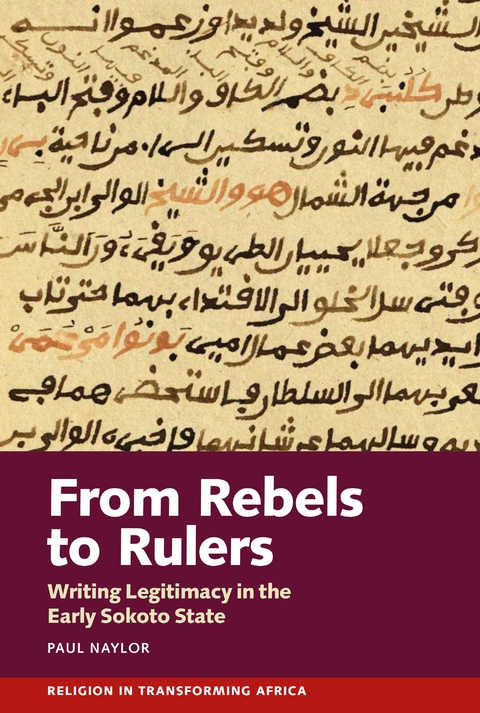
From Rebels to Rulers (eBook)
228 Seiten
Boydell & Brewer (Verlag)
978-1-80010-234-7 (ISBN)
Introduction
The Arabic Writings of the Fodiawa in their Context
A History of the Historiography
Approaching Legitimacy
1. Sources of Legitimacy in the Nineteenth-Century Sahel
Fiqh
Kashf
Nasab
Conclusion
2. Discourses of Dissent and Moderation
Laying Claims to Legitimacy: Usman's Writings in the 1790s
A Discourse of Dissent (c.1804-1810)
A Discourse of Moderation (1810-1812)
The Intellectual Challenge of Abdullahi dan Fodio (c.1812-1817)
Conclusion: from Ijtihad to Taqlid
3. 'Lesser of two evils': The Succession of Muhammad Bello
Defending the Succession (1817)
A Second Jihad (1817-1821)
'Fear them not, but fear me': Enforcing Obedience to Bello's Rule
Creating a Caliphate: Bello's Exchanges with Ahmad Lobbo
Conclusion
4. 'God has subjugated this land for me': Bello's Rule of Sokoto 1821-1837
Policies of Integration: The Hausa
Policies of Enslavement
Policies of Exclusion: The Tuareg
Policies of Sedentarisation: The Fulani
Meanwhile, in Gwandu...
Conclusion
Appendix: Sokoto Chronology
Bibliography
| Erscheint lt. Verlag | 2.8.2021 |
|---|---|
| Reihe/Serie | Religion in Transforming Africa | Religion in Transforming Africa |
| Zusatzinfo | 4 b/w, 1 line illus. |
| Verlagsort | Woodbridge |
| Sprache | englisch |
| Maße | 160 x 160 mm |
| Themenwelt | Geisteswissenschaften ► Geschichte ► Regional- / Ländergeschichte |
| Geschichte ► Teilgebiete der Geschichte ► Religionsgeschichte | |
| Geisteswissenschaften ► Religion / Theologie ► Islam | |
| Sozialwissenschaften ► Soziologie ► Spezielle Soziologien | |
| Schlagworte | African History • Cultural History • Legitimacy • Muslim Empires • religious movements • sokoto • West Africa |
| ISBN-10 | 1-80010-234-8 / 1800102348 |
| ISBN-13 | 978-1-80010-234-7 / 9781800102347 |
| Informationen gemäß Produktsicherheitsverordnung (GPSR) | |
| Haben Sie eine Frage zum Produkt? |
 PDF (Adobe DRM)
Kopierschutz: Adobe-DRM
Adobe-DRM ist ein Kopierschutz, der das eBook vor Mißbrauch schützen soll. Dabei wird das eBook bereits beim Download auf Ihre persönliche Adobe-ID autorisiert. Lesen können Sie das eBook dann nur auf den Geräten, welche ebenfalls auf Ihre Adobe-ID registriert sind.
Details zum Adobe-DRM
Dateiformat: PDF (Portable Document Format)
Mit einem festen Seitenlayout eignet sich die PDF besonders für Fachbücher mit Spalten, Tabellen und Abbildungen. Eine PDF kann auf fast allen Geräten angezeigt werden, ist aber für kleine Displays (Smartphone, eReader) nur eingeschränkt geeignet.
Systemvoraussetzungen:
PC/Mac: Mit einem PC oder Mac können Sie dieses eBook lesen. Sie benötigen eine
eReader: Dieses eBook kann mit (fast) allen eBook-Readern gelesen werden. Mit dem amazon-Kindle ist es aber nicht kompatibel.
Smartphone/Tablet: Egal ob Apple oder Android, dieses eBook können Sie lesen. Sie benötigen eine
Geräteliste und zusätzliche Hinweise
Buying eBooks from abroad
For tax law reasons we can sell eBooks just within Germany and Switzerland. Regrettably we cannot fulfill eBook-orders from other countries.


