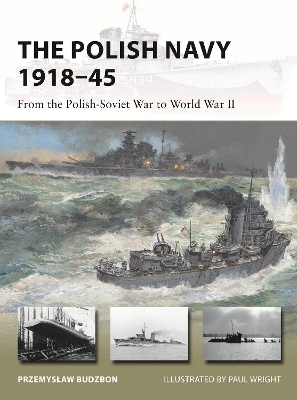
The Polish Navy 1918–45
Osprey Publishing (Verlag)
978-1-4728-4700-3 (ISBN)
Newly independent Poland’s naval force was created in 1920, initially with six ex-German torpedo boats. However, after German-Soviet exercises off the Polish coast in 1924, funding for warships was hastily allocated. Two destroyers and three submarines were built in France but, disappointed with their quality, Poland ordered new ships, mostly from British and Dutch shipyards.
By summer 1939, the Polish Navy comprised four destroyers, five submarines, one minelayer, six minesweepers and a handful of lesser ships. Although the Grom-class destroyers were two of the fastest and best-armed destroyers of the war, the tiny Polish fleet would stand little chance against the Kriegsmarine, and on 30 August three destroyers were dispatched to Britain, followed by two submarines that escaped internment. The remaining Polish surface fleet was sunk by 3 September.
In exile, the Polish Navy operated not only their own ships, but also Royal Navy warships, including a cruiser, destroyers, submarines and motor torpedo boats which fought alongside the Allies in the Battle of the Atlantic, the Arctic Convoys, and at the Normandy landings. This detailed account not only describes the Polish Navy’s contribution to the Allied war effort but also the episode of the Polish destroyer Piorun which took on the Bismarck in a lone gun duel leading to the sinking of the great German battleship.
Przemyslaw Budzbon is a naval architect who worked on warship construction for the Soviet Navy in the 1980s. He has written widely on the history of the Polish and Soviet navies of World War II and his book Soviet Navy at War 1941–45 was published in 1989 followed by Warship in 2019. He is currently working on a seven-volume history of the Polish shipyards in the post-1990 era. Paul Wright has painted ships of all kinds for most of his career, specializing in steel and steam warships from the late 19th century to the present day. Paul’s art has illustrated the works of Patrick O’Brian, Dudley Pope and C.S. Forester amongst others, and hangs in many corporate and private collections all over the world. A Member of the Royal Society of Marine Artists, Paul lives and works in Surrey.
INTRODUCTION
Poland regains independence, 1918
THE POLISH–BOLSHEVIK WAR
1919 campaign
1920 campaign
POLISH NAVY DEVELOPMENT 1921–39
The navy from World War I remnants, 1921
The first naval programme, 1925
Between the Soviet Union and Germany
THE POLISH NAVY IN WORLD WAR II
The German–Soviet assault
Revival: the Polish naval detachment 1939
The year of dashed hopes, 1940
The Battle of the Atlantic 1940–44
The Arctic convoys
The North Atlantic
The Mediterranean 1941–44
Invasion of the continent 1944
CONCLUSION
FURTHER READING
INDEX
| Erscheinungsdatum | 02.06.2022 |
|---|---|
| Reihe/Serie | New Vanguard |
| Illustrationen | Paul Wright |
| Zusatzinfo | Illustrated throughout with 40 photos and 8pp of colour illustrations |
| Sprache | englisch |
| Maße | 184 x 244 mm |
| Gewicht | 168 g |
| Themenwelt | Sachbuch/Ratgeber ► Geschichte / Politik ► Allgemeines / Lexika |
| Natur / Technik ► Fahrzeuge / Flugzeuge / Schiffe ► Militärfahrzeuge / -flugzeuge / -schiffe | |
| Geschichte ► Allgemeine Geschichte ► Neuzeit (bis 1918) | |
| Geschichte ► Allgemeine Geschichte ► 1918 bis 1945 | |
| Geschichte ► Teilgebiete der Geschichte ► Militärgeschichte | |
| Sozialwissenschaften ► Politik / Verwaltung | |
| ISBN-10 | 1-4728-4700-8 / 1472847008 |
| ISBN-13 | 978-1-4728-4700-3 / 9781472847003 |
| Zustand | Neuware |
| Informationen gemäß Produktsicherheitsverordnung (GPSR) | |
| Haben Sie eine Frage zum Produkt? |
aus dem Bereich