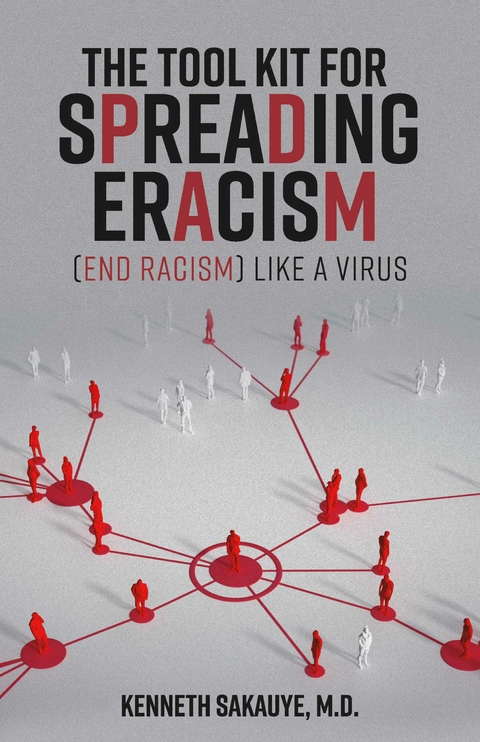
Tool Kit for Spreading Eracism (End Racism) Like a Virus (eBook)
92 Seiten
Bookbaby (Verlag)
978-1-0983-8295-7 (ISBN)
What does it mean to feel empowered to deal with racism? This book introduces you to three tools for these situations. The Trust Equation highlights essential considerations for developing a working relationship with someone. Motivational Interviewing uses Client Centered therapy techniques to avoid arguing or being unknowingly insulting or controlling and help someone find their personal reason to change. Mindfulness helps us become more aware of our feelings and reactions to others, improve empathy, and avoid letting our own feelings and biases rule us. Facing up to someone on an individual level requires a different type of empowerment than political action and protest. The COVID-19 pandemic offers a new metaphor to help teach what our Civil Rights icons exemplified. They would not have avoided racist people (social distancing) or "e;called them out"e; (forcing a defensive reaction). They would make an effort to reduce hostility and engage the other person in a constructive conversation in order to lessen their use of PPE and allow time for an ERACISM infection to take hold. They understood the pathophysiology of racism and supported change rather than demanding it. Empowerment comes from having confidence to talk without arguing or giving in, and counter dehumanization by showing human traits of integrity, self-awareness, honesty, courage, sincerity, and commitment. The goal is not to fight or retaliate out of anger, but to show our humanity by making a difficult interaction positive. We show empathy by putting ourselves in the other person's shoes and follow guidelines of motivational interviewing The only good excuse to author a short book about ending racism is the belief that one can contribute a fresh approach.
“Under heaven all can see beauty as beauty only because there is ugliness. All can know good as good only because there is evil.”
– Lao Tzu, Tao Te Ching
Pathophysiology of Racism
If Eracism were a virus, it would be classified in the same family of viruses as Racism, but Racism would exemplify a virulent form while Eracism would be an attenuated form. This is similar to the family of Corona Viruses where SARS and COVID-19 are virulent forms but the common cold and many others in the family do not cause serious disease. Eracism, can be considered a good virus for society that allows mankind to support each other and provides a degree of immunity against the more virulent strain.
Pathophysiology in medicine is defined as the disordered physiological processes associated with disease or injury. The pathophysiology of racism are the processes associated with how it infects and changes its host. It involves perceptual distortion, problems in learning, reasoning, empathy, rigidity, emotion regulation, and decision making in the face of unknown or incomplete information about the world around us.
Pathophysiology explains why an infection is severe in some people but mild in others, and what allows Eracism to cause immunity to racism. Some people with racism may only show mild symptoms where their bias is restricted to stereotyping and beliefs, but others can have such severe symptoms that they appear irrational and out of control. In severe racism, people become blind to the incongruence of their stated values and actions, close their minds to any other possibility than their belief, become intolerant of diversity, and even show violent tendencies.
Academic disciplines like anthropology, economics, history, law, politics, psychology, sociology, psychiatry, and the neurosciences shed light on different aspects of racism, though we still need to translate them into practical interventions. This chapter provides a sampling of what might be applied.
Some aspects of computer science have relevance in that it functionally mimics what human brains do. For example, information technology (IT) deals with memory and retrieval, long and short-term memory, and storage; and artificial intelligence (AI) deals with processes of learning, reasoning and decision making. New disciplines of Computational Psychology and Computational Psychiatry have burst into existence which combine data-driven theory and machine-learning models. It involves mathematical modeling, computer simulation, and behavior experiments. None of these computer science disciplines have modeled the phenomenon of racism yet, but one can imagine its promise. It might be possible to use computer models to facilitate new directions in thinking, correct bias, or handle errors in logic or prediction.
Bias
Bias is defined as a disproportionate weight in favor of or against an idea or thing without sufficient facts to justify the belief. Bias is usually unconscious and difficult for a person to explain. Yet we often believe our bias is truth and make decisions based on it. This conversion of bias into truth is explained by cognitive dissonance theory which predicts we will overvalue our choices to quiet the psychological distress of holding contradictory beliefs, values, or ideas. This means we show a tendency to jump to conclusions before all the facts are in and hold onto our view after we have decided.
Although bias is a normal human cognitive process, racism adds an emotional dimension of fear, hatred, or anger. Bias can be looked at from many angles. Nicholas Eply reframed the problem in his book Mindwise. Although he did not deal with racism per se, he summarized four universal human tendencies, borne out by social science, that seem to underlie our misunderstanding and dehumanization of others. First, we tend to show an almost blind loyalty to one’s own social group while distancing ourselves from outside groups. Second, we often act irrationally with very little information. Third, we tend to anthropomorphize anything important to us, like thinking our dog feels guilty, or seeing nature as a nurturing Mother Nature or an angry storm. Fourth, once we make a decision, we tend to overvalue it and believe it to be the right decision with no additional information. Basically, in racism, we often follow the leader blindly, suspend rationality, dehumanize the race we feel is different from us, and then double down on the correctness of our view despite contradictory evidence.
Difficulty Differentiating Lies from Bias
Another angle on bias was evident in a popular Instagram site @SHARONSAYSSO that began as a reaction to Qanon conspiracy theories. She felt people believe these theories because they have difficulty distinguishing a lie from a bias. For example, one can be biased, like disliking a right-wing news commentator, but still be truthful in disputing what that person said. She has been able to counter untruths with facts and do so in such a way that people seem to listen without resorting to hate mail or threats to quiet her. Facts are easy to verify, like what is written in the Constitution. Her approach does not seem that different from fact checking, except in the way she does it. Her secret seems to be her application of the academic dictum to divorce the message from the messenger and stick to the issue. She does not accuse anyone of lying, but just presents the facts about the issue. This suggests people will accept the truth, or at least listen, if they do not feel shamed or criticized.
However, we often seek the truth from sources that appeal to emotions and ignore the facts. A colleague commented that in today’s world, social media plays a key role in spreading information. The motivational speaking industry is worth 1.9 billion dollars, religion has become big business through the media, and even astrology has become a 2.2 billion-dollar industry. Although these sources may be legitimate, others may be misinformed or deliberately spread untruths. We must be cautious not to add confirmation bias to the problem. Two wrongs do not make a right. That is, we should not believe everything we hear from any source, and we should not only hear what we want to believe.
Luckily, even though we might not be aware of having biases, there are a few telltale signs that should make us question if negative bias is determining our actions. We may be acting on a wrong bias if any of the following are seen:
- If we try to justify information or beliefs that are not widely held or have been discredited.
- If we have a one-track mind and can only accept one answer, even if other more plausible possibilities exist.
- If we overgeneralize from just one event that is not representative of the norm.
- If we catch ourselves acting “out of character” like being unnecessarily rude or irritated.
Computer Models
Artificial Intelligence (AI) is a wide-ranging branch of computer science concerned with performing tasks or problem solving that typically require human intelligence. It requires a rule-based inference system and truth maintenance systems (TMS). Truth maintenance systems are also called reason maintenance systems because they must do several tasks like provide justifications for conclusions, recognize inconsistencies, catch false logic, and reset if we are on the wrong path.
In problem solving we often have to make decisions with sparse information, act on a set of assumptions that might be wrong, jump to the most probable or logical answer, and then check if the outcome fits the prediction or not. For example, if the premise is ‘Black men are dangerous’ and John is a Black man, the program would predict John is dangerous. However, if John is not dangerous, the program would have to decide if the assumption is wrong, or if the assumption just requires other conditions to be true.
There are three main types of TMS in computing. The first type is a simple justification-based system that only examines if the outcome was predicted by the assumption. If the assumption did not occur, the computer just switches among alternate sets of assumptions, i.e. changes to a different node in its algorithm. Simple justification is susceptible to confirmation bias and faulty data which can lead to a wrong conclusion. In the example above, if John turned out to be dangerous, it would have been a self-fulling prophesy about all black men, even though it is not true.
The second type of TMS is an assumption-based system that allows the program to maintain and reason with several simultaneous, possibly incompatible, sets of assumptions. If a set of assertions is inconsistent, it is considered a no-good set of assumptions, and must be revised.
The third type of TMS is a...
| Erscheint lt. Verlag | 20.9.2021 |
|---|---|
| Sprache | englisch |
| Themenwelt | Sozialwissenschaften ► Politik / Verwaltung |
| ISBN-10 | 1-0983-8295-1 / 1098382951 |
| ISBN-13 | 978-1-0983-8295-7 / 9781098382957 |
| Informationen gemäß Produktsicherheitsverordnung (GPSR) | |
| Haben Sie eine Frage zum Produkt? |
 EPUB (Adobe DRM)
Größe: 924 KB
Kopierschutz: Adobe-DRM
Adobe-DRM ist ein Kopierschutz, der das eBook vor Mißbrauch schützen soll. Dabei wird das eBook bereits beim Download auf Ihre persönliche Adobe-ID autorisiert. Lesen können Sie das eBook dann nur auf den Geräten, welche ebenfalls auf Ihre Adobe-ID registriert sind.
Details zum Adobe-DRM
Dateiformat: EPUB (Electronic Publication)
EPUB ist ein offener Standard für eBooks und eignet sich besonders zur Darstellung von Belletristik und Sachbüchern. Der Fließtext wird dynamisch an die Display- und Schriftgröße angepasst. Auch für mobile Lesegeräte ist EPUB daher gut geeignet.
Systemvoraussetzungen:
PC/Mac: Mit einem PC oder Mac können Sie dieses eBook lesen. Sie benötigen eine
eReader: Dieses eBook kann mit (fast) allen eBook-Readern gelesen werden. Mit dem amazon-Kindle ist es aber nicht kompatibel.
Smartphone/Tablet: Egal ob Apple oder Android, dieses eBook können Sie lesen. Sie benötigen eine
Geräteliste und zusätzliche Hinweise
Buying eBooks from abroad
For tax law reasons we can sell eBooks just within Germany and Switzerland. Regrettably we cannot fulfill eBook-orders from other countries.
aus dem Bereich