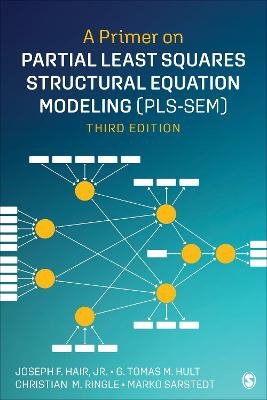
A Primer on Partial Least Squares Structural Equation Modeling (PLS-SEM)
SAGE Publications Inc (Verlag)
9781544396408 (ISBN)
The third edition of A Primer on Partial Least Squares Structural Equation Modeling (PLS-SEM) guides readers through learning and mastering the techniques of this approach in clear language. Authors Joseph H. Hair, Jr., G. Tomas M. Hult, Christian Ringle, and Marko Sarstedt use their years of conducting and teaching research to communicate the fundamentals of PLS-SEM in straightforward language to explain the details of this method, with limited emphasis on equations and symbols. A running case study on corporate reputation follows the different steps in this technique so readers can better understand the research applications. Learning objectives, review and critical thinking questions, and key terms help readers cement their knowledge. This edition has been thoroughly updated, featuring the latest version of the popular software package SmartPLS 3. New topics have been added throughout the text, including a thoroughly revised and extended chapter on mediation, recent research on the foundations of PLS-SEM, detailed descriptions of research summarizing the advantages as well as limitations of PLS-SEM, and extended coverage of advanced concepts and methods, such as out-of-sample versus in-sample prediction metrics, higher-order constructs, multigroup analysis, necessary condition analysis, and endogeneity.
Joseph F. Hair, Jr. is Cleverdon Chair of Business, and director of the PhD degree in business administration, Mitchell College of Business, University of South Alabama. He previously held the Copeland Endowed Chair of Entrepreneurship and was Director of the Entrepreneurship Institute, Ourso College of Business Administration, Louisiana State University. Joe was recognized by Clarivate Analytics from 2018 through 2024 for being in the top 1% globally of all business and economics professors based on his citations and scholarly accomplishments, which exceed 550,000 over his career. He has authored more than 145 editions of his books, including Multivariate Data Analysis (8th edition, 2019; cited 240,000+ times), PLS-SEM Primer (4th edition; 2026); Advanced PLS (2nd edition, 2024); MKTG (14th edition, 2024); Essentials of Business Research Methods (5th edition, 2024); Essentials of Marketing Analytics (2nd edition, 2025); and Essentials of Marketing Research (6th edition, 2026). He also has published numerous articles in scholarly journals and was recognized as the Academy of Marketing Science Marketing Educator of the Year. As a popular guest speaker, Professor Hair often presents seminars on research techniques, multivariate data analysis, and marketing issues for organizations in Europe, Australia, China, India, and South America. He has a forthcoming book on Sales Analytics (Sage 2026). G. Tomas M. Hult, PhD, has been Professor in the Broad College of Business at Michigan State University (USA) since 2001 and a visiting professor at the Företagsekonomiska Institutionen at Uppsala University (Sweden) since 2013. Professor Hult is a member of the Expert Networks of the World Economic Forum and United Nations/UNCTAD’s World Investment Forum and is also part of the Expert team at the American Customer Satisfaction Index (ACSI). Dr. Hult was recognized in 2016 as the Academy of Marketing Science/CUTCO-Vector Distinguished Marketing Educator; he is an elected fellow of the Academy of International Business, and is one of the world’s most cited marketing academics. At Michigan State University, Dr. Hult was recognized with the Beal Outstanding Faculty Award in 2019 (MSU’s highest award “for outstanding total service to the University”). He has also been recognized with the John Dunning AIB Service Award for outstanding service to AIB as the longest-serving executive director in AIB’s history (2004-2019) (the most prestigious service award given by the Academy of International Business). Professor Hult regularly teaches doctoral seminars on multivariate statistics, structural equation modeling, and hierarchical linear modeling. He is a dual citizen of Sweden and the United States. More information about Professor Hult can be found at https://broad.msu.edu/profile/hult/. Christian M. Ringle is a Chaired Professor and the Director of the Institute of Management and Decision Sciences at the Hamburg University of Technology (Germany), an Adjunct Professor at the James Cook University (Australia), a Visiting Guest Researcher at the University of California, Berkeley (USA), and an RHB-UKM Endowment Fund Distinguished Chairholder at the National University of Malaysia (UKM). His research focuses on management, marketing, technology and innovation management, method development, business analytics, machine learning, artificial intelligence, and the application of business research methods to decision making. His contributions have been published in journals such as Decision Sciences, European Journal of Marketing, International Journal of Research in Marketing, Information Systems Research, Journal of Business Research, Journal of Service Research, Journal of the Academy of Marketing Science, Long Range Planning, MIS Quarterly, and Organizational Research Methods. Since 2018, Christian has been included in the Clarivate Analytics′ list of Highly Cited Researchers (HCR). He is a co-developer and co-founder of the statistical software SmartPLS (https://www-smartpls.com). More info: https://www.tuhh.de/mds/team/prof-dr-c-m-ringle. Marko Sarstedt is a chaired professor of marketing at the Ludwig-Maximilians-University Munich (Germany) and an adjunct research professor at Babe?-Bolyai-University Cluj-Napoca (Romania). His main research interest is the advancement of research methods and psychological measurement to further the understanding of consumer behavior. His research has been published in Nature Human Behaviour, Journal of Marketing Research, Journal of the Academy of Marketing Science, Multivariate Behavioral Research, Organizational Research Methods, MIS Quarterly, and Psychometrika, among others. His research ranks Marko among the most frequently cited in the social sciences with more than 300,000 citations according to Google Scholar. Marko has won numerous best paper and citation awards and has been repeatedly named member of Clarivate Analytics’ Highly Cited Researchers List. In March 2022, he was awarded an honorary doctorate from Babe?-Bolyai-University Cluj-Napoca for his research achievements and contributions to international exchange.
Preface
About the Authors
Chapter 1. An Introduction to Structural Equation Modeling
Chapter Preview
What Is Structural Equation Modeling?
Considerations in Using Structural Equation Modeling
Principles of Structural Equation Modeling
PLS-SEM, CB-SEM, and Regressions Based on Sum Scores
Considerations When Applying PLS-SEM
Guidelines for Choosing Between PLS-SEM and CB-SEM
Organization of Remaining Chapters
Summary
Review Questions
Critical Thinking Questions
Key Terms
Suggested Readings
Chapter 2. Specifying the Path Model and Examining Data
Chapter Preview
Stage 1: Specifying the Structural Model
Stage 2: Specifying the Measurement Models
Stage 3: Data Collection and Examination
Case Study Illustration—Specifying the PLS-SEM Model
Summary
Review Questions
Critical Thinking Questions
Key Terms
Suggested Readings
Chapter 3. Path Model Estimation
Chapter Preview
Stage 4: Model Estimation and the PLS-SEM Algorithm
Case Study Illustration—PLS Path Model Estimation (Stage 4)
Summary
Review Questions
Critical Thinking Questions
Key Terms
Suggested Readings
Chapter 4. Assessing PLS-SEM Results—Part I: Evaluation of the Reflective Measurement Models
Chapter Preview
Overview of Stage 5: Evaluation of Measurement Models
Stage 5a: Assessing Results of Reflective Measurement Models
Case Study Illustration—Evaluation of the Reflective Measurement Models (Stage 5a)
Summary
Review Questions
Critical Thinking Questions
Key Terms
Suggested Readings
Chapter 5. Assessing PLS-SEM Results—Part II: Evaluation of the Formative Measurement Models
Chapter Preview
Stage 5b: Assessing Results of Formative Measurement Models
Case Study Illustration—Evaluation of the Formative Measurement Models (Stage 5b)
Summary
Review Questions
Critical Thinking Questions
Key Terms
Suggested Readings
Chapter 6. Assessing PLS-SEM Results—Part III: Evaluation of the Structural Model
Chapter Preview
Stage 6: Structural Model Results Evaluation
Case Study Illustration—Evaluation of the Structural Model (Stage 6)
Summary
Review Questions
Critical Thinking Questions
Key Terms
Suggested Readings
Chapter 7. Mediator and Moderator Analysis
Chapter Preview
Mediation
Moderation
Case Study Illustration—Moderation
Summary
Review Questions
Critical Thinking Questions
Key Terms
Suggested Readings
Chapter 8. Outlook on Advanced Methods
Chapter Preview
Importance-Performance Map Analysis
Necessary Condition Analysis
Higher-Order Constructs
Confirmatory Tetrad Analysis
Examining Endogeneity
Treating Observed and Unobserved Heterogeneity
Measurement Model Invariance
Consistent PLS-SEM
Summary
Review Questions
Critical Thinking Questions
Key Terms
Suggested Readings
Glossary
References
Index
| Erscheinungsdatum | 06.08.2021 |
|---|---|
| Verlagsort | Thousand Oaks |
| Sprache | englisch |
| Maße | 152 x 228 mm |
| Gewicht | 560 g |
| Themenwelt | Sozialwissenschaften ► Soziologie ► Empirische Sozialforschung |
| Wirtschaft ► Betriebswirtschaft / Management ► Unternehmensführung / Management | |
| ISBN-13 | 9781544396408 / 9781544396408 |
| Zustand | Neuware |
| Informationen gemäß Produktsicherheitsverordnung (GPSR) | |
| Haben Sie eine Frage zum Produkt? |
aus dem Bereich