The Paramedic Revision Guide (eBook)
John Wiley & Sons (Verlag)
978-1-119-75808-2 (ISBN)
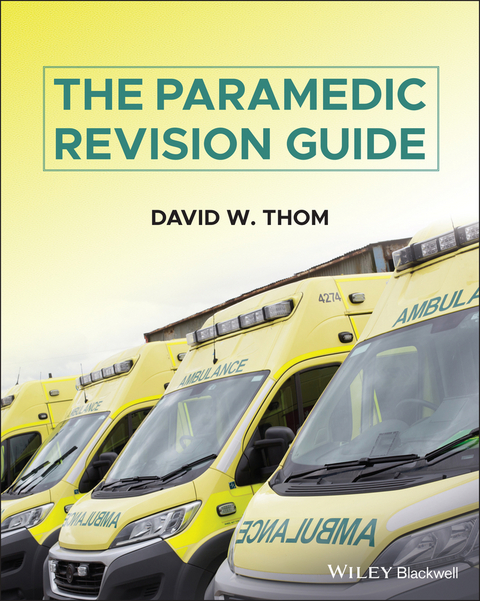
The Paramedic Revision Guide delivers a one-stop reference for paramedic students, paramedicine educators, and practicing paramedics. Designed to take the mystery out of paramedic education, the book provides a solid foundation of understanding in crucial areas of paramedic science and practice, including practical skills, research, anatomy and physiology, pharmacology, and medical emergencies.
This guide furthers readers' understanding and practice of emergency care, and includes:
- A thorough introduction to paramedic anatomy and physiology, including anatomical and medical terms, cellular biology, and pediatrics
- An exploration of practical skills for paramedics, including scene survey, airway practices, basic life support and defibrillation, burns, and head injuries
- Practical discussions of medical emergencies, research and evidence-based practice, and the ethical and legal considerations for paramedics
- An analysis of pre-hospital trauma treatment, including the physics and physiology of trauma
The Paramedic Revision Guide earns a place on the shelves of all paramedic students and educators who need a comprehensive handbook full of succinct and easily digestible information, ideal for exam preparation and quick reference.
David W. Thom, Specialist Paramedic in Critical Care for the Dorset and Somerset Air Ambulance at the South Western Ambulance Service NHS Foundation Trust, UK
David W. Thom, Specialist Paramedic in Critical Care for the Dorset and Somerset Air Ambulance at the South Western Ambulance Service NHS Foundation Trust, UK
Introduction
Chapter 1 - Paramedic Anatomy and Physiology - 1
Chapter 2 - Practical skills for Paramedics - 1
Chapter 3 - Pharmacology - 1
Chapter 4 - Medical emergencies - 1
Chapter 5 - Research and Evidence-Based Practice - 1
Chapter 6 - Ethical and Legal Considerations for Paramedics
Chapter 7 - Paramedic Anatomy and Physiology - 2
Chapter 8 - Practical skills for Paramedics - 2
Chapter 9 - Pharmacology - 2
Chapter 10 - Medical emergencies - 2
Chapter 11 - Research and Evidence-Based Practice - 2
Chapter 12 - Practical skills for Paramedics - 3
Chapter 13 - Pre-hospital Trauma
Chapter 14 - Pharmacology - 3
Chapter 15 - Research and Evidence-Based Practice - 3
Answers
1
Paramedic anatomy and physiology – 1
Contents
- Anatomical and medical terms
- Questions
- References and Further Reading
- Cellular biology
- Quick Questions
- References and Further Reading
- The nervous system
- Questions
- Questions
- References and Further Reading
- The respiratory system
- Questions
- Quick Questions
- References and Further Reading
- The cardiovascular system
- Questions
- The heart
- Questions
- Electrocardiogram (ECG)
- References and Further Reading
- The gastrointestinal system
- References and Further Reading
- The endocrine and exocrine system
- Questions
- References and Further Reading
- The renal and urinary system
- Questions
- References and Further Reading
- The skeletal system
- References and Further Reading
- The muscular system
- References and Further Reading
- The integumentary system
- Questions
- References and Further Reading
- Paediatrics
- References and Further Reading
This section will take you through the basics of anatomy, physiology and some pathophysiology required for your learning. Physiology is often overlooked but it underpins every aspect of clinical care within medicine. By understanding the physiology you can interpret how the patient is presenting even if you don't know what is wrong with them, from this you will be able to form management plans to alter the physiology back to normal.
Firstly what you will need to learn is how to classify areas of the body and general terms for describing movement and positioning within healthcare. It may seem daunting at first but with repetition and application in practice the terms will stick. There are regular question breaks throughout to check your learning.
Anatomical and medical terms
Anatomy – The science of the body structures and the relationship between them studied by dissection.
Physiology – The science of how the body functions and the actions of each organ.
The anatomical position – Facing forwards with palms forwards
Regions of the body
Figure 1.1 A labeled representation presented in the anatomical position.
Directional terminology
Superior – Above or higher to the point described e.g. the head is superior to the shoulders
Inferior – Below or lower to the point described e.g. the bowel is inferior to the diaphragm
Anterior (Ventral) – Towards the front of (using the anatomical position) e.g. the sternum is anterior to the heart.
Posterior (Dorsal) – Towards the back of e.g. the oesophagus is posterior to the trachea
Medial – Closer to the midline e.g. the heart is medial to the lungs
Lateral – Further from the midline e.g. the lungs are lateral to the heart
Ipsilateral – On the same side as e.g. the gallbladder and the appendix are ipsilateral
Contralateral – On the opposite side to e.g. the spleen is contralateral to the ascending colon
Proximal – Closer to the point of origin e.g. the knee is proximal to the ankle
Distal – Further from the point of origin e.g. the wrist is distal to the elbow
Superficial – Closer to the surface e.g. the epidermis is superficial to the subcutaneous
Deep – Further below the surface e.g. the subcutaneous is deep to the epidermis
Anatomical planes
Midsagital – Divides the body or organ vertically into equal left and right portions
Parasagital – Divides the body or organ vertically into unequal left and right portions
Frontal (Cronal) – Divides the body or organ vertically into anterior and posterior portions
Transverse – Divides the body or organ horizontally into superior and inferior portions
Oblique – Passes through the body or an organ at an angle
Postural terms
Supine – Lying on their back
Prone – Lying on their front
Right lateral recumbent ‐ Lying on their right side
Left lateral recumbent ‐ Lying on their left side
Fowlers – Sitting up with legs bent or straight
Tredelenburg – Lying supine with their legs raised
These terms, although it may not seem it now, are essential to your practice as they allow for greatly improved paperwork, handovers and conversations with colleagues.
Planes of movement
Abduction – Movement away from the midline e.g. raising arms out (to abduct)
Adduction – Movement towards the midline e.g. lowering arms (to add together)
Flexion – Bending at a joint e.g. raising forearm (flexing biceps)
Extension – Straightening a joint e.g. lowering forearm (extending a hand to shake)
Medial rotation – Turning inwards e.g. toe in
Lateral rotation – Turning outwards e.g. toe out
Supination – Rotation of the forearm so that the palm faces forwards (palm UP)
Pronation – Rotation of the forearm to that the palm faces backwards (palm DOWN)
Abdominal regions
Figure 1.2 Labeled nine regions of the abdomen.
Questions
- Without looking, define the following terms. (These you can check yourself)
- Anterior
- Proximal
- Inferior
- Medial
- Superficial
The last few pages have been very wordy so here are some questions just to help test if it has gone in. See what you can do without looking.
- Fill in the blanks
- The kidneys are ______________________ to the stomach
- The shoulders are ______________________ to the head
- The trachea is ______________________ to the oesophagus
- Brain is found in the ______________________ region
- The fingers are ______________________ to the wrist
- A patient found lying on their back is said to be in what position?
- The plane that divides the body or an organ vertically into equal left and right portions is what?
- What movement is involved when the hand touches the shoulder?
Further questions – don't worry if you can't answer these now you may choose to research these now, but if not be sure to revisit them later.
The appendix is found in which region? (Try to use the nine segments)
Trendelenburg position is primarily utilised in patients with what?
Shortening and lateral rotation of a leg is a sign of (but not definitively) what?
Answers can be found at the back of the book
References and Further Reading
- Gregory, P. and Ward, A. (2010). Sanders’ Paramedic Textbook. Edinburgh: Mosby Elsevier.
- Marcovitch, H. (2017). Black’s Medical Dictionary, 43e. London: Bloomsbury.
- Tortora, G.J. and Derrickson, B.H. (2017). Tortora’s Principles of Anatomy and Physiology, 15e. Chichester: Wiley.
- Waugh, A. and Grant, A. (2018). Ross and Wilson Anatomy and Physiology. Edinburgh: Elsevier.
Cellular biology
Nice to know or need to know? This may seem a bit in depth for a Paramedic however having a good understanding at this level allows for a greater understanding on a larger scale. The benefits will also show when discussing drugs later on! Let’s start with the basics.
Cells are complicated but the basics can be broken down at this level. We will build on this throughout the book so it's worth getting an understanding now. So what makes up a cell?
Parts of a cell
Figure 1.3 Labeled diagram of a cell.
The cell wall
Figure 1.4 Simplified depiction of the phospholipid bilayer of a cell wall.
Functions of the main organelles
- Nucleus – Storage and synthesis of DNA
- Mitochondria – Production of energy in the form of ATP (Adenosine triphosphate) by respiration
- Rough Endoplasmic Reticulum – Protein synthesis
- Smooth Endoplasmic Reticulum – Lipid synthesis
- Centrioles – Microtubules associated with nuclear division
- Golgi apparatus – Storage, modification and packaging of proteins and other chemicals
Biological terms...
| Erscheint lt. Verlag | 27.5.2021 |
|---|---|
| Sprache | englisch |
| Themenwelt | Medizin / Pharmazie ► Allgemeines / Lexika |
| Medizin / Pharmazie ► Pflege ► Fachpflege | |
| Sozialwissenschaften ► Soziologie | |
| Schlagworte | Acute, Critical & Emergency Care • Emergency Medicine & Trauma • evidence-based paramedic • evidence-based paramedicine • Intensiv- u. Notfallpflege • Krankenpflege • Medical Science • Medizin • Notfallmedizin • Notfallmedizin u. Traumatologie • nursing • paramedic anatomy • Paramedicine • paramedicine quick reference • paramedicine reference • paramedicine textbook • paramedic quick reference • paramedic reference guide • paramedic textbook • Rettungssanitäter • Sanitäter |
| ISBN-10 | 1-119-75808-4 / 1119758084 |
| ISBN-13 | 978-1-119-75808-2 / 9781119758082 |
| Informationen gemäß Produktsicherheitsverordnung (GPSR) | |
| Haben Sie eine Frage zum Produkt? |
 EPUB (Adobe DRM)
Kopierschutz: Adobe-DRM
Adobe-DRM ist ein Kopierschutz, der das eBook vor Mißbrauch schützen soll. Dabei wird das eBook bereits beim Download auf Ihre persönliche Adobe-ID autorisiert. Lesen können Sie das eBook dann nur auf den Geräten, welche ebenfalls auf Ihre Adobe-ID registriert sind.
Details zum Adobe-DRM
Dateiformat: EPUB (Electronic Publication)
EPUB ist ein offener Standard für eBooks und eignet sich besonders zur Darstellung von Belletristik und Sachbüchern. Der Fließtext wird dynamisch an die Display- und Schriftgröße angepasst. Auch für mobile Lesegeräte ist EPUB daher gut geeignet.
Systemvoraussetzungen:
PC/Mac: Mit einem PC oder Mac können Sie dieses eBook lesen. Sie benötigen eine
eReader: Dieses eBook kann mit (fast) allen eBook-Readern gelesen werden. Mit dem amazon-Kindle ist es aber nicht kompatibel.
Smartphone/Tablet: Egal ob Apple oder Android, dieses eBook können Sie lesen. Sie benötigen eine
Geräteliste und zusätzliche Hinweise
Buying eBooks from abroad
For tax law reasons we can sell eBooks just within Germany and Switzerland. Regrettably we cannot fulfill eBook-orders from other countries.
aus dem Bereich