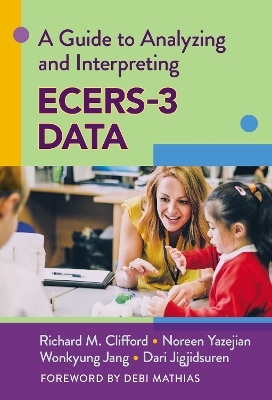
A Guide to Analyzing and Interpreting ECERS-3 Data
Teachers' College Press (Verlag)
978-0-8077-6608-8 (ISBN)
- Titel z.Zt. nicht lieferbar
- Versandkostenfrei
- Auch auf Rechnung
- Artikel merken
Early childhood is a crucial stage in a child's life, and aspects of the environment in the physical, social-emotional, cognitive, and health and safety domains all play important roles in shaping children's development during these early years. Having a valid and reliable measure of the quality of these aspects of children's care settings is critical. The Early Childhood Environment Rating Scale (ECERS-3) is the leading research-based instrument for examining these influential global factors that directly impact children in early childhood environments.
In this new guide, readers will find an in-depth description of both the conceptual model underlying the ECERS-3 and innovative ways of analyzing data for a fuller understanding of what can be done with the scale and why it is integral to the evaluation of early care and education. The authors analyze a large database of classroom observations to help ECERS-3 users better understand, interpret, and utilize their own findings. Readers will also see how components of their ECERS-3 data relate to one another, within and across subscales, and within the scale as a whole.
A Guide to Analyzing and Interpreting ECERS-3 Data will assist program directors, agency administrators, preK–K teaching coaches/mentors, school principals, researchers, and others who use the ECERS-3 to more successfully document, interpret, and analyze the quality of essential influential factors in an early learning setting. This resource will help guide program improvement initiatives with insight into what is needed for children's development and learning.
Book Features:
Provides a framework for thinking about how early childhood care and education learning environments fit into the larger picture of influences on children's development.
Presents a theory of change that combines understanding how children learn and develop with how early education and care affect long-term outcomes.
Analyzes what ECERS-3 data looks like for a large sample of classrooms and by different child and teacher characteristics.
Includes full color tables and figures illuminating the data analysis of the classroom observations.
Richard M. Clifford, Ph.D., is senior scientist emeritus at the Frank Porter Graham Child Development Institute, the University of North Carolina at Chapel Hill and past president of NAEYC. Noreen Yazejian, Ph.D., is senior research scientist at the Frank Porter Graham Child Development Institute, the University of North Carolina at Chapel Hill. Wonkyung Jang, M.S., is a doctoral candidate at the University of North Carolina at Chapel Hill School of Education. Dari Jigjidsuren, Ph.D., MSW, MSPH, is an adjunct assistant professor in the Department of Sociology at Mississippi State University.
Contents
Foreword Debi Mathias v
Acknowledgments ix
1. Introduction 1
Purpose of the Guide 2
Early Childhood Learning Environments:
A Conceptual Framework 2
Views of How Children
Learn and Develop 4
Theory of Change 6
Assessing Quality 9
2. ECERS-3 Background 11
Early Work in Assessing Learning Environments 11
ECERS Revisions Process 13
Administration 16
Overview of the Subscales 16
Comparability 18
Validity and Reliability of Previous Versions 22
3. Summarizing ECERS-3 Data Descriptively 24
Sample 24
Statistical Methods 24
Describing Items 27
Describing Subscales 32
Other Summary Scores 36
4. Describing Statistical Relationships 40
Differences Between Groups or Conditions 40
Summary 44
5. Examining Predictors of Quality: Structural Equations Modeling 45
Head Start 45
Methods 46
Associations Among Quality and Three Features of Classrooms 47
Applications and Implications 50
6. Examining Predictors of Quality: Hierarchical Linear Models 52
Model 1: Unconditional Model 52
Model 2: Random-Intercept
Model 53
Sensitivity Analysis Using LASSO 56
7. Examining Groups With Shared Characteristics 61
8. Special Issues 64
Use in Quality Rating and Improvement Systems and Other High-Stakes Applications 64
Race, Ethnicity, and Equity 67
Serving Children With Disabilities 68
National Norms 69
International Uses 71
Safe and Healthy Environments 72
9. Future Work 73
Exploring Alternative Structures in the ECERS-3 73
Ensuring Adequate Consideration of Equity and Diversity in Early Childhood Environments 74
Focusing on Specific Features of Programming: Extensions of the ECERS-3 75
Expanding International Use 76
Measuring Associations With Children’s Outcomes 76
10. Conclusions 77
Appendix: Supplementary Analyses 81
Blinder-Oaxaca Decomposition 81
Item Response Theory: Rasch Model Without Covariates 83
Differential Item Functioning 85
Bibliography 89
Index 107
About the Authors 117
| Erscheinungsdatum | 01.12.2021 |
|---|---|
| Verlagsort | New York |
| Sprache | englisch |
| Maße | 152 x 229 mm |
| Gewicht | 333 g |
| Themenwelt | Sozialwissenschaften ► Pädagogik ► Allgemeines / Lexika |
| Sozialwissenschaften ► Pädagogik ► Bildungstheorie | |
| Sozialwissenschaften ► Pädagogik ► Vorschulpädagogik | |
| ISBN-10 | 0-8077-6608-9 / 0807766089 |
| ISBN-13 | 978-0-8077-6608-8 / 9780807766088 |
| Zustand | Neuware |
| Informationen gemäß Produktsicherheitsverordnung (GPSR) | |
| Haben Sie eine Frage zum Produkt? |
aus dem Bereich