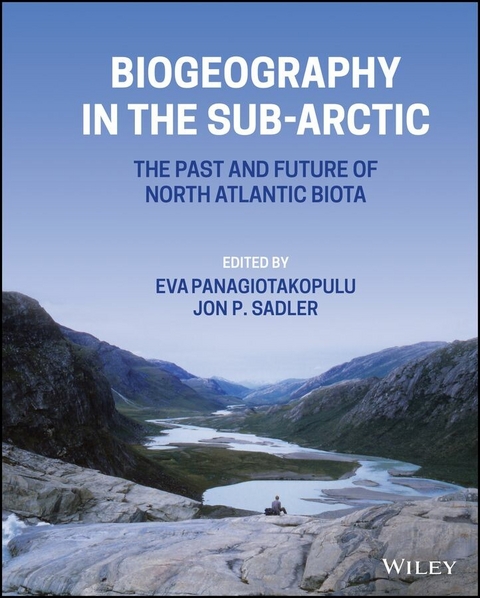
Biogeography in the Sub-Arctic (eBook)
John Wiley & Sons (Verlag)
978-1-118-56135-5 (ISBN)
There is no escaping the fact that the?island biogeography of the North Atlantic Region?is?singularly?peculiar. Sitting in?the?north of the Atlantic Ocean, these islands have been subjected to largescale shifts in climate over the last few million years, unlike the other island groups further south which were likely more buffered from the vicissitudes of Quaternary climate changes.?Uniquely for a group of islands there is only one documented extinction?in the North Atlantic (the Great Auk), and those in the insects are local events relating to species that are distributed throughout the Palaearctic region. Over half the insect species in Iceland and Greenland are introduced. The faunas, excluding Greenland, are?predominantly of Palaearctic?origin and have close affinities with the faunas of Scandinavia and the British Isles and.?These unique physical and biological characteristics have interested biologists and biogeographers for?centuries.?
The key debates concerning?the?biogeography?of the North Atlantic islands?still?rumble on:?Do the biota reflect cryptic refugia?or otherwise, or tabula rasa and recolonization??How important were?human communities in shaping the existing biota and biogeographical patterns??Throw into this mix?current concerns over global warming,?and we can now ask,?how resilient is the biota to change, either natural or anthropogenic? This volume draws together a range of researchers with longstanding research interests in the region, from diverse?academic?backgrounds, to evaluate some of these questions.??
About the Editors
Eva Panagiotakopulu is a palaeoecologist who specialises on Quaternary fossil insects and has worked on biogeography, climate change and human impact from sites ranging from the North Atlantic to North Africa. She has a particular interest in islands and human impact.
Jon P. Sadler is a biogeographer and ecologist whose research focuses on species population and assemblage dynamics in animals (sometimes plants). His work is highly interdisciplinary, bisecting biogeography, ecology, urban design, riparian management and island biogeography.
There is no escaping the fact that the island biogeography of the North Atlantic Region is singularly peculiar. Sitting in the north of the Atlantic Ocean, these islands have been subjected to largescale shifts in climate over the last few million years, unlike the other island groups further south which were likely more buffered from the vicissitudes of Quaternary climate changes. Uniquely for a group of islands there is only one documented extinction in the North Atlantic (the Great Auk), and those in the insects are local events relating to species that are distributed throughout the Palaearctic region. Over half the insect species in Iceland and Greenland are introduced. The faunas, excluding Greenland, are predominantly of Palaearctic origin and have close affinities with the faunas of Scandinavia and the British Isles and. These unique physical and biological characteristics have interested biologists and biogeographers for centuries. The key debates concerning the biogeography of the North Atlantic islands still rumble on: Do the biota reflect cryptic refugia or otherwise, or tabula rasa and recolonization? How important were human communities in shaping the existing biota and biogeographical patterns? Throw into this mix current concerns over global warming, and we can now ask, how resilient is the biota to change, either natural or anthropogenic? This volume draws together a range of researchers with longstanding research interests in the region, from diverse academic backgrounds, to evaluate some of these questions.
About the Editors Eva Panagiotakopulu is a palaeoecologist who specialises on Quaternary fossil insects and has worked on biogeography, climate change and human impact from sites ranging from the North Atlantic to North Africa. She has a particular interest in islands and human impact. Jon P. Sadler is a biogeographer and ecologist whose research focuses on species population and assemblage dynamics in animals (sometimes plants). His work is highly interdisciplinary, bisecting biogeography, ecology, urban design, riparian management and island biogeography.
List of Contributors vii
Introduction xi
Jon P. Sadler and Eva Panagiotakopulu
Section I: Remote Origins 1
1 The Opening of the North Atlantic 3
Brian G. J. Upton
2 Cenozoic Vegetation and Phytogeography of the Sub-arctic North Atlantic 29
Fridgeir Grímsson, Thomas Denk and Reinhard Zetter
3 Interglacial Biotas from the North Atlantic Islands 51
Ole Bennike and Jens Böcher
Section II: Origins of the Present Biota 83
4 Origin and Dispersal of the North Atlantic Vascular Plant Floras 85
Christian Brochmann and Inger G. Alsos
5 The Aquatic Fauna of the North Atlantic Islands with Emphasis on Iceland 103
Gísli Már Gíslason
6 The Vascular Floras of High-Latitude Islands with Special Reference to Iceland 113
Thóra Ellen Thórhallsdóttir
7 Quaternary Vertebrates from the North Atlantic Islands 147
Ole Bennike and Bernd Wagner
8 North Atlantic Insect Faunas, Fossils and Pitfalls 161
Eva Panagiotakopulu
Section III: Human Impact 185
9 Landnám and the North Atlantic Flora 187
Kevin J. Edwards, Egill Erlendsson and J. Edward Schofield
10 Origin of the Northeast Atlantic Islands Bird Fauna: Scenarios of Ecosystem Development 215
Aevar Petersen and Bergur Olsen
11 Human Impact on North Atlantic Biota: Farming and Farm Animals, Fishing, Sealing and Whaling 251
Ingrid Mainland and Jennifer Harland
Section IV: Conservation in a Warming World 273
12 A Fleet of Silver: Local Knowledge Perceptions of Sea Ice from Iceland and Labrador/Nunatsiavut 275
Astrid E. J. Ogilvie, Brian T. Hill and Gaston R. Demarée
13 Biodiversity Conservation in the Faroe Islands Under Changing Climate and Land Use 293
Anna Maria Fosaa
14 Biodiversity Conservation in Iceland Under Changing Climate 303
Erlingur Hauksson
15 The Natural Environment and Its Biodiversity in Greenland During the Present Climate Change 339
Ib Johnsen and Henning Heide-Jørgensen
Index 359
Introduction
Jon P. Sadler1 and Eva Panagiotakopulu2
1 School of Geography, Earth and Environmental Sciences, The University of Birmingham, Birmingham, UK
2 School of GeoSciences, University of Edinburgh, Edinburgh, UK
There is no escaping the fact that the island biogeography of the North Atlantic Region is singularly peculiar. While it has aspects of the characteristics of many island groups in terms of disharmonic and impoverished species pools (Coope 1986), it lacks true endemics (Buckland 1988; Downes 1988, but cf. Böcher 1988), although it is home to a wide number of putative subspecies and races (e.g. Lindroth 1968; Löve and Löve 1963). Sitting in the north of the Atlantic Ocean these islands have been subjected to large‐scale shifts in climate over the last few million years, unlike the other island groups further south which were likely buffered from the vicissitudes of Quaternary climate changes (Sadler 2001). Unlike island groups elsewhere, there is only one documented extinction on these island groups (the Great Auk) and those in the insects are local events relating to species that are distributed throughout the Palaearctic region. Over half the insect species in Iceland and Greenland are non‐indigenous and many of these were first introduced to the islands by the Norse colonists (Buckland 1988; Panagiotakopulu 2014; Sadler 1990). The faunas, excluding Greenland (Böcher 1988, are predominantly Palaearctic (Buckland 1988; Downes 1988; Lindroth 1931), and have close affinities with the faunas of the British Isles and Scandinavia. These unique physical and biological characteristics have interested biologists and biogeographers for centuries (Hooker 1862).
In their seminal book North Atlantic Biota and Their History, Löve and Löve (1963) concluded that plants survived the heavily glaciated Atlantic areas, in ‘glacial refuges’ or ‘nunataks’, dismissing the earlier ‘now merely historical’ tabula rasa idea – the hypothesis that the current Atlantic floras were established following postglacial immigration from source areas situated outside the ice sheets. The virtually complete consensus among plant biogeographers (with notable exceptions among some palaeoecologists) at that time was based on two main arguments, the occurrence of (a) disjunct and (b) endemic taxa in the North Atlantic region. Firstly, the presence of disjuncts was believed to necessitate in situ glacial survival because long‐distance dispersal in general and trans‐oceanic dispersal in particular was considered to be extremely rare, if not impossible, because many amphi‐Atlantic disjuncts lacked adaptations for long‐distance dispersal. Secondly, the occurrence of endemics was believed to necessitate in situ glacial survival because the postglacial period was considered to be far too short to allow for evolution of endemic taxa, an argument that has been supported in later studies (e.g. Dahl 1987). The pervading view was to postulate in situ glacial survival not only during the last glaciation but throughout the entire Pleistocene, to explain the occurrence of disjuncts and endemics in the North Atlantic region. Other research on insects, principally by Lindroth (1957), also argued for early immigration via landbridges and glacial refugia to explain the biogeographical affinities of the biota. More recent work also supports the refugial hypothesis (Maggs et al. 2008).
Löve and Löve (1963) perceptively pointed to the fact that conclusive tests of these varying colonization hypotheses must await a more extensive fossil record. Indeed, recent investigations of a rich plant fossil record seem to support the view that a North Atlantic Land Bridge facilitated plant migration between North America and Europe until the late Miocene (e.g. Brochmann et al. 2003). The Quaternary fossil record is now very extensive and has been used by many to support tabula rasa and post‐glacial colonization via ice rafting at the terminal phase of the last glaciation (Buckland et al. 1988; Coope 1986). Moreover, the fossil beetle fauna demonstrates that even at the beginning of the previous interglacial period a similar situation might have occurred, capable of transporting European taxa over the North Atlantic to Greenland (Bennike and Böcher 1994; Böcher 2012).
Unlike several island archipelagos (e.g. Pacific and Indian oceans) and continental shelf islands (e.g. Magascar), Pre‐European settlement in the North Atlantic was restricted to Greenland where Inuit settlers colonized the islands in the mid‐Holocene (Andreasen 1996; Jensen 2006). Although some scholars have consistently argued for pre‐Viking settlement of the Faroe and Iceland (e.g. Church et al. 2013; Hermanns‐Audardóttir 1991), the first major European settlement of the North Atlantic region was undertaken by Norse or Viking colonists who reached Faroe by CE 850, Iceland by CE 870, Greenland by CE 986 and ultimately America (Newfoundland) by CE 1000 (Fitzhugh and Ward 2000). In Greenland, however, European settlements were abandoned by the sixteenth century (Arneborg 2003), although the island was recolonized by Norwegians some 200 years later. The role that these human colonists played in shaping biogeographical patterns shows pulses of European introductions linked to Norse arrival (e.g. Panagiotakopulu 2014). The impact of the settlers on the island ecosystems also had an indirect influence in shaping habitats and therefore assemblage dynamics. Palynological work has tracked the Landnám ‘footprints’ of the Norse settlers in the region (Edwards et al. 2008, 2011) and Dugmore et al. (2012) have recently presented a comprehensive review of the environmental impact of Norse farming practices on ecosystem management, soils and pasture management. Wholescale environmental modification of this magnitude has left its mark on the biota in terms of assemblage changes and local extinctions (Buckland and Panagiotakopulu 2010; McGovern et al. 2007).
Some 40 years have elapsed since Löve and Löve's (1963) volume was published and the key debates concerning the biogeography of the North Atlantic islands still rumble on. Was it cryptic refugia (Stuart and Lister 2001) or otherwise (Willis and Whittaker 2000), or tabula rasa and recolonization (Buckland and Dugmore 2010)? How important were human communities in shaping the existing biota and biogeographical patterns? Throw into this mix current concerns over global warming, we can now add how resilient is the biota to change, either natural or anthropogenic? This volume draws together a range of researchers with longstanding research interests in the region, from diverse academic backgrounds, to evaluate these questions.
This book is organized into sections each examining a particular theme. Section I focuses on the remote origins of the islands, diving deep into the early history of the region. Upton (Chapter 1) examines the opening of the North Atlantic from a geological perspective, charting its origin from super‐continent in the lower Palaeozoic, approximately 420–430 million years (Ma) ago, to the development of the North Atlantic Ocean as a late product of the disintegration of Laurasia, a part of Pangaea, which split to form North America, Greenland, Europe and Asia. The Cenozoic vegetation and phytogeography of the sub‐arctic areas are discussed by Grímsson et al. (Chapter 2). They examine the ‘Arcto‐Tertiary element’ hypothesis and present data that demonstrate that several north temperate tree taxa thrived in the sub‐arctic during the Paleogene, while also noting evidence for the presence of several ‘Arcto‐Tertiary elements’ in Greenland. They then go on to evaluate the possible role for the ‘The North Atlantic Land Bridge’, reviewing recent investigations of the rich plant fossil record, and demonstrate that the NALB facilitated plant migration between North America and Europe until the late Miocene. Moving forward in time, Bennike and Böcher (Chapter 3) examine the biotal record from the last interglacial period. They review the refugia‐tabula rasa debate in light of this record and point to areas where knowledge is lacking, such as the role of microclimate and insolation in supporting the former. They illustrate that during the interglacials there was a rich biota in suitable biotopes on the North Atlantic.
Section II of the volume examines the contentious issue of biotal origins. Brochmann and Alsos (Chapter 4) present new genetic evidence based on a total of 9018 plants from 1140 populations to re‐evaluate their earlier conclusions (Brochmann et al. 2003) on the origins and dispersal of the North Atlantic vascular plant floras. The data point towards postglacial immigration of a highly dispersive flora, although they note convincing molecular evidence suggesting in situ glacial persistence of some elements of the ‘west‐arctic’ species group. Gíslason (Chapter 5) examines the aquatic fauna of the North Atlantic islands with a particular emphasis on Iceland. He notes that the islands have few aquatic species, almost no aquatic endemics, but their faunas are closely related. He goes on to discuss how the proportion of continental (Norway and Britain) species...
| Erscheint lt. Verlag | 13.5.2021 |
|---|---|
| Sprache | englisch |
| Themenwelt | Naturwissenschaften ► Biologie ► Ökologie / Naturschutz |
| Naturwissenschaften ► Geowissenschaften ► Geografie / Kartografie | |
| Naturwissenschaften ► Geowissenschaften ► Geologie | |
| Sozialwissenschaften ► Soziologie ► Makrosoziologie | |
| Schlagworte | Biogeographie • biogeography • biogeography in the sub arctic • Biowissenschaften • earth sciences • Geowissenschaften • Great Auk • Greenland, fauna Greenland • insect species Iceland • Island biogeography • Life Sciences • North American Region • North atlantic biotas • Palaartic origin • Quartärforschung • Quartärforschung, Glaziologie • Quaternary Science & Glaciology • Subarktische Zone |
| ISBN-10 | 1-118-56135-X / 111856135X |
| ISBN-13 | 978-1-118-56135-5 / 9781118561355 |
| Informationen gemäß Produktsicherheitsverordnung (GPSR) | |
| Haben Sie eine Frage zum Produkt? |
 EPUB (Adobe DRM)
Kopierschutz: Adobe-DRM
Adobe-DRM ist ein Kopierschutz, der das eBook vor Mißbrauch schützen soll. Dabei wird das eBook bereits beim Download auf Ihre persönliche Adobe-ID autorisiert. Lesen können Sie das eBook dann nur auf den Geräten, welche ebenfalls auf Ihre Adobe-ID registriert sind.
Details zum Adobe-DRM
Dateiformat: EPUB (Electronic Publication)
EPUB ist ein offener Standard für eBooks und eignet sich besonders zur Darstellung von Belletristik und Sachbüchern. Der Fließtext wird dynamisch an die Display- und Schriftgröße angepasst. Auch für mobile Lesegeräte ist EPUB daher gut geeignet.
Systemvoraussetzungen:
PC/Mac: Mit einem PC oder Mac können Sie dieses eBook lesen. Sie benötigen eine
eReader: Dieses eBook kann mit (fast) allen eBook-Readern gelesen werden. Mit dem amazon-Kindle ist es aber nicht kompatibel.
Smartphone/Tablet: Egal ob Apple oder Android, dieses eBook können Sie lesen. Sie benötigen eine
Geräteliste und zusätzliche Hinweise
Buying eBooks from abroad
For tax law reasons we can sell eBooks just within Germany and Switzerland. Regrettably we cannot fulfill eBook-orders from other countries.
aus dem Bereich