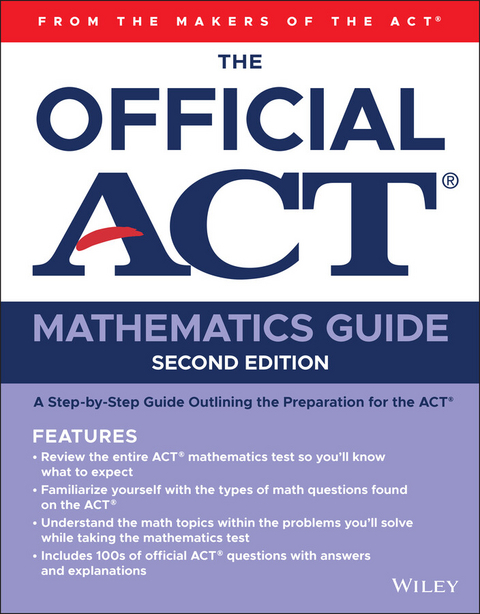
Official ACT Mathematics Guide (eBook)
432 Seiten
Wiley (Verlag)
978-1-119-78739-6 (ISBN)
The ACT official subject guides are a step by step guide for outlining the preparation for the ACT section tests. These prep guides provide students a concept-based outline for the subjects they plan to focus on. Each one of the official guides, is an efficient prep tool comprised of the most current and relevant test information packed into one guide. In addition to the book, the entire pool of questions are available online for a customizable learning experience. The ACT official subject guides are the best resource to get detailed input and practice to help you in preparation for the ACT. By using this guide, students can feel comfortable and confident that they are preparing to do their best!
Features of the ACT® Official Math Guide Includes: Review of the entire mathematics test so you'll know what to expect; Familiarize yourself with the types of math questions for on the ACT; Understand the math topics within the problems you'll solve while taking the mathematics test; detailed explanations for every official ACT Math question in the book The only books with real ACT Math questions organized by question type; includes detailed explanations for each questions; understand math problems within the problems you'll solve while taking the mathematics test.
ACT (Iowa City, IA) is a not-for-profit organization providing assessment, research, information, and program management services to support education and workforce development. Known most widely as the makers of the ACT exam--the college readiness and placement assessment taken by some 1.8 million high school students each year--ACT produces a number of assessments and services reaching more than 10 million people along the kindergarten through career continuum. ACT's rigorous research informs policy decisions and helps develop programs that boost lifelong learning potential in schools and workplaces around the world. To learn more, visit www.act.org.
The ACT official subject guides are a step by step guide for outlining the preparation for the ACT section tests. These prep guides provide students a concept-based outline for the subjects they plan to focus on. Each one of the official guides, is an efficient prep tool comprised of the most current and relevant test information packed into one guide. In addition to the book, the entire pool of questions are available online for a customizable learning experience. The ACT official subject guides are the best resource to get detailed input and practice to help you in preparation for the ACT. By using this guide, students can feel comfortable and confident that they are preparing to do their best! Features of the ACT Official Math Guide Includes: Review of the entire mathematics test so you'll know what to expect; Familiarize yourself with the types of math questions for on the ACT; Understand the math topics within the problems you'll solve while taking the mathematics test; detailed explanations for every official ACT Math question in the book The only books with real ACT Math questions organized by question type; includes detailed explanations for each questions; understand math problems within the problems you'll solve while taking the mathematics test.
Chapter 2:
Number and Quantity
Number and Quantity tests your ability to apply real and complex number systems in various forms, including integer and rational exponents, vectors, and matrices.
Real and Complex Number Systems
A real number is any number that appears on the number line, whether positive or negative. This includes every fraction, decimal, whole number, and zero.
A non-real number is a number that can't exist in real math and therefore isn't on the number line. Two types of non-real number may appear on the ACT mathematic test: any number divided by zero and the square root of a negative number, also known as an imaginary number or i, covered later in this chapter.
A rational number is any number or fraction that can be expressed as a terminating or repeating decimal. For example, the fraction can be expressed as the decimal 0.25, which both terminates and expresses the true value of the decimal. The fraction can be expressed as the decimal , which doesn't terminate but is considered rational because it repeats. The fraction , equivalent to , is also considered rational because the 18 in the decimal repeats.
A non-rational or irrational number is a real number that cannot be written as a fraction or a terminating or repeating decimal. Examples of non-rational numbers are and .
Number Line and Absolute Value
The number line represents the spectrum of all real numbers and symbolically extends infinitely in both directions.
Absolute value represents an expression's distance from 0 on the number line. Absolute value is always positive, because a distance is always positive. Because –5 is 5 units from 0, the absolute value of –5, written as , is 5.
You can take the negative of an absolute value, but the absolute value itself is always positive. For example, is the same thing as , which equals –7. The trick is to take the calculations step by step: , and the negative of that is –7.
Reporting Category Quiz: Preparing for Higher Mathematics | Number and Quantity
- On the real number line, what is the midpoint of −5 and 17?
- −11
- 6
- 11
- 12
- 22
- On the real number line below, with coordinates as labeled, an object moves according to the following set of instructions: from point P the object moves right to Q, then left to R, then right to S, and finally left until it returns to its original position at P. What is the closest estimate of the total length, in coordinate units, of the movements this object makes?
- 0
- 4
- 12
- 22
- 36
- If the inequality is true, then which of the following must be true?
Whole Numbers
An integer is any number, positive, negative, or zero, that can be written without a fractional or decimal component. A whole number is any positive integer and doesn't include zero.
Multiples, Factors, and Prime Numbers
A multiple is a whole number that results from the product of two other whole numbers. For example, to find multiples of 7, multiply 7 by 1, 2, 3, and so on, resulting in 7, 14, 21, and so on. Note that every whole number is a multiple of itself: 23 is a multiple of 23.
A factor is a whole number that results from dividing two other whole numbers. For example, to find the factors of 30, find the pairs of numbers that multiply to 30: 5 and 6, 3 and 10, 2 and 15, and 1 and 30. Note that 1 is a factor of every whole number, and every whole number is a factor of itself. For example, factors of 52 include 1 and 52.
A prime number is a whole number that has exactly two factors: 1 and itself. For example, 13 is a prime number, because its only factors are 1 and 13. Note that 2 is the only even prime number, and 1 and 0 are not considered prime.
A composite number is a whole number that isn't prime; that is, it has more than two factors. For example, 12 is a composite number, because its factors are 1, 2, 3, 4, 6, and 12.
Prime factorization is the factoring of a composite number to its primes, including duplicates. For example, the prime factorization of 30 is . Note that prime factorization doesn't include 1 as a factor.
These composite numbers can be prime factored:
- 20
- 36
- 48
Results:
Reporting Category Quiz: Integrating Essential Skills
- Mr. Dietz is a teacher whose salary is $22,570 for this school year, which has 185 days. In Mr. Dietz's school district, substitute teachers are paid $80 per day. If Mr. Dietz takes a day off without pay and a substitute teacher is paid to teach Mr. Dietz's classes, how much less does the school district pay in salary by paying a substitute teacher instead of paying Mr. Dietz for that day?
- $42
- $80
- $97
- $105
- $122
- The following chart shows the current enrollment in all the mathematics classes offered by Eastside High School.
The school owns 2 classroom sets of 30 calculators each, which students are required to have during their mathematics class. There are 2 calculators from one set and 6 calculators from the other set that are not available for use by the students because these calculators are being repaired.
For which of the following class periods, if any, are there NOT enough calculators available for each student to use a school-owned calculator without having to share?
- Period 2 only
- Period 3 only
- Period 4 only
- Periods 3 and 4 only
- There are enough calculators for each class period.
- Nick needs to order 500 pens from his supplier. The catalog shows that these pens come in cases of 24 boxes with 10 pens in each box. Nick knows that he may NOT order partial cases. What is the fewest number of cases he should order?
- 2
- 3
- 18
- 21
- 50
Reporting Category Quiz: Preparing for Higher Mathematics | Number and Quantity
- Kareem has 4 sweaters, 6 shirts, and 3 pairs of slacks. How many distinct outfits, each consisting of a sweater, a shirt, and a pair of slacks, can Kareem select?
- 13
- 36
- 42
- 72
- 216
- How many prime numbers are there between 30 and 50?
- 4
- 5
- 6
- 7
- 8
Decimals and Percents
A decimal represents a fraction where the denominator is a multiple of 10. For example, 0.3 is equivalent to , and 2.19 is equivalent to or .
A percent represents the first two decimal places of a decimal, or a fraction over 100. For example, 21% is equivalent to 0.21 or . To convert a decimal amount to a percent, multiply the decimal amount by 100. For example, . To convert a fraction to a percent, convert the fraction so that it has a denominator of 100, and use the numerator. For example, .
Percent of Change
To find the percent of change, place the quantity of change over the starting quantity, and convert this to a fraction with a denominator of 100.
For example, to find the percent of change of the price of a calculator that increased from $20 to $25, place the quantity of change, 5, over the starting quantity for , and convert this to a fraction with a denominator of 100: , for 25%.
If that calculator goes on sale from $25 to $20, find the new percent of change: place the quantity of change, 5, over the starting quantity for , and convert this to a fraction with a denominator of 100: , for 20%.
Note that the same $5 price change yields a different percent of change when starting from different amounts. Also, a percent of change is always positive: the price didn't change negative 20%; it went down (positive) 20%.
These are examples of numbers with percents of change:
- From 5 to 3
- From 50 to 66
- From 20 to 70
Results:
- 40%.
The quantity of change is 2 and the starting quantity is 5:.
- 32%.
The quantity of change is 16 and the starting quantity is 50:.
- 250%.
The quantity of change is 50 and the starting quantity is 20:.
Percent of a Group
To find the percent of a group, place the number of the subgroup over the entire group and convert the fraction. For example, if 7 of the 20 job applicants have college degrees, find the percent who have college degrees:
- The number of the subgroup: 7
- Over the entire group:
- Converted fraction:
7 out of 20 is 35%.
These are examples of percents of groups:
- 6 out of 25 dogs are Labs.
- 170 out of 200 flights are on time.
- 28 out of 40 cars are electric.
Results:
- 24%.
The number of the subgroup is 6 and the entire group is 25:.
- 85%.
The number of the subgroup is 170 and the entire group is 200:.
- 70%.
The number of the subgroup is 28 and the entire group is 40:.
Reporting Category Quiz: Integrating Essential...
| Erscheint lt. Verlag | 29.4.2021 |
|---|---|
| Sprache | englisch |
| Themenwelt | Sozialwissenschaften ► Pädagogik ► Erwachsenenbildung |
| ISBN-10 | 1-119-78739-4 / 1119787394 |
| ISBN-13 | 978-1-119-78739-6 / 9781119787396 |
| Informationen gemäß Produktsicherheitsverordnung (GPSR) | |
| Haben Sie eine Frage zum Produkt? |
 EPUB (Adobe DRM)
Größe: 18,0 MB
Kopierschutz: Adobe-DRM
Adobe-DRM ist ein Kopierschutz, der das eBook vor Mißbrauch schützen soll. Dabei wird das eBook bereits beim Download auf Ihre persönliche Adobe-ID autorisiert. Lesen können Sie das eBook dann nur auf den Geräten, welche ebenfalls auf Ihre Adobe-ID registriert sind.
Details zum Adobe-DRM
Dateiformat: EPUB (Electronic Publication)
EPUB ist ein offener Standard für eBooks und eignet sich besonders zur Darstellung von Belletristik und Sachbüchern. Der Fließtext wird dynamisch an die Display- und Schriftgröße angepasst. Auch für mobile Lesegeräte ist EPUB daher gut geeignet.
Systemvoraussetzungen:
PC/Mac: Mit einem PC oder Mac können Sie dieses eBook lesen. Sie benötigen eine
eReader: Dieses eBook kann mit (fast) allen eBook-Readern gelesen werden. Mit dem amazon-Kindle ist es aber nicht kompatibel.
Smartphone/Tablet: Egal ob Apple oder Android, dieses eBook können Sie lesen. Sie benötigen eine
Geräteliste und zusätzliche Hinweise
Buying eBooks from abroad
For tax law reasons we can sell eBooks just within Germany and Switzerland. Regrettably we cannot fulfill eBook-orders from other countries.
aus dem Bereich