


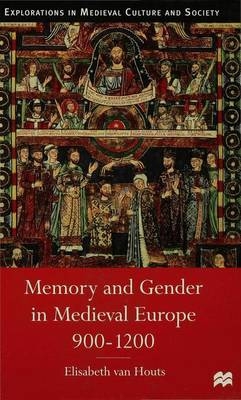
Memory and Gender in Medieval Europe, 900-1200
Seiten
1999
Palgrave Macmillan (Verlag)
978-0-333-56858-3 (ISBN)
Palgrave Macmillan (Verlag)
978-0-333-56858-3 (ISBN)
- Titel ist leider vergriffen;
keine Neuauflage - Artikel merken
Remembering the past in the Middle Ages is a subject that is often perceived as a study of chronicles and annals written by monks. This book challenges this view and emphasizes the collaboration between men and women in the memorial tradition through both narrative sources and material culture.
Remembering the past in the Middle Ages is a subject that is often perceived as a study of chronicles and annals written by monks in monasteries. Following in the footsteps of early Christian historians such as Eusebius and St Augustine, the medieval chroniclers are thought of as men isolated in their monastic institutions, writing about the world around them. As the sole members of their society versed in literacy, they had a monopoly on the knowledge of the past as preserved in learned histories, which they themselves updated and continued. A self-perpetuating cycle of monks writing chronicles, which were read, updated and continued by the next generation, so the argument goes, remained the vehicle for a narrative tradition of historical writing for the rest of the Middle Ages. Elisabeth van Houts challenges this view and emphasizes the collaboration between men and women in the memorial tradition of the Middle Ages through both narrative sources (chronicles, saints' lives and miracles) and material culture (objects such as jewellery, memorial stones and sacred vessels).
Remembering the past in the Middle Ages is a subject that is often perceived as a study of chronicles and annals written by monks in monasteries. Following in the footsteps of early Christian historians such as Eusebius and St Augustine, the medieval chroniclers are thought of as men isolated in their monastic institutions, writing about the world around them. As the sole members of their society versed in literacy, they had a monopoly on the knowledge of the past as preserved in learned histories, which they themselves updated and continued. A self-perpetuating cycle of monks writing chronicles, which were read, updated and continued by the next generation, so the argument goes, remained the vehicle for a narrative tradition of historical writing for the rest of the Middle Ages. Elisabeth van Houts challenges this view and emphasizes the collaboration between men and women in the memorial tradition of the Middle Ages through both narrative sources (chronicles, saints' lives and miracles) and material culture (objects such as jewellery, memorial stones and sacred vessels).
ELISABETH VAN HOUTS is Lecturer in Medieval History at Emmanuel College, Cambridge.
Preface Introduction PART ONE: GENDER AND AUTHORITY OF ORAL WITNESSES Chronicles and Annals Saints' Lives and Miracles PART TWO: REMEMBRANCE OF THE PAST Ancestors, Family Reputation and Female Traditions Objects as Pegs for Memory PART THREE: ONE EVENT REMEMBERED The Memory of the Norman Conquest of England in 1066 Conclusion Appendices Abbreviations Notes Further Reading Index
| Erscheint lt. Verlag | 26.5.1999 |
|---|---|
| Reihe/Serie | Medieval Culture & Society |
| Zusatzinfo | notes, further reading, index |
| Verlagsort | Basingstoke |
| Sprache | englisch |
| Maße | 141 x 222 mm |
| Gewicht | 375 g |
| Themenwelt | Geschichte ► Allgemeine Geschichte ► Mittelalter |
| Geisteswissenschaften ► Geschichte ► Regional- / Ländergeschichte | |
| Sozialwissenschaften ► Soziologie ► Gender Studies | |
| ISBN-10 | 0-333-56858-3 / 0333568583 |
| ISBN-13 | 978-0-333-56858-3 / 9780333568583 |
| Zustand | Neuware |
| Informationen gemäß Produktsicherheitsverordnung (GPSR) | |
| Haben Sie eine Frage zum Produkt? |
Mehr entdecken
aus dem Bereich


aus dem Bereich
der epische Kampf um das Heilige Land
Buch | Hardcover (2025)
C.H.Beck (Verlag)
CHF 49,95


