America on Film (eBook)
985 Seiten
John Wiley & Sons (Verlag)
978-1-118-74388-1 (ISBN)
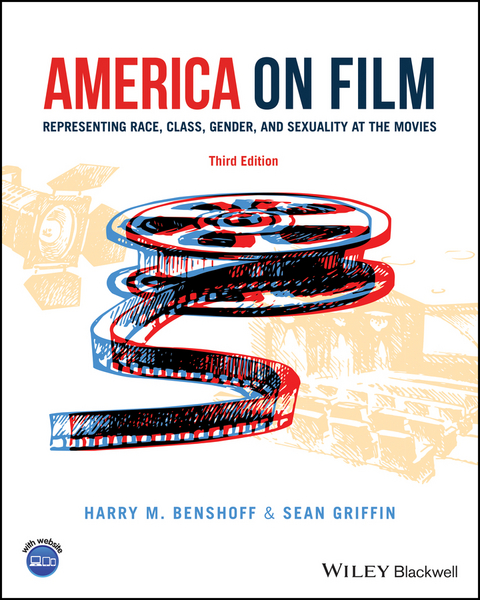
A comprehensive and insightful examination of the representation of diverse viewpoints and perspectives in American cinema throughout the 20th and 21st centuries
America on Film: Representing Race, Class, Gender and Sexuality at the Movies, now in its third edition, is an authoritative and lively examination of diversity issues within American cinema. Celebrated authors and academics Harry M. Benshoff and Sean Griffin provide readers with a comprehensive discussion and overview of the industrial, socio-cultural, and aesthetic factors that contribute to cinematic representations of race, class, gender, sexuality, and ability.
The book incorporates several different theoretical perspectives, including film genre, auteurism, cultural studies, Orientalism, the 'male gaze,' feminism, and queer theory. The authors examine each selected subject via representative films, figures, and movements. Each chapter also includes an in-depth analysis of a single film to illuminate and inform its discussion of the chosen topic.
America on Film fearlessly approaches and tackles several controversial areas of representation in film, including the portrayal of both masculinity and femininity in film and African- and Asian-Americans in film. It devotes the entirety of Part V to an analysis of the depiction of sex and sexuality in American film, with a particular emphasis on the portrayal of homosexuality. Topics covered include:
- The structure and history of American filmmaking, including a discussion of the evolution of the business of Hollywood cinema
- African Americans and American film, with a discussion of BlacKkKlansman informing its examination of broader issues
- Asian, Latin/x, and Native Americans on film
- Classical Hollywood cinema and class, with an in-depth examination of The Florida Project
- Women in classical Hollywood filmmaking, including a discussion of the 1955 film, All that Heaven Allows
Perfect for undergraduate and graduate students in film, media, and diversity-related courses, the book also belongs on the shelves of anyone interested in diversity issues in the context of American studies, communications, history, or gender studies. Lastly, it's ideal for use within corporate diversity training curricula and human relations training within the entertainment industry.
HARRY M. BENSHOFF, PhD, is Professor of Media Arts at the University of North Texas. He received his PhD in Critical Studies at the University of Southern California's School of Cinema-Television. His research focuses include the representation of African Americans and queer people in film and television, particularly within the horror genre.
SEAN GRIFFIN, PhD, is Professor of Film and Media Arts, Southern Methodist University. He received his doctorate from the University of Southern California in 1997. He has written and studied extensively in the area of queer representation in film, as well as the history of the American musical film.
A comprehensive and insightful examination of the representation of diverse viewpoints and perspectives in American cinema throughout the 20th and 21st centuries America on Film: Representing Race, Class, Gender and Sexuality at the Movies, now in its third edition, is an authoritative and lively examination of diversity issues within American cinema. Celebrated authors and academics Harry M. Benshoff and Sean Griffin provide readers with a comprehensive discussion and overview of the industrial, socio-cultural, and aesthetic factors that contribute to cinematic representations of race, class, gender, sexuality, and ability. The book incorporates several different theoretical perspectives, including film genre, auteurism, cultural studies, Orientalism, the "e;male gaze,"e; feminism, and queer theory. The authors examine each selected subject via representative films, figures, and movements. Each chapter also includes an in-depth analysis of a single film to illuminate and inform its discussion of the chosen topic. America on Film fearlessly approaches and tackles several controversial areas of representation in film, including the portrayal of both masculinity and femininity in film and African- and Asian-Americans in film. It devotes the entirety of Part V to an analysis of the depiction of sex and sexuality in American film, with a particular emphasis on the portrayal of homosexuality. Topics covered include: The structure and history of American filmmaking, including a discussion of the evolution of the business of Hollywood cinema African Americans and American film, with a discussion of BlacKkKlansman informing its examination of broader issues Asian, Latin/x, and Native Americans on film Classical Hollywood cinema and class, with an in-depth examination of The Florida Project Women in classical Hollywood filmmaking, including a discussion of the 1955 film, All that Heaven Allows Perfect for undergraduate and graduate students in film, media, and diversity-related courses, the book also belongs on the shelves of anyone interested in diversity issues in the context of American studies, communications, history, or gender studies. Lastly, it's ideal for use within corporate diversity training curricula and human relations training within the entertainment industry.
HARRY M. BENSHOFF, PhD, is Professor of Media Arts at the University of North Texas. He received his PhD in Critical Studies at the University of Southern California's School of Cinema-Television. His research focuses include the representation of African Americans and queer people in film and television, particularly within the horror genre. SEAN GRIFFIN, PhD, is Professor of Film and Media Arts, Southern Methodist University. He received his doctorate from the University of Southern California in 1997. He has written and studied extensively in the area of queer representation in film, as well as the history of the American musical film.
Chapter 1
INTRODUCTION TO THE STUDY OF FILM FORM AND REPRESENTATION
The purpose of this book is to analyze how American films have represented race, class, gender, sexuality, and ability throughout the twentieth century and into the early twenty‐first. It is a basic principle of this work that by studying American film history, we can gain keen insights into the ways that different groups of American people have been treated (and continue to be treated). Images of people on film actively contribute to the ways in which people are understood and experienced in the “real world.” As seminal cultural theorist Richard Dyer has asserted, “Images Matter.” Furthermore, there are multiple and varied connections between film and “real life,” and we need to have agreed‐upon ways of discussing those connections and their ramifications. Therefore, before examining in detail how specific groups of people have been represented within American cinema, we need to understand some preliminary concepts: how film works to represent people and things, how and why social groupings are and have been formed, and how individuals interact with the larger socio‐cultural structures of the United States of America. This chapter introduces some basic ideas about film form, American history, and cultural studies.
Film Form
Film form refers to the constitutive elements that make a film uniquely a “film” and not a painting or a short story. All works of art might be said to have both form and content. Content is what a work is about, while form is how that content is expressed. Form and content are inextricably combined, and it is an old adage of art theory that “form follows content,” which means that the content of a work of art should dictate the form in which it should be expressed. For example, many different poems might have the same content – say, for example, a rose – but the content of a rose can be expressed in various forms in an infinite number of ways: in a sonnet, a ballad, an epic, a haiku, a limerick, and so forth. Each of these formal structures will create a different “take” on the content. For example, a limerick tends to be humorous or flippant, while a sonnet tends to be more serious and romantic. Likewise, different films with similar content can be serious, frivolous, artistic, intellectual, comedic, or frightening. Therefore, understanding how cinema communicates or creates meaning requires more than paying attention to what is specifically going on in the story (the film’s content); it also requires paying attention to how various artistic choices (the film’s form) affect the way the story is understood by the viewer.
Many entire books have been written analyzing the various formal elements of film but, for the purposes of this basic introduction, they can be broken into five main aspects: literary design, visual design, cinematography, editing, and sound design. The first aspect of film form, literary design, refers to the elements of a film that come from the script and story ideas. The literary design includes the story, the setting, the action, the characters, the characters’ names, the dialog, the film’s title, and any deeper subtexts or thematic meanings. Film is capable of many literary devices: metaphor, irony, satire, allegory, and so forth. Some films are black comedies and must be understood according to that form. Other films are dramas to be taken seriously while still others try to make us laugh by being deliberately juvenile. Yet other films try to shock or provoke us with new and unexpected ideas. Analyzing a movie’s literary design is a good place to start when analyzing a film, but one should not ignore the four other axes of film form and how they contribute to a film’s meaning.
Another broad aspect of film form has been labeled mise‐en‐scène, a French term for what goes into each individual shot (or uninterrupted run of film). Aspects of mise‐en‐scène include our second and third formal axes: the visual design of what’s being filmed (the choice of sets, costumes, makeup, lighting, color, and actors’ performance and arrangement before the camera) and the cinematographic design – that is, how the camera records the visual elements that have been dictated by the literary design. The cinematographic design includes things like the choice of framing, lenses, camera angle, camera movement, what is in focus and what is not. Each of these choices of mise‐en‐scène can affect the viewer’s feelings toward the story and its characters. A room that is brightly lit may seem comfortable or even festive; that same room with heavy shadows may seem threatening or scary. If everyone in a crowd scene is wearing various shades of gray and black, the viewer will tend to see them as just a crowd; if one person is wearing red, the viewer will tend to focus on that one person. Similarly, a camera shooting up from the floor at a character will create a different feeling than a camera aimed at eye‐level. In yet another example, if only one couple on a dance floor are kept in focus, the viewer will pay attention to them; if the whole ballroom is kept in focus, the viewer may choose to look in a number of directions.
The fourth axis of film form is called montage or editing, and refers to how all the individual shots the camera records are put together in order to create meaning or tell a story. Most movies are made up of hundreds and hundreds of shots which are edited together to make a full‐length feature film. Many choices get made at the editing stage. Not only do filmmakers usually have multiple takes of the same scene to choose from, they also choose which shots to place together with other shots. It may seem obvious to an audience, since the editing would seem to need to follow the story (A follows B follows C), but an editor may choose to break up a shot of a group of people talking with individual close‐ups of people in the group. Such a choice affects audience understanding by forcing the viewer to pay attention to just one person instead of the entire group. Audience identification with specific characters can be encouraged or discouraged in this manner. Montage also involves choosing the length of each shot. Usually, longer shot lengths are used to create quiet or contemplative moments, while action sequences or chases often are put together with short, quick shots.
The fifth and final formal axis of cinema is sound design. Although cinema audiences are usually referred to as viewers or spectators, audiences both watch and listen to films, and the same types of artistic choices that are made with the visual images are also made with the soundtrack. The dialog of some of the characters on the screen is easy to hear, while the dialog of others is inaudible (thus directing the audience member to pay attention to the conversation that the filmmakers want them to pay attention to). Most films have a musical score that the audience can hear but which the characters cannot. Choosing what type of music to play under a scene will greatly affect viewer comprehension – that is why the music is there in the first place – by directing the viewer toward the preferred understanding of the images. Playing a luscious ballad during a scene between a woman and her fiancé helps create a romantic sense, but playing ominous music during the same scene may make the viewer think the man is out to hurt the woman (or vice versa).
Although this only begins to introduce the subject of film form, these few examples do point out how cinema’s basic aesthetic qualities help to create meaning. Discussing how various types of people are represented in American cinema, then, requires more than analyzing only the stories and the characters. For example, let’s imagine a film about both a white man and a Native American man. The story alternates between the two characters, showing their daily activities: getting up, eating, interacting with their family and friends, working, and then going to sleep. There would seem to be nothing necessarily biased or prejudiced according to this description of the film’s content. Yet, in this hypothetical film, all the scenes with the white man are brightly lit, with the camera placed at eye‐level; the shots are of medium length, and calm, pleasant music is used for underscoring. In contrast, all the scenes of the Native American man are composed with dark shadows, with the camera constantly tilted at weird angles; the shots are quick and choppy, and dark, brooding music is used for underscoring. Such choices obviously slant how a viewer is supposed to react to these two characters. The content of the film may have seemed neutral, but when the other axes of film form are analyzed, one realizes that the white man was presented in a favorable (or neutral) light, while the Native American man was made to seem shifty or dangerous.
The above example is an imaginary one, but throughout this book actual films will be analyzed in detail in terms of both content and form, in order to examine how various American identities are represented in American films. As the next chapters will discuss in detail, the Hollywood studio system developed certain traditions in its formal choices that would vastly affect how race, class, gender, sexuality, and ability were and are treated in mainstream narrative films. But before turning to specifics, we must also examine the social and...
| Erscheint lt. Verlag | 6.4.2021 |
|---|---|
| Sprache | englisch |
| Themenwelt | Kunst / Musik / Theater ► Film / TV |
| Sozialwissenschaften ► Kommunikation / Medien ► Medienwissenschaft | |
| Schlagworte | American Cinema • American cinema diversity • American Cinema History • American Cinema Studies • American film • American film diversity • American film history • American film studies • Communication & Media Studies • Cultural Studies • diversity in American cinema • diversity in American film • Film • Filmforschung • Film Studies • Kommunikation u. Medienforschung • Kultursoziologie • Kulturwissenschaften • Media Studies • Medienforschung • Sociology • Sociology of Culture • Soziologie • USA |
| ISBN-10 | 1-118-74388-1 / 1118743881 |
| ISBN-13 | 978-1-118-74388-1 / 9781118743881 |
| Informationen gemäß Produktsicherheitsverordnung (GPSR) | |
| Haben Sie eine Frage zum Produkt? |
 EPUB (Adobe DRM)
Kopierschutz: Adobe-DRM
Adobe-DRM ist ein Kopierschutz, der das eBook vor Mißbrauch schützen soll. Dabei wird das eBook bereits beim Download auf Ihre persönliche Adobe-ID autorisiert. Lesen können Sie das eBook dann nur auf den Geräten, welche ebenfalls auf Ihre Adobe-ID registriert sind.
Details zum Adobe-DRM
Dateiformat: EPUB (Electronic Publication)
EPUB ist ein offener Standard für eBooks und eignet sich besonders zur Darstellung von Belletristik und Sachbüchern. Der Fließtext wird dynamisch an die Display- und Schriftgröße angepasst. Auch für mobile Lesegeräte ist EPUB daher gut geeignet.
Systemvoraussetzungen:
PC/Mac: Mit einem PC oder Mac können Sie dieses eBook lesen. Sie benötigen eine
eReader: Dieses eBook kann mit (fast) allen eBook-Readern gelesen werden. Mit dem amazon-Kindle ist es aber nicht kompatibel.
Smartphone/Tablet: Egal ob Apple oder Android, dieses eBook können Sie lesen. Sie benötigen eine
Geräteliste und zusätzliche Hinweise
Buying eBooks from abroad
For tax law reasons we can sell eBooks just within Germany and Switzerland. Regrettably we cannot fulfill eBook-orders from other countries.
aus dem Bereich