


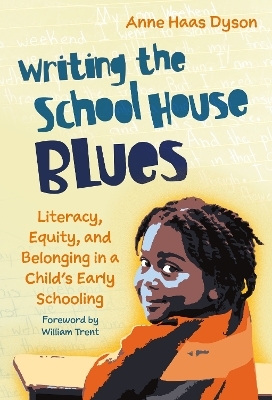
Writing the School House Blues
Teachers' College Press (Verlag)
978-0-8077-6578-4 (ISBN)
- Titel z.Zt. nicht lieferbar
- Versandkostenfrei
- Auch auf Rechnung
- Artikel merken
Anne Dyson confronts race and racism head-on with this ethnographic study of a child's efforts to belong-to be a child among children. Follow the journey of a small Black child, Ta'Von, as he moves from a culturally inclusive preschool through the early grades in a school located in a majority white neighborhood. Readers will see Ta'Von encountering obstacles but finding agency and joy through writing and music-making, especially his love of the blues. Most attempts at desegregating schools are studied by reducing individual children to demographic statistics and test scores. This book, instead, provides a child's perspective on challenges to classroom inclusion. Ta'Von's journey demonstrates that it is within children's peer worlds-formed in response to institutional policies and practices like desegregation initiatives, standardized testing, and a curricular focus on so-called "basic literacy skills"-that inequity becomes part of the experience of childhood. This book examines policies about literacy testing and teaching, including the potential power of the written word and of the arts.Book Features:
A fresh approach to issues of inclusion, equity, and learning opportunities as seen through a child's eye.
Narrative vignettes that bring to life the equity issues of everyday school experiences.
An overview of the kinds of challenges to inclusion that may be faced by minoritized children in majority-dominated schools.
Details about changing institutional literacy policies and practices over time and grade level, emphasizing their impact on relationships and learning.
Examples of teachers and children enacting inclusive communities.
Anne Haas Dyson is a professor of education policy, organization, and leadership at the University of Illinois at Urbana-Champaign. Her books include (with Celia Genishi) Children, Language, and Literacy: Diverse Learners in Diverse Times and ReWRITING the Basics: Literacy Learning in Children's Cultures.
Contents
Foreword William Trent ix
Preface xi
Acknowledgments xv
PART I: SETTING THE STAGE FOR THE DRAMA TO COME 1
1. A Sense of Belonging: Inclusion and Equity in Ta’Von’s Journey Into School 3
A First Glance at Ta’Von 5
Historical and Ideological Forces 9
Transition Into Early Schooling and the Problematics of Race 13
About Those Blues 15
Queries and Visions 16
2. Preparation: Gathering Data, Finding Theoretical Glasses, and Becoming “My Friend From Preschool” 19
Accompanying Ta’Von on the Journey 21
Constructing a Telling Case 30
The Secret Ingredient in Case Writing 33
PART II: THE SCHOOL HOUSE BLUES: TA’VON’S TRANSITION TO AND THROUGH SCHOOL 35
3. Schooling Begins: “I Really Really Loved Preschool” 37
A Place for Everyone: “We” Gather Together 40
Everyone Is Equal: We Are ALL Learners 44
We Make Worlds: Social Pleasures and Power of Multimodal Composing 47
“You” Join “Me” in the Social Pleasure of Popular Song 51
On Turning to a New Chapter 53
4. A Shift in Schools and in a Sense of Belonging: “How Come … He’s in Kindergarten?” 55
Ta’Von and the Refracted “We”: Intersectionality and the Construction of “Difference” 57
Concluding: The Relational Dynamics of Classroom Belonging 80
5. Smartness and Friendship in a Stratified World: “I Know I’m Smart ’Cause I Don’t Copy” 83
The Fate of the Collective “We”: Stratification and Belonging 85
“Smartness” as a Source of Social Power: Gifts of Help and Assumptions of Leadership 90
Belonging and Learning 96
Coming Attractions: Belonging, Learning, and the Music of “Not Real” Composing 98
6. Shifts in the Terms of Engagement: “I’m a Musician” 101
Stretching the “We”: Indexing Belonging in the Music of “Not Real” Composing 103
Textual Resources and Compositional Feats: Official Skills in “Not Real” Spaces 106
Music “Smarts” as a Social Tool?: “How ’bout We Form a Club?” 113
Unofficial Resources and Official Places: Knocking on the Curricular Door 118
Belonging, Competence, and Learning: Toward Textual Crossroads 120
7. Educational Reverberations of the School House Blues: Toward Inclusive Classrooms 125
Preschool: “We” All Belong 127
Kindergarten: The Social Stratification of “We” 131
2nd Grade: Rhythmic Beats on Curricular Walls 137
Final Notes of the School House Blues 143
Appendix: Reflections on the Drama of Research and the Discipline of Methods 147
References 151
Index 161
About the Author 171
| Erscheinungsdatum | 01.09.2021 |
|---|---|
| Reihe/Serie | Language and Literacy Series |
| Vorwort | William Trent |
| Verlagsort | New York |
| Sprache | englisch |
| Maße | 152 x 229 mm |
| Gewicht | 399 g |
| Themenwelt | Sozialwissenschaften ► Ethnologie |
| Sozialwissenschaften ► Pädagogik ► Vorschulpädagogik | |
| Sozialwissenschaften ► Soziologie | |
| ISBN-10 | 0-8077-6578-3 / 0807765783 |
| ISBN-13 | 978-0-8077-6578-4 / 9780807765784 |
| Zustand | Neuware |
| Informationen gemäß Produktsicherheitsverordnung (GPSR) | |
| Haben Sie eine Frage zum Produkt? |
aus dem Bereich


