


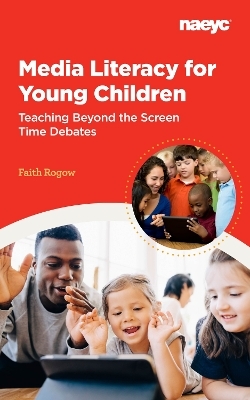
Media Literacy for Young Children: Teaching Beyond the Screen Time Debates
National Association for the Education of Young Children (Verlag)
978-1-938113-97-0 (ISBN)
It's also a Spring 2023 Smart Book winner from the Academics' Choice Awards.
Media literacy is about wonder and imagination, questioning and learning, thinking and reflecting!
Media Literacy for Young Children: Teaching Beyond the Screen Time Debates is about all these things, and more importantly, it is about how early childhood educators and professionals can prepare children for their digital future.
This book is a first-of-its-kind guide for pre-service and currently practicing teachers and child care professionals looking for pedagogically sound and developmentally appropriate ways to help today’s children navigate their media-rich world with confidence, curiosity, and critical thinking. Detailed descriptions of media literacy competencies, along with dozens of activities, strategies, and tips designed for children ages 2–7, demonstrate how to integrate foundational skills, knowledge, and dispositions into existing routines as well as experiment with new lessons.
By examining media through a literacy lens, this book will show you ways to
Use inquiry and media-making to teach children about media
Plan activities to engage children in meaningful media discussions
Engage with families about the importance of media literacy education for young children
Address media concerns with joy and creativity rather than anxiety or fear
. . . and much more!
Faith Rogow, PhD, is a media literacy leader, innovator, and founder of Insighters Educational Consulting. She was the founding president of the National Association for Media Literacy Education (NAMLE), a founding editorial board member of the Journal for Media Literacy Education, a founding advisor to Project Look Sharp, and a coauthor of NAMLE’s “Core Principles of Media Literacy Education in the United States” (2007). For more than twenty years she has been one of the few people in the United States advocating for and creating media literacy education that is developmentally appropriate for early childhood. Her groundbreaking article “The ABCs of Media Literacy” (Telemedium, Spring 2002) has been widely circulated, as has her chapter—“Media Literacy in Early Childhood Education: Inquiry-Based Technology Integration”—in the Routledge/NAEYC anthology Technology and Digital Media in the Early Years: Tools for Teaching and Learning (Donohue 2015). She also coauthored The Teacher’s Guide to Media Literacy: Critical Thinking in a Multimedia World (Corwin, 2012). www.insighterseducation.com
Acknowledgments
Start Here
Part I: Getting Ready
Chapter 1: Media, Society, and Us
Chapter 2: Visual
Literacy
Chapter 3: How We
Make Meaning
Chapter 4: Framing:
How We Think About Our Work
Part II: Defining the Task
Chapter 5: What Is
This “Media Literacy Education” of Which You Speak?
Chapter 6: Engaging
Through Inquiry
Chapter 7: Building
Media Knowledge: Key Concepts
Part III: From Pedagogy to Practice
Chapter
8: Integrating Media Literacy: Routines and Modifications
Chapter
9: Integrating Media Literacy: Planned Activities
Chapter 10: Engaging
Families
Chapter 11: Taking
the Next Step
Appendix A: 100 Words That Build Media Literacy
Vocabulary
Appendix B: Using Media Analysis Questions to Draw Conclusions
About Media Effects Research
Appendix C: Resources
Index
About the Author
| Erscheinungsdatum | 06.08.2021 |
|---|---|
| Zusatzinfo | Color illustrations throughout |
| Verlagsort | Washington DC |
| Sprache | englisch |
| Maße | 215 x 279 mm |
| Themenwelt | Sozialwissenschaften ► Pädagogik |
| ISBN-10 | 1-938113-97-7 / 1938113977 |
| ISBN-13 | 978-1-938113-97-0 / 9781938113970 |
| Zustand | Neuware |
| Informationen gemäß Produktsicherheitsverordnung (GPSR) | |
| Haben Sie eine Frage zum Produkt? |
aus dem Bereich


