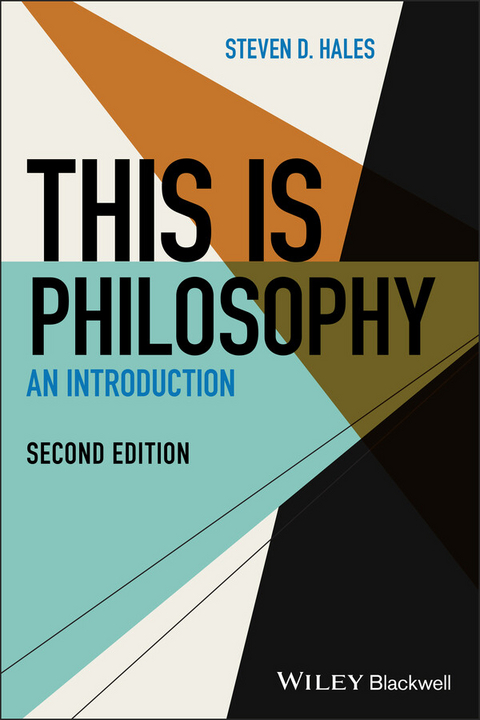
This Is Philosophy (eBook)
John Wiley & Sons (Verlag)
978-1-119-63555-0 (ISBN)
'The second edition of This is Philosophy improves upon an excellent first edition. This clear, succinct book is quite possibly the best introduction to Western philosophy on the market.'
-Gregory Morgan, Stevens Institute of Technology
'This is a terrific book. The writing is not only extremely clear, it is downright gripping-with relevant and detailed examples at every turn. Steven Hales has produced not just a great little introduction to philosophy-he has produced a great little book in philosophy, period.'
-Michael Lynch, University of Connecticut
'Hales clearly explains important philosophical ideas with a minimum of jargon and without sacrificing depth of content and he consistently gives a fair and accurate presentation of both sides of central philosophical disputes.'
-Matthew Van Cleave, Teaching Philosophy
As the oldest discipline in the academy, philosophy began by asking questions of the world and of human nature. Philosophers are responsible for the Enlightenment and laid the foundations for constitutional governments. Yet, while it may have given birth to the natural sciences, philosophy has earned a contemporary reputation as an esoteric and impractical field out of touch with everyday life-but it doesn't have to be that way. This is Philosophy: An Introduction expertly guides students through the fundamentals of philosophy by illuminating difficult, abstract ideas with straightforward language. Assuming no prior background in the subject, this volume brings philosophical concepts into sharp focus through relatable examples and clear explanations of philosophy's big questions and arguments.
The second edition of this accessible textbook is organized around seven central philosophical problems, including ethics, the existence of God, free will, personal identity, philosophy of mind, and epistemology. New to this edition is a chapter on political philosophy that explores the state of nature, anarchy, contractarianism, libertarianism, and the liberal state. These self-contained chapters have been reordered and recalibrated to best suit the needs of introductory philosophy courses, and can be taught independently or in sequence. Enhanced by updated examples, new hyperlinks and references, and detailed bibliographies, the book is complemented by extensively-revised online resources available to instructors, including a 200-question test bank and over 450 PowerPoint slides designed to strengthen student comprehension of key concepts.
Strengthening the popular first edition which launched the series, This is Philosophy: An Introduction, Second Edition is the perfect primary textbook for beginning philosophy students as well as general readers with an interest in philosophy.
STEVEN D. HALES is Professor and Chair of Philosophy at Bloomsburg University of Pennsylvania. He works primarily in metaphysics and epistemology, and has published in Mind, Noûs, Philosophy and Phenomenological Research, and other journals. He has been a Visiting Professor at the Universities of Cambridge, Turin, Edinburgh, and London, and has won awards for both teaching and research. He has written or edited 12 books, most recently The Myth of Luck: Philosophy, Fate and Fortune (2020).
THIS IS PHILOSOPHY The second edition of This is Philosophy improves upon an excellent first edition. This clear, succinct book is quite possibly the best introduction to Western philosophy on the market. Gregory Morgan, Stevens Institute of Technology This is a terrific book. The writing is not only extremely clear, it is downright gripping with relevant and detailed examples at every turn. Steven Hales has produced not just a great little introduction to philosophy he has produced a great little book in philosophy, period. Michael Lynch, University of Connecticut Hales clearly explains important philosophical ideas with a minimum of jargon and without sacrificing depth of content and he consistently gives a fair and accurate presentation of both sides of central philosophical disputes. Matthew Van Cleave, Teaching PhilosophyAs the oldest discipline in the academy, philosophy began by asking questions of the world and of human nature. Philosophers are responsible for the Enlightenment and laid the foundations for constitutional governments. Yet, while it may have given birth to the natural sciences, philosophy has earned a contemporary reputation as an esoteric and impractical field out of touch with everyday life but it doesn t have to be that way. This is Philosophy: An Introduction expertly guides students through the fundamentals of philosophy by illuminating difficult, abstract ideas with straightforward language. Assuming no prior background in the subject, this volume brings philosophical concepts into sharp focus through relatable examples and clear explanations of philosophy s big questions and arguments.The second edition of this accessible textbook is organized around seven central philosophical problems, including ethics, the existence of God, free will, personal identity, philosophy of mind, and epistemology. New to this edition is a chapter on political philosophy that explores the state of nature, anarchy, contractarianism, libertarianism, and the liberal state. These self-contained chapters have been reordered and recalibrated to best suit the needs of introductory philosophy courses, and can be taught independently or in sequence. Enhanced by updated examples, new hyperlinks and references, and detailed bibliographies, the book is complemented by extensively-revised online resources available to instructors, including a 200-question test bank and over 450 PowerPoint slides designed to strengthen student comprehension of key concepts.Strengthening the popular first edition which launched the series, This is Philosophy: An Introduction, Second Edition is the perfect primary textbook for beginning philosophy students as well as general readers with an interest in philosophy.
STEVEN D. HALES is Professor and Chair of Philosophy at Bloomsburg University of Pennsylvania. He works primarily in metaphysics and epistemology, and has published in Mind, Noûs, Philosophy and Phenomenological Research, and other journals. He has been a Visiting Professor at the Universities of Cambridge, Turin, Edinburgh, and London, and has won awards for both teaching and research. He has written or edited 12 books, most recently The Myth of Luck: Philosophy, Fate and Fortune (2020).
Preface for Instructors x
Preface for Students xiv
Acknowledgments xvi
1 Ethics: Preliminary Views 1
1.1 Is Morality Just Acting on Principles? 3
1.2 Divine Command Theory (Is Morality Just What God Tells Me to Do?) 6
1.3 Egoism (Is Morality Just My Own Personal Code?) 10
1.4 Moral Relativism (Is Morality Just How Society Says We Should Act?) 18
2 Ethics: The Big Three Theories 27
2.1 Utilitarianism (Is Morality Doing What I Can to Make This the Best World Possible?) 27
2.2 Deontology, or Kantianism (Is There an Absolute Moral Law?) 42
2.3 Objections 48
2.4 Virtue Ethics (Is Morality all about Having a Virtuous Character?) 52
2.5 Objections 54
3 God 62
3.1 The Attributes of God 64
3.2 Why There is a God 66
3.3 Why There is No God 93
3.4 Atheist Responses to the Free Will Defense 102
4 Freedom 111
4.1 Against Free Will, Part 1: Divine Foreknowledge 114
4.2 Against Free Will, Part 2: A Regress of Reasons for Acting 117
4.3 Against Free Will, Part 3: Determinism and the Dilemma Argument 123
4.4 The Incompatibilist Argument 126
4.5 The Dilemma Argument Against Free Will 129
4.6 Free Will and Moral Responsibility 129
4.7 Agent Causation 133
4.8 Compatibilism 135
4.9 The Feeling of Freedom 139
5 Self 145
5.1 Preliminary Positions 147
5.2 The Soul Criterion 149
5.3 Objections 151
5.4 The Physicalist Criterion 156
5.5 The Psychological Criterion 163
5.6 The Bundle Theory 173
6 Mind 183
6.1 Substance Dualism 184
6.2 Behaviorism 192
6.3 Mind-brain Identity Theory 196
6.4 Functionalism 202
7 Knowledge 215
7.1 The Value of Truth 215
7.2 The Value of Evidence 219
7.3 The Sources of Evidence 230
7.4 The Nature of Knowledge 233
7.5 The Skeptic's Challenge 236
8 Politics 254
8.1 State of Nature 255
8.2 Anarchy 257
8.3 Contractarianism 260
8.4 Leviathan and the Philosopher Kings 266
8.5 The Minimal State 272
8.6 The Liberal State 276
Postscript 284
Index 286
1
ETHICS: PRELIMINARY VIEWS:
Life’s just filled with all sorts of things you’re supposed to do. You should be nice to your sister, brush between meals, never mix beer and wine, get your car inspected, tithe to the poor, wear clean underwear, avoid consumer debt, love thy neighbor as thyself, buy low and sell high, read good books, exercise, tell the truth, have evidence-based beliefs, come to a complete stop at a red light, eat your vegetables, call your Dad once in a while. The list goes on and on. All these things you should do, various obligations, duties, and responsibilities, form the normative universe. Shoulds, oughts, duties, rights, the permissible and the impermissible populate the normative universe. Not all these shoulds and oughts are ethical in nature, however. There are many dimensions to the normative universe, not just the moral dimension. Here are a few examples:
- Jeff is deciding whether he should invest his money in gold bullion, mutual funds, or government bonds.
- Jennifer wonders whether it is permissible for her to turn right on red in this state.
- Kevin is debating whether he ought to put more cinnamon in his ginger snaps.
- Holly is considering whether her crossword answer is right.
The first case is about what Jeff should practically or prudentially invest in; the second example concerns the legal permissibility of turning right on red; the third offers an aesthetic case regarding what Kevin ought to do when baking cookies; and the fourth case is about the accuracy of Holly’s believing that her crossword answer is correct. In these cases, “should,” “permissible,” “ought,” and “right” have nothing to do with morality, even though they are still normative expressions. When exactly those words concern morality is not an easy matter to describe with any precision. Nevertheless, confusion will ensue if we aren’t sensitive to the fact that what we ought to do practically or legally is not the same as what we ought to do morally. We will see more of this later.
Everyone is faced with making ethical choices–decisions about what they should do in some circumstance. We must each decide for ourselves whether a potential action is right or wrong, and contemplate the nature of honor, duty, and virtue. There are standards of correct action that aren’t moral standards. Still, it is clear that the following are cases of moral deliberation.
- Your best friend’s girlfriend is coming on to you at the party. If you can get away with it, should you hook up with her?
- Your friend Shawna knows how to pirate new-release movies, and wants to show you how. Should you go with her and get some flicks?
- Your grandmother is dying of terminal pancreatic cancer and has only a few, painful, days to live. She is begging you to give her a lethal overdose of morphine, which will depress her respiration and allow her to die peacefully. Should you give her the overdose?
- You are a pregnant, unmarried student. Testing has shown that your fetus has Down Syndrome. Should you abort?
- You didn’t study enough for your chem exam, and don’t have all those formulas you need memorized. One of your friends tells you to program your smartwatch with the formulas you need. Your prof will just think you are looking at the time and never catch you cheating. You should do whatever you can to get ahead in this world, right?
These aren’t far-fetched cases; at least a few of them should fit your own experience. Well, how do you decide what to do? If you’re like most people, you might reflect on whatever values your parents taught you growing up; or think about what your religion or holy book has to say on the topic; or go with your gut instinct about what to do; or consider the consequences if you do the action; or imagine how it would make you feel later if you did it; or think about whether the proposed action is compatible with some moral rule you believe, like do unto others as they would do unto you. If you look at this list, you’ll see that it naturally divides into two main approaches: (1) base your action on some rule, principle, or code, and (2) base your action on some intuition, feeling, or instinct.
1.1 Is Morality Just Acting on Principles?
You might think that moral action means sticking to your principles, holding fast to your beliefs and respecting how you were raised. Or perhaps morality is acting as you think God intends, by strictly following your holy book. Acting on the basis of your instincts and sympathies is to abandon genuine morality for transient emotions. One person who subscribed to the view that moral action requires strict adherence to principles and tradition was Osama bin Laden.
Osama bin Laden was, of course, the notorious terrorist mastermind of the 9/11 attacks. Bin Laden was not a madman or a lunatic, though, and if you read his writings you’ll see that he was an articulate, educated spokesman for his views. Bin Laden believed that the Western nations are engaged in a Crusader war against Islam, and that God demands that the Islamic Caliphate (i.e. the theocratic rule of all Muslims under an official successor to the Prophet Muhammad) be restored to power, and that all nations follow Islamic religious law (sharia). In a post-9/11 interview, Bin Laden responded to the criticism that he sanctioned the killing of women, children, and innocents.
The scholars and people of the knowledge, amongst them Sahib al-Ikhtiyarat [ibn Taymiyya] and ibn al-Qayyim, and Shawanni, and many others, and Qutubi–may God bless him–in his Qur’an commentary, say that if the disbelievers were to kill our children and women, then we should not feel ashamed to do the same to them, mainly to deter them from trying to kill our women and children again. And that is from a religious perspective…
As for the World Trade Center, the ones who were attacked and who died in it were part of a financial power. It wasn’t a children’s school! Neither was it a residence. And the general consensus is that most of the people who were in the towers were men that backed the biggest financial force in the world, which spreads mischief throughout the world. And those individuals should stand before God, and rethink and redo their calculations. We treat others like they treat us. Those who kill our women and our innocent, we kill their women and innocent, until they stop doing so.
(Lawrence, 2005, pp. 118–119)
Bin Laden was clearly concerned with the morality of killing “women and innocents;” he took pains to note that al-Qaeda attacked the World Trade Center, a financial building that–in his view–contained supporters of an materialist, imperialist nation of unbelievers. WTC was not a school or a home. Moreover, Bin Laden cited religious scholars and interpreters of the Qur’an to support his belief that killing noncombatants as a form of deterrence is a morally permissible act, sanctioned by his religion. Bin Laden was a devout and pious man who scrupulously adhered to his moral principles. If you think that he was a wicked, mass-murdering evildoer, it is not because he failed to be principled. It is because you find his principles to be bad ones.
What proof is there that Bin Laden’s moral principles are the wrong ones? None, really, other than an appeal to our common ethical intuitions that the intentional murder of innocents to further some idiosyncratic political or religious goal is morally heinous. If you disagree, it may be that your moral compass points in such an opposite direction that you don’t have enough in common with ordinary folks to engage in meaningful moral discussion. Even Bin Laden worried that it is wrong to kill children and women, which is why he was careful to justify his actions.
Just because you base your actions on some rule, principle, or moral code that you’ve adopted or created is no guarantee that you’ll do the right thing. You could have a bad moral code. Of course, everyone thinks their own moral code is correct, but that’s no guarantee that it is–just look at Bin Laden. Well, is it better to base your actions on your intuitions, on the feelings you have about whatever situation is at hand? Not necessarily. Feelings are immediate and case-specific, and the situation right in front of us is always the most vivid and pressing. Your gut instincts may lead you to choose short-term benefits over what’s best in the long term. For example, imagine a mother who has taken a toddler in for a vaccination. The child is crying, not wanting to feel the pain of the needle. Surely the mother’s instincts are to whisk the child away from the doctor advancing with his sharp pointy stick. Yet sometimes the right action is to set our feelings aside to see the larger picture. The mother has a moral obligation to care for her child, and so must hold back her protective sympathies and force the child to get the shot.
If we can’t trust our moral principles and rules (because we might have bad principles and rules), and we can’t trust our moral intuitions (because our sympathies might be short-sighted and narrow), then what should we do? The most prominent approach is to use the best of both worlds. We should use our most fundamental moral intuitions to constrain and craft moral theories and principles. This approach does not mean that we just capitulate to our gut instincts. Sometimes our principles should override...
| Erscheint lt. Verlag | 5.3.2021 |
|---|---|
| Reihe/Serie | This is Philosophy |
| This is Philosophy | This is Philosophy |
| Sprache | englisch |
| Themenwelt | Geisteswissenschaften ► Philosophie ► Allgemeines / Lexika |
| Geisteswissenschaften ► Philosophie ► Geschichte der Philosophie | |
| Geisteswissenschaften ► Philosophie ► Philosophie der Neuzeit | |
| Sozialwissenschaften | |
| Schlagworte | Cultural Studies • Digital Culture & the Information Age • Digitale Kultur im Informationszeitalter • Einführungen in die Philosophie • Introductions to Philosophy • Kulturwissenschaften • Philosophie • Philosophy |
| ISBN-10 | 1-119-63555-1 / 1119635551 |
| ISBN-13 | 978-1-119-63555-0 / 9781119635550 |
| Informationen gemäß Produktsicherheitsverordnung (GPSR) | |
| Haben Sie eine Frage zum Produkt? |
 EPUB (Adobe DRM)
Kopierschutz: Adobe-DRM
Adobe-DRM ist ein Kopierschutz, der das eBook vor Mißbrauch schützen soll. Dabei wird das eBook bereits beim Download auf Ihre persönliche Adobe-ID autorisiert. Lesen können Sie das eBook dann nur auf den Geräten, welche ebenfalls auf Ihre Adobe-ID registriert sind.
Details zum Adobe-DRM
Dateiformat: EPUB (Electronic Publication)
EPUB ist ein offener Standard für eBooks und eignet sich besonders zur Darstellung von Belletristik und Sachbüchern. Der Fließtext wird dynamisch an die Display- und Schriftgröße angepasst. Auch für mobile Lesegeräte ist EPUB daher gut geeignet.
Systemvoraussetzungen:
PC/Mac: Mit einem PC oder Mac können Sie dieses eBook lesen. Sie benötigen eine
eReader: Dieses eBook kann mit (fast) allen eBook-Readern gelesen werden. Mit dem amazon-Kindle ist es aber nicht kompatibel.
Smartphone/Tablet: Egal ob Apple oder Android, dieses eBook können Sie lesen. Sie benötigen eine
Geräteliste und zusätzliche Hinweise
Buying eBooks from abroad
For tax law reasons we can sell eBooks just within Germany and Switzerland. Regrettably we cannot fulfill eBook-orders from other countries.
aus dem Bereich