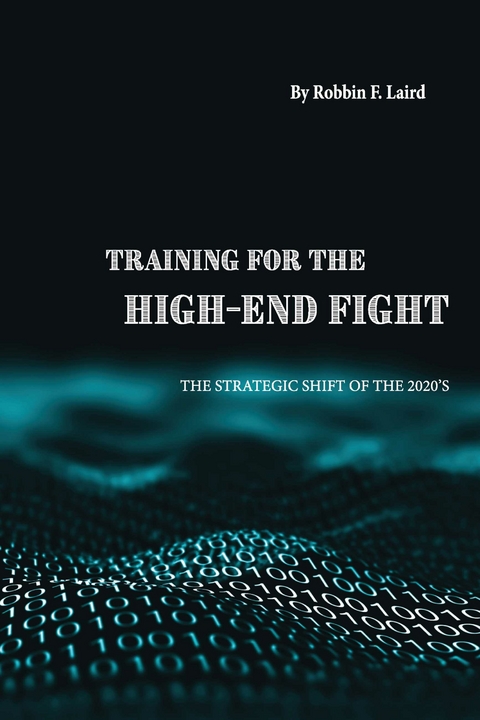
Training for the High-End Fight (eBook)
218 Seiten
Bookbaby (Verlag)
9781098350765 (ISBN)
"e;Training for the High-End Fight"e; highlights the essential strategic shift for the US and allied militaries from land wars in the Middle East to the return of great power competition. The primary challenge of this strategic shift will be the need to operate a full spectrum crisis management force. That means training a force capable of delivering the desired combat and crisis management effect in dealing with 21st century authoritarian powers. This reset in combat approach is pivotal to enhancing our escalation management skills and for protecting the liberal democracies against 21st century authoritarian powers. Informed by interviews with officers at a number of US war fighting training centers, readers will discover the future of 21st Century combat, and how our forces are preparing for it.
Introduction
The U.S. military has been focused along with core allies in dealing with counter-insurgencies for two decades, which represents a defining generation of combat experience for the joint, and coalition force. We have an entire generation of military officers with little or no experience in dealing with the direct threat from peer competitors or operating in contested air and maritime space.
With the return of great power conflict and the return of core nuclear questions with the coming of a second nuclear age, force structures are changing along with concepts of operations as well as the need for relevant and effective crisis management strategies. A strategic shift is underway for the military establishments in the liberal democracies.
For the past decade, the military has primarily focused its training and operations dealing with counter-insurgency and stability operations. Now the need to deal with operations in contested air and sea space from adversaries that can bring significant capability to bear against U.S. and allied forces requires a significant reset of efforts.
It is a strategic space in which operations by the military will unfold in contested settings over an expanded combat space. It is about learning how to deal with the policies and capabilities of peer competitors who are seeking strategic and military advantage against the liberal democracies. And this challenge is one which will require the civilian leadership to come to terms with the challenge of crisis management in which escalation and de-escalation will have to be mastered as a strategic art form. It will not just be combat effect sought; but crisis management effects as well.
It is not just about sending off the military to fights thousands of miles away and welcoming them back from time to time. It will be about facing the adversary squarely and forcing his hand and shaping outcomes to the benefit of the liberal democracies against those of the illiberal powers, and by doing so with using military means as one of the key tool sets
The nature of the threat facing the liberal democracies was well put by a senior Finnish official: “The timeline for early warning is shorter; the threshold for the use of force is lower.” What is unfolding is that capabilities traditionally associated with high-end warfare are being drawn upon for lower threshold conflicts, designed to achieve desired political effects.
Higher-end capabilities being developed by China and Russia are becoming tools to achieve political–military objectives throughout the diplomatic engagement spectrum. The non-liberal or authoritarian powers are clearly leveraging new military capabilities to support their global diplomacy to try to get outcomes and advantages that enhance their position and interests.
The systems they are building and deploying are clearly recognized by the Western militaries as requiring a response; less recognized is how the spectrum of conflict is shifting in terms of using higher-end capabilities for normal diplomatic gains.
As the strategic shift from the land wars gains momentum, the investments and training in an appropriate twenty-first century crisis management and high intensity combat force will not be modeled on the Cold War European-based force. It is not about a German–U.S. Army brotherhood with significant presence. It is not about reestablishing air–land battle. It is about leveraging core force integration capabilities, such as F-35 with the Aegis, which can provide a pull function moving the United States and the allies toward a more flexible and scalable force that can operate across the spectrum of operations.
Because the adversaries are building to mass and are emphasizing their expansion of strike capabilities controlled by a very hierarchical command structure, the kind of force which will best fit Western interests and capabilities is clearly a distributed one. Fortunately, the technology is already here to move effectively down this path, a path which allows engagement at the low end and provides building blocks for higher end capabilities.
The force we need to build will have five key interactives capabilities:
- Enough platforms with Allied and U.S. forces in mind to provide significant presence;
- A capability to maximize an economy of force with that presence;
- Scalability whereby the presence force can reach back if necessary, at the speed of light and to receive combat reinforcements;
- Be able to tap into variable lethality capabilities appropriate to the mission or the threat in order to exercise dominance; and
- And to have the situational awareness (SA) relevant for proactive crisis management at the point of interest and an ability to link the fluidity of local knowledge to appropriate tactical and strategic decisions.
The new approach is one which can be expressed in terms of a kill web, that is United States and allied forces so scalable that if an ally goes on a presence mission and is threatened by a ramp up of force from a Russia or China, then that presence force can reach back to relevant allies as well as their own force structure to deliver the appropriate response.
The inherent advantage for the United States and its allies is the capability to shape a more integrated force which can leverage one another in a crisis. A shift to a kill web approach to force building, training, and operations is a foundation from which the United States and its allies can best leverage the force we have and the upgrade paths to follow.
A kill web linked force allows a modest force package—economy of force—to reach back to other combat assets to provide for enhanced options in a crisis or to ramp up the level of conflict if that is being dictated by the situation.
The evolution of twenty-first century weapons technologies is breaking down the barriers between offensive and defensive systems. Is missile defense about providing defense or is it about enabling global reach, for offense or defense? Likewise, the new fifth-generation aircraft has been largely not understood because they are inherently multidomain systems, which can be used for forward defense or forward offensive operations.
Indeed, an inherent characteristic of many new systems is that they are really about presence and putting a grid over an operational area, and therefore they can be used to support strike or defense within an integrated approach. In the twentieth century, surge was built upon the notion of signaling. One would put in a particular combat capability—a Carrier Battle Group, Amphibious Ready Group, or Air Expeditionary Wing—to put down your marker and to warn a potential adversary that you were there and ready to be taken seriously. If one needed to, additional forces would be sent in to escalate and build up force. With the new multidomain systems—fifth-generation aircraft and Aegis, for example—the key is presence and integration able to support strike or defense in a single operational presence capability. Now the adversary cannot be certain that you are simply putting down a marker.
The strategic thrust of integrating modern systems is to create a grid that can operate in an area as a seamless whole, able to strike or defend simultaneously. The US Navy (USN) leadership has coined their version of this approach, the “kill web.”
In an interview we conducted with Rear Admiral Manazir, then head of N-98, Naval Aviation, he discussed the new approach. “If you architect the joint force together, you achieve a great effect. It is clear that C2 (command and control) is changing and along with it the CAOC (Combined Air and Space Operations Center). The hierarchical CAOC is an artifact of nearly sixteen years of ground war where we had complete air superiority; however, as we build the kill web, we need to be able to make decisions much more rapidly. As such, C2 is ubiquitous across the kill web. Where is information being processed? Where is knowledge being gained? Where is the human in the loop? Where can core C2 decisions best be made and what will they look like in the fluid battlespace?
“The key task is to create decision superiority. But what is the best way to achieve that in the fluid battlespace we will continue to operate in? What equipment and what systems allow me to ensure decision superiority? We are creating a force for distributed fleet operations. When we say distributed, we mean a fleet that is widely separated geographically capable of extended reach. Importantly, if we have a network that shares vast amounts of information and creates decision superiority in various places, but then gets severed, we still need to be able to fight independently without those networks.
“This not only requires significant and persistent training with new technologies but also informs us about the types of technologies we need to develop and acquire in the future. Additionally, we need to have mission orders in place so that our fleet can operate effectively even when networks are disrupted during combat; able to operate in a modular-force approach with decisions being made at the right level of operations for combat success.”1
Inherent in such an enterprise is scalability and reach-back. By deploying a digital warfare grid or a C2/Information superiority “honeycomb,” the shooters in the enterprise can reach back to each other to enable the entire grid of operation, for either defense or offense. By being able to plug into such a digitally enabled honeycomb, the United...
| Erscheint lt. Verlag | 3.2.2021 |
|---|---|
| Sprache | englisch |
| Themenwelt | Sozialwissenschaften ► Politik / Verwaltung |
| ISBN-13 | 9781098350765 / 9781098350765 |
| Informationen gemäß Produktsicherheitsverordnung (GPSR) | |
| Haben Sie eine Frage zum Produkt? |
 EPUB (Ohne DRM)
Größe: 692 KB
Digital Rights Management: ohne DRM
Dieses eBook enthält kein DRM oder Kopierschutz. Eine Weitergabe an Dritte ist jedoch rechtlich nicht zulässig, weil Sie beim Kauf nur die Rechte an der persönlichen Nutzung erwerben.
Dateiformat: EPUB (Electronic Publication)
EPUB ist ein offener Standard für eBooks und eignet sich besonders zur Darstellung von Belletristik und Sachbüchern. Der Fließtext wird dynamisch an die Display- und Schriftgröße angepasst. Auch für mobile Lesegeräte ist EPUB daher gut geeignet.
Systemvoraussetzungen:
PC/Mac: Mit einem PC oder Mac können Sie dieses eBook lesen. Sie benötigen dafür die kostenlose Software Adobe Digital Editions.
eReader: Dieses eBook kann mit (fast) allen eBook-Readern gelesen werden. Mit dem amazon-Kindle ist es aber nicht kompatibel.
Smartphone/Tablet: Egal ob Apple oder Android, dieses eBook können Sie lesen. Sie benötigen dafür eine kostenlose App.
Geräteliste und zusätzliche Hinweise
Buying eBooks from abroad
For tax law reasons we can sell eBooks just within Germany and Switzerland. Regrettably we cannot fulfill eBook-orders from other countries.
aus dem Bereich