


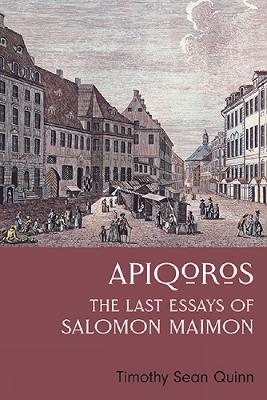
Apiqoros
The Last Essays of Salomon Maimon
Seiten
2021
Hebrew Union College Press,U.S. (Verlag)
978-0-87820-301-7 (ISBN)
Hebrew Union College Press,U.S. (Verlag)
978-0-87820-301-7 (ISBN)
This book provides both an intellectual biography of Salomon Maimon and an English language translation of his essays on moral psychology. "Salomon Maimon (1753–1800) is one of the most acute, original, and complicated philosophers, and one of the most fascinating personalities, of the eighteenth century" (Stanford Encyclopedia of Philosophy).
Although Kant considered him the greatest critic of his work, and Fichte thought him the most impressive mind of the generation, Salomon Maimon (1753-1800) has fallen into relative obscurity. Apiqoros: The Last Essays of Salomon Maimon draws attention to works written during the final years of Maimon's life. These essays are of particular interest: they show that even though Maimon was a self-proclaimed apiqoros grappling with the implications of Kantian philosophy, his thinking remained deeply influenced by his Jewish intellectual inheritance, especially by Maimonides, the medieval Sephardic philosopher. The volume is divided into two parts. The first is a general account of Maimon's intellectual biography, along with commentary on his final essays. The second part provides translations of those essays, the principal themes of which concern moral psychology. The reader is thus able to see the degree to which Maimon, at the end of his life, became sceptical of his effort to unite Kant and Maimonides, and remained a thinker caught "between two worlds." The book concludes with a translation of an account of Maimon's final hours, penned by one of his friends.
Although Kant considered him the greatest critic of his work, and Fichte thought him the most impressive mind of the generation, Salomon Maimon (1753-1800) has fallen into relative obscurity. Apiqoros: The Last Essays of Salomon Maimon draws attention to works written during the final years of Maimon's life. These essays are of particular interest: they show that even though Maimon was a self-proclaimed apiqoros grappling with the implications of Kantian philosophy, his thinking remained deeply influenced by his Jewish intellectual inheritance, especially by Maimonides, the medieval Sephardic philosopher. The volume is divided into two parts. The first is a general account of Maimon's intellectual biography, along with commentary on his final essays. The second part provides translations of those essays, the principal themes of which concern moral psychology. The reader is thus able to see the degree to which Maimon, at the end of his life, became sceptical of his effort to unite Kant and Maimonides, and remained a thinker caught "between two worlds." The book concludes with a translation of an account of Maimon's final hours, penned by one of his friends.
Timothy Sean Quinn is Professor and Chair of Philosophy at Xavier University, Cincinnati, Ohio.
| Erscheinungsdatum | 24.05.2021 |
|---|---|
| Sprache | englisch |
| Maße | 156 x 236 mm |
| Gewicht | 445 g |
| Themenwelt | Geisteswissenschaften ► Philosophie ► Philosophie der Neuzeit |
| Sozialwissenschaften ► Soziologie ► Spezielle Soziologien | |
| ISBN-10 | 0-87820-301-X / 087820301X |
| ISBN-13 | 978-0-87820-301-7 / 9780878203017 |
| Zustand | Neuware |
| Informationen gemäß Produktsicherheitsverordnung (GPSR) | |
| Haben Sie eine Frage zum Produkt? |
Mehr entdecken
aus dem Bereich

aus dem Bereich
ein Dialog mit Simone Weil
Buch | Softcover (2025)
Matthes & Seitz Berlin (Verlag)
CHF 19,55


