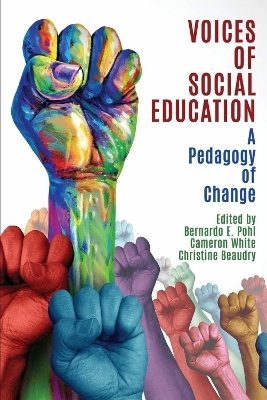
Voices of Social Education
Information Age Publishing (Verlag)
9781648023750 (ISBN)
There is only one place where social education can occur and flourish: through the voices that create a pedagogy of change. And it is these voices where the most exciting and provocative moments can occur for those of us who are passionate about education, teaching, social justice, equity, and love. As such, social education is a journey—an endeavor that makes us savor the experience of the journey more than the destination. And social education is a journey that ins enhanced through educator and student voices because it occurs in the most important spaces of our personal and professional lives. It occurs in the hallways of the schools we teach, in the staff meetings we attend, in the mountain villages we venture to visit, in the places we work, and in the spaces we occupy. Moreover, social education is a unique kind of journey because it is a human experience that seldom occurs alone. It happens with our colleagues and our loved ones. It happens with our students, administrators, and other professionals who are fighting for the same things that we so fervently believe. In the end, social education occurs and flourishes in the trenches because it is the active pursuit of getting our hands dirty in our endless pursuit for a better and more just world.
Social education is also a narrative, which takes on a different meaning for each one of us. This is because sooner or later each person that embarks into the journey of social education develops its own personal definition of what social education entails through his or her own personal landscape and knowledge. This personal landscape has been evolving since we were very young with some of the best examples of human courage and tenacity in the fight for social justice.
Voices of Social Education: A Pedagogy of Change is a collection of personal stories. In this volume, academics, teachers, students, activists, and artists share their personal stories of triumph, tribulations, and courage in their daily fight for social justice and equality. The term social education is not defined as a set number of guidelines or a specific definition; we give the term an organic fluency to stress that social education is a point of encounter--a common space-- where we can share with each other our experiences, values, and culture to form a more genuine and just social experience.
Bernardo Pohl, University of Houston-Downtown Cameron White, University of Houston Christine Beaudry, Nevada State College
Introduction; Bernardo Pohl, Cameron White, and Christine Beaudry.
Part I. Voices From The Field.
Chapter 1. Oral History in a Guatemalan International School: The Yo Recuerdo Project; Christopher Lemley, Sandra Talbert, and Tony Talbert.
Chapter 2. Outsider Kids: Working Toward the Development of Conscientization; Jennifer L. Martin and Julia Persky.
Chapter 3. From Field Text to Research Text: Watershed Moments in Critically Rendering Sensitive Issues; Gayle A. Curtis.
Chapter 4. Perception of Urban Youth Regarding Service Learning; Frecia Todd.
Chapter 5. Schools, Friends, and Drugs: Examining Interactions Between Individual and Environmental Determinants of Adolescent Substance Use; Stephen Clipper, Nina Barbieri, and Nadine Connell.
Chapter 6. Ecopedagogy as a Life-Style, as a Learned Style; C. Lynne Hannah, Sarah Commander, Janet Stevens, and Emily Alexander.
Part II. Voices From The Classroom.
Chapter 7. Factors That Influence Young, Highly-Effective Educators to Leave Traditional Public Schools for Charter Schools; Andre Haughton.
Chapter 8. Speculating the Classroom: The Pedagogy of Speculative Fiction and Fandom; Derek Newman-Stille.
Chapter 9. Exploring Teacher Perceptions of Historically Underrepresented Students in AP Classes; Matthew Campbell.
Chapter 10. Lowering Suspension and Office Referrals Within an Urban Middle School: A Variable in Disrupting the School-to-Prison Pipeline; Frank Cisneros.
Chapter 11. Literacy in Urban Educations: Equity for Preteachers and Future Students; Eve Zehavi.
Chapter 12. Using Digital Narratives to Create a Sense of Belonging Among Storytellers in the Classroom; Laura A. Mitchell and Irene Linlin Chen.
Chapter 13. Social Justice in Mathematics Education: Addressing the Numeracy Gap in Urban Public Schools; Jackie Sack.
Chapter 14. A Story of Staying: Narratives from the Trenches During the First Two Years of Teaching; Bernardo Pohl.
Chapter 15. Stepping Out of the Trenches: Practicing Relational Pedagogy in a School Within a School; Julie Singleton.
Part III. Voices Of Action.
Chapter 16. Democratic Social Education: The Need for a Conscious, Deliberate, Participatory Approach; Dayna Ford and Melissa Brevetti.
Chapter 17. The Risk of Social Education: Conflicting Views of Citizenship in the Special Education Classroom; Bernardo Pohl.
Chapter 18. If I Only Had a Brain: Scholarly Identity at Oddz in the World of Academia; Denise McDonald.
Chapter 19. Social/Intercultural Education: A Pedagogy for Hope; Cameron White.
Chapter 20. Voices From Social Education: Challenging Neoliberalism Through a Social Education EdD; Christine Beaudry, Jane Cooper, and Leslie Gauna.
About the Authors.
| Erscheinungsdatum | 01.04.2021 |
|---|---|
| Sprache | englisch |
| Maße | 156 x 234 mm |
| Gewicht | 530 g |
| Themenwelt | Sozialwissenschaften ► Pädagogik ► Allgemeines / Lexika |
| Sozialwissenschaften ► Pädagogik ► Bildungstheorie | |
| Sozialwissenschaften ► Pädagogik ► Didaktik | |
| ISBN-13 | 9781648023750 / 9781648023750 |
| Zustand | Neuware |
| Informationen gemäß Produktsicherheitsverordnung (GPSR) | |
| Haben Sie eine Frage zum Produkt? |
aus dem Bereich