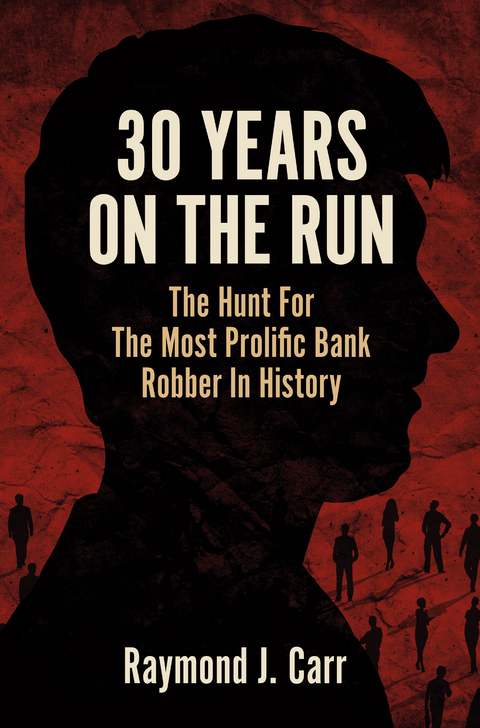
30 Years On The Run (eBook)
328 Seiten
Bookbaby (Verlag)
9781098340759 (ISBN)
30 YEARS ON THE RUN: THE HUNT FOR THE MOST PROLIFIC BANK ROBBER IN HISTORY, is told masterfully by author and retired FBI Special Agent Raymond J. Carr. Readers will follow the painstaking and extraordinary steps that led to the discovery of the most prolific bank robber in history, an evil genius who evaded police for 30 years and whose robberies totaled more than those of Bonnie and Clyde, John Dillinger, and Willie Sutton combined. This was Carr's case, and his story to tell. As one of few FBI agents privileged to play a role in the early success of the FBI's formidable Behavioral Analysis Unit, known worldwide as the BAU, Carr delves into the fascinating world of profiling. Via actual FBI documents, the book details the offender's background, revealing the intimate discussions that helped Carr understand how the well-educated man chose a life of crime and circumvented law enforcement for decades. Carr also discusses poignantly how he survived numerous roadblocks throughout the investigation, including the terrorist attacks on 9/11 and devastating family hardships. The notorious bank robber also suffered, and readers learn how a specific event in his youth changed the course of his life.
CHAPTER 5
It’s a Miracle
Shortly after returning home, Dad was assigned to Fort Dix Army Post in Burlington County, New Jersey. My parents bought their first home in nearby Willingboro, one of the three original Levittowns. It meant a new school for me – eighth grade in local Corpus Christi School, followed by high school at Holy Cross in Delran’s neighboring community.
In high school, I found that I loved playing sports and excelled at swimming, wrestling, baseball, and especially football. As I entered my senior year, in 1974 and 1975, I started being courted by coaches to play football for numerous colleges in Pennsylvania and New Jersey, including Rutgers, Temple, and Lehigh.
Many of the college coaches liked the way I played but were worried about my size -- 5-foot-8 and 180 pounds -- in a sport that was increasingly dominated by large, beefy players. I picked an offer based not on the football team’s strength, but the coach’s character. In all my campus visits, Kutztown’s George Baldwin, a retired marine gunnery sergeant from Paris Island, a training facility for new marines, was the only coach to remember my name.
More than just being a great coach, I sensed that Baldwin was a good man. I knew he would become a big part of my life. That was more important than football.
Off the field, I decided to major in criminal justice. Remember, I was that kid in Philadelphia who loved watching Efrem Zimbalist Jr. as the agent in the “FBI” television series. I dreamed of becoming an FBI special agent. Now I could take the first step.
In 1977, I picked up a summer job at a Gulf Refinery in South Philadelphia. Outside, it was in the nineties with humidity to match. Sounded good to me: I liked the heat. It would prepare me for the grueling weather at the football camp. I worked inside a 390,000-barrel tank where it was hotter than hell– 120 degrees – its humidity thanks to a mix of petroleum vapor and steam from a power washer. Still, I was 20, a working-class college kid. The money was good despite waking at 5 a.m., five days a week, to catch a ride on a maintenance truck with other refinery workers.
There was one big downside that had nothing to do with no vacation or time with friends. I was trying to prepare for my mid-August return to football camp at Kutztown. I was hoping to bulk up for my position as nose guard but couldn’t maintain weight, let alone gain it. I ate like a horse, but my daily shift at the refinery, followed by two hours of working out in a weight room, melted away the pounds. And it wouldn’t get any easier when I got back to college in rural Berks County, Pennsylvania, where Baldwin coached the Golden Bears like a drill instructor at Parris Island. He would wake us at 6 a.m. every morning to do a three-mile run. Here we were, more than 150 football players of all shapes and sizes, running through the Kutztown borough, with Coach Baldwin leading the way. Thank God he was a slow runner!
During one of these runs, I was in the back of the pack, where I felt most comfortable, talking with the defensive back and special teams coaches. All of a sudden, a coach yelled, “Car coming!” The players parted like the Red Sea to allow the car to pass between them. I had an idea. I told the coach to yell, “Car coming!” again. Only this time there was no car.
When the players parted again, I ran down the middle to Coach Baldwin and told him, “Carr’s here.” He laughed and said he had been waiting for me all season.
Little did I know that when I walked into the football office in 1975 and met Coach Baldwin, just how much of an impact he would have on my life. He was more than a coach. He was also a mentor to his players.
One spring day in 1979, I received a message to report to the football office during my senior year, but the message wasn’t about football. Instead, Coach Baldwin said that some people from a juvenile correctional facility in Glen Mills, Pennsylvania, wanted to talk to me about a counselor position. Jobs were scarce then, and I had no other prospects, so I agreed to meet them.
One of the people who worked at Glen Mills was Dennis Clisham, a football player from Mansfield University, whom we had played. We developed an immediate bond and trust, mainly because of the football field. I knew another player would look out for me, even though he was from another team.
I understood that Glen Mills needs someone who could handle himself in stressful situations. That was me. They invited me for an interview and hired me a week later.
Meanwhile, my personal life was also progressing. I met my future wife, Coleen Mihalik, at Kutztown in May of 1979, just before graduating. She didn’t graduate with her degree in elementary education until May of 1982, and she began working at a preschool program in Allentown. During that year’s Christmas holidays, we were engaged then married in August 1982 at the Immaculate Conception Catholic Church in Allentown. In November of 1984, our first child, Kelly, was born. We would have two more children: Raymond III, born in 1987, and Jillian in 1990.
Glen Mills was in a rural section of Delaware County, about 20 miles west of Philadelphia. For me, a newly-minted college graduate with a degree in criminal justice, Glen Mills was tailor-made. The oldest school of its type in the United States, Glen Mills was founded in 1826 as a residential facility for teenage boys who had been adjudicated delinquent by the courts. It had gone through several iterations in its history: from a farm, then a military school, to a lock-down facility where students were housed in jail cells and moved between buildings on the 800-acre campus through a series of underground tunnels.
In 1979, Glen Mills was still recovering from a fire that killed three boys who had been locked in their cells. The school’s Board of Managers hired Sam D. Ferrainola as its new executive director, and he would do more than get Glen Mills through the fire’s aftermath. Ferrainola came to the facility with a new vision of turning around the lives of boys committed to Glen Mills. He had locks removed from the doors. The school would now be an open-format so students could move freely throughout the campus. And the underground tunnels would no longer be used. Yes, he took a risk, but the behavioral system structure was taken directly from a street-gang philosophy, and many of the students were former gang members. The premise centered around peer pressure and the rewards of status. These students understood that. They could wrap their heads around the new system.
Considered radical by some, Ferrainola’s philosophy was new at Glen Mills when I arrived in June of 1979 as a counselor, supervising one of the eight residential units from 4 p.m. to midnight. I took the job seriously. It wasn’t law enforcement, but it was a form of crime prevention, and I believed I could make a difference.
I also agreed to coach Glen Mills’s football team. I didn’t know it was one of the most prestigious and high-profile jobs there. The school’s football team, The Battling Bulls, gave students a chance to excel in the outside world. As members of the Pennsylvania Interscholastic Athletic Association and the Delaware Valley Athletic Association, Glen Mills’s teams competed against other public and private high schools in the Philadelphia area. It was a distinction that set the team and its coaches apart on campus. Ferrainola was the team’s biggest fan. That was not lost on me.
Coaching the Bulls was challenging because many Glen Mills students remained there for only a year or two. Traditional high school athletic programs afford coaches the luxury of developing players over four years. That wasn’t possible at Glen Mills. Still, many of our players went on to play for college and the NFL. For me, a man who dreamed of joining the FBI, Glen Mills was a laboratory in human behavior, especially the conflicted personalities of teenage boys in a crucial phase of their emotional and psychological development. I built skills in observing behavior, though I didn’t know how critically those skills would impact my future.
There were good and bad times. Not all of these kids were angels. One time, we took the kids on a trip to the Outer Banks in North Carolina. One of them was misbehaving. When I came back from crabbing and heard about it, I went to him and found him sleeping. One of the counselors opened up a sleeping bag, where I placed three live crabs. He jumped out of his skin, having no idea what the creatures were since he had never seen a crab. He was a model student for the rest of the trip.
Or the time when a six-foot-five, 250-pound football player/ student was having difficulty getting up for class. I had already asked him three times to get up, but it appeared that he needed assistance. I grabbed his mattress, turned it over, and rolled him out of bed. He hit the ground and said, “Aww, Coach, why’d you do that?”
“Time to go to class,” I said. He got dressed, went to class, and never complained again. I only had to ask him to do things once from that time forward.
Then there was the trip to the Florida Keys when we took 15 students in two Winnebagos. We pulled into a campground on a beach and began to set up camp. One of the boys said, “Damn, Ray, that’s the biggest lake I’ve ever seen.” I told him it was not...
| Erscheint lt. Verlag | 1.2.2021 |
|---|---|
| Sprache | englisch |
| Themenwelt | Sozialwissenschaften ► Politik / Verwaltung |
| ISBN-13 | 9781098340759 / 9781098340759 |
| Informationen gemäß Produktsicherheitsverordnung (GPSR) | |
| Haben Sie eine Frage zum Produkt? |
 EPUB (Ohne DRM)
Größe: 14,3 MB
Digital Rights Management: ohne DRM
Dieses eBook enthält kein DRM oder Kopierschutz. Eine Weitergabe an Dritte ist jedoch rechtlich nicht zulässig, weil Sie beim Kauf nur die Rechte an der persönlichen Nutzung erwerben.
Dateiformat: EPUB (Electronic Publication)
EPUB ist ein offener Standard für eBooks und eignet sich besonders zur Darstellung von Belletristik und Sachbüchern. Der Fließtext wird dynamisch an die Display- und Schriftgröße angepasst. Auch für mobile Lesegeräte ist EPUB daher gut geeignet.
Systemvoraussetzungen:
PC/Mac: Mit einem PC oder Mac können Sie dieses eBook lesen. Sie benötigen dafür die kostenlose Software Adobe Digital Editions.
eReader: Dieses eBook kann mit (fast) allen eBook-Readern gelesen werden. Mit dem amazon-Kindle ist es aber nicht kompatibel.
Smartphone/Tablet: Egal ob Apple oder Android, dieses eBook können Sie lesen. Sie benötigen dafür eine kostenlose App.
Geräteliste und zusätzliche Hinweise
Buying eBooks from abroad
For tax law reasons we can sell eBooks just within Germany and Switzerland. Regrettably we cannot fulfill eBook-orders from other countries.
aus dem Bereich