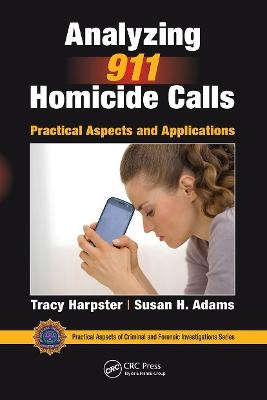
Analyzing 911 Homicide Calls
CRC Press (Verlag)
978-0-367-77909-2 (ISBN)
This book provides police investigators and homicide detectives with a practical method of analyzing 911 homicide calls to uncover the truth. A structured analysis of 911 homicide calls can directly aid in developing investigative leads, planning interviews, and solving cases. Case examples provide practice in analyzing calls to determine the likelihood of the caller’s innocence or guilt. Every member of the investigative team, from call-taker to first responder, investigator, coroner’s investigator, and prosecutor, can contribute to the success of investigations through their knowledge of 911 call analysis.
Deputy Chief Tracy Harpster has served with the Moraine Police Department in Ohio since 1984. He has worked as a street officer, undercover narcotics officer, Sergeant, Detective Sergeant, Operations Lieutenant and Deputy Chief. From 2002-2005, Deputy Chief Harpster was a Task Force Director in the Ohio Organized Crime Investigations Commission, investigating large scale RICO, theft, money laundering and gambling crimes. From 2005-2007, he was assigned to the FBI Joint Terrorism Task Force in Dayton, Ohio. From 2007 to 2011 Deputy Chief Harpster was the director of the Tactical Crime Suppression Unit Narcotics Task Force. Deputy Chief Harpster received a B.S. in Criminal Justice from Bowling Green State University and is a graduate of the 216th Session of the Federal Bureau of Investigation National Academy, Quantico, VA. In 2006, Deputy Chief Harpster achieved a Graduate Degree from the University of Cincinnati where his Master’s Thesis examined the indicators of innocence and guilt of 911 homicide callers reporting the offense. Deputy Chief Harpster is a member of the Vidocq Society, a crime-solving organization that meets monthly at the Union League of Philadelphia. Members of the Vidocq Society apply their collective forensic skills and experience to "cold case" homicides and unsolved deaths. V.S.M.'s donate their deductive and scientific talents for the common good. Dr. Susan Adams, a retired FBI Agent, is an international speaker and author in Investigative Interviewing Techniques. She has taught in Vienna, Prague, Edinburgh, Ottawa, Toronto, and throughout the United States. Her work appears in over a dozen international journals, books and law enforcement publications. As an instructor at the FBI Academy, Dr. Adams supervised the FBI Academy Unit responsible for teaching Investigative Interviewing and Statement Analysis to National Academy police officers and FBI Agents. She currently teaches Criminal Justice at the Graduate School of the University of Maryland University College. Dr. Adams earned her Ph.D. in Human Development from Virginia Tech and received the University of Virginia’s Jefferson Award for Excellence in Research for her study examining indicators of veracity and deception in written statements provided to law enforcement. She serves as a member of the Vidocq Society, a non-profit group of forensic professionals who offer their services to help solve cold case homicides.
Dedication
Acknowledgements
Authors’ Note
Foreword
Part 1: Introduction
Chapter One: The Critical Value of 911 Call Analysis
Chapter Two: Case Study: Mr. and Mrs. Hunt
Part 2: Who Is the Call About?
Chapter Three: Does the Caller Demand Help?
Chapter Four: Does the Caller Provide an Immediate Assessment of the Victim?
Chapter Five: Who is the Caller’s Focus?
Chapter Six: Does the Caller Accept the Victim’s Death?
Chapter Seven: Does the Caller Provide Aid to the Victim as Directed?
Part 3: What is the Call About?
Chapter Eight: Is the Information Relevant?
Chapter Nine: How Does the Caller Describe the Situation?
Chapter Ten: How Does the Caller Prioritize the Information?
Chapter Eleven: How Does the Caller Describe the Conditions?
Part 4: How is the Call Made?
Chapter Twelve: Does the Caller Express Urgency or No Urgency?
Chapter Thirteen: Is the Caller Fearful?
Chapter Fourteen: Is the Caller in Close Proximity to the Victim?
Chapter Fifteen: Does the Caller Begin with Initial Sounds or Initial Delays?
Chapter Sixteen: Does the Caller Use Aggressive Demands or Passive Defenses?
Chapter Seventeen: Does the Caller Show Cooperation with Dispatcher or Resistance to Dispatcher?
Part 5: Independent Guilty Indicators
Chapter Eighteen: Attempts to Convince
Chapter Nineteen: Awkward Phrases
Chapter Twenty: Conflicting Facts
Chapter Twenty-One: "Huh?" Factor
Chapter Twenty-Two: "I Don’t Know"
Chapter Twenty-Three: Isolated "Please"
Chapter Twenty-Four: Lack of Contractions
Chapter Twenty-Five: No Modulation
Chapter Twenty-Six: Unexplained Knowledge
Chapter Twenty-Seven: Indicators Trending Toward Guilty
Part 6: The Big Picture
Chapter Twenty-Eight: Does the Call Match the Scene?
Chapter Twenty-Nine: Create a Timeline: Murder Does Not Happen in a Vacuum
Part 7: 911 Analysis Tips for the Law Enforcement Team
Chapter Thirty: 911 Analysis Tips for Dispatchers
Chapter Thirty-One: 911 Analysis Tips for Patrol Officers
Chapter Thirty-Two: 911 Analysis Tips for Investigators
Chapter Thirty-Three: 911 Analysis Tips for Prosecutors
Chapter Thirty-Four: Case Studies
Epilogue
Appendices
Appendix A: Case Study Analyses
Appendix B: Glossary of Terms
Index
| Erscheinungsdatum | 06.04.2021 |
|---|---|
| Reihe/Serie | Practical Aspects of Criminal and Forensic Investigations |
| Verlagsort | London |
| Sprache | englisch |
| Maße | 156 x 234 mm |
| Gewicht | 453 g |
| Themenwelt | Naturwissenschaften ► Biologie |
| Recht / Steuern ► Strafrecht ► Kriminologie | |
| Sozialwissenschaften | |
| ISBN-10 | 0-367-77909-9 / 0367779099 |
| ISBN-13 | 978-0-367-77909-2 / 9780367779092 |
| Zustand | Neuware |
| Informationen gemäß Produktsicherheitsverordnung (GPSR) | |
| Haben Sie eine Frage zum Produkt? |
aus dem Bereich