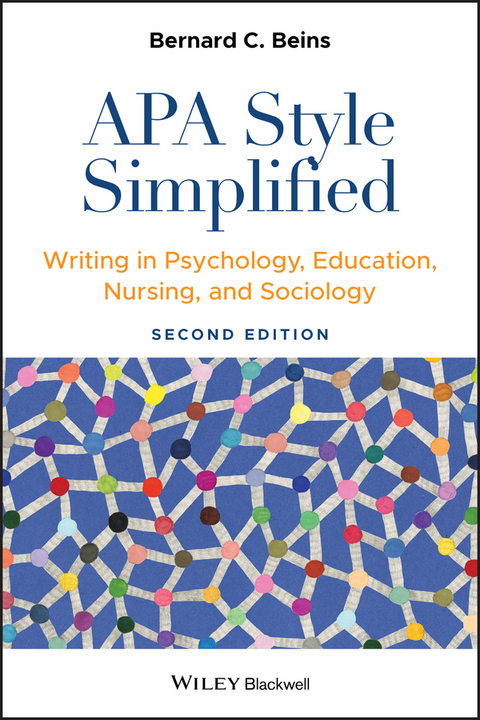
APA Style Simplified (eBook)
224 Seiten
Wiley-Blackwell (Verlag)
9781119745297 (ISBN)
Master the fundamentals of 7th Edition APA style with this newly updated one-step resource
The newly and thoroughly revised Second Edition of APA Style Simplified: Writing in Psychology, Education, Nursing, and Sociology delivers a concise but comprehensive guide to writing clearly and effectively in APA style. It incorporates fresh guidelines from the Seventh Edition of the APA publication manual.
Distinguished psychologist, academic, and author Dr. Bernard C. Beins walks readers through how to write objective scientific research papers using engaging prose. He explains how to develop ideas, connect them to what others have written, and express them clearly. The book also describes the differences between written, oral, and poster presentations and offers instructions for applying APA style to each one.
APA Style Simplified: Writing in Psychology, Education, Nursing, and Sociology 2nd Edition goes beyond mere structural conventions and teaches readers the importance of choosing effective wording, the right and wrong times to use technical language, and avoiding commonly encountered mistakes in word and sentence selection. The author also includes sections on:
- How to write an engaging and informative introduction, including an interesting hypothesis
- How to describe your chosen experimental method, including participants and subjects, materials and apparatus selection, procedure, and design
- How to effectively communicate statistics and statistical concepts by keeping your mind on the point you're trying to make
- How to show your results and relate them back to your hypothesis, including a few points about how to present your results to others
Perfect for students pursuing psychology, education, nursing, or sociology programs at any level, from undergraduate to postgraduate, APA Style Simplified also belongs on the bookshelves of working professionals in the same fields who hope to sharpen their APA-style writing, communication, and presentation skills.
Bernard C. Beins, PhD, is Professor of Psychology at Ithaca College, New York. He is the recipient of the Charles L. Brewer Distinguished Teaching of Psychology Award from the American Psychological Foundation. He has served as president of the Society for the Teaching of Psychology, the Eastern Psychological Association, and the New England Psychological Association. He is a Fellow of the American Psychological Association, Association for Psychological Science, Eastern Psychological Association, and New England Psychological Association.
Bernard C. Beins, PhD, is Professor of Psychology at Ithaca College, New York. He is the recipient of the Charles L. Brewer Distinguished Teaching of Psychology Award from the American Psychological Foundation. He has served as president of the Society for the Teaching of Psychology, the Eastern Psychological Association, and the New England Psychological Association. He is a Fellow of the American Psychological Association, Association for Psychological Science, Eastern Psychological Association, and New England Psychological Association.
???????????????????????????????????????????????????????????????????????????????????????APA Style Simplified? 2
Contents 6
Preface to the Second Edition 10
Preface to the First Edition 12
1. Writing Professionally 16
How Does Professional Writing Differ from Other Kinds of Writing? 18
Using APA Style 19
Making a Credible Argument 20
Different Types of Communication 21
Effective Communication 23
Establishing Good Writing Habits 24
Ethical Writing 25
2. Elements of Style 30
Recognizing the Importance of Good Grammar and Style 31
Choosing Effective Wording 32
Using Inclusive and Appropriate Language 34
Deciding on the Use of Technical Language 36
Avoiding Common Problems 37
Verb Forms 40
Spelling 41
Specific Word Use 43
3. The Introduction Section 46
Introducing the Topic 47
Different Approaches to Starting the Introduction 47
How to Begin 50
Reviewing What Others Have Already Done 51
Reasons for Reviewing the Literature 52
Clarifying Terms in the Research 52
Introducing Your Research: Generating a Hypothesis 53
4. The Method Section 56
Participants and Subjects 57
Materials and Apparatus 65
Procedure 67
Design 68
5. Communicating Statistics 70
Why Do We Use Statistics? 71
What Point Are You Trying to Make? 72
Understanding Your Numbers 73
Helping Readers Understand Your Statistics 76
Differentiating Results and Interpretations 79
6. The Results 80
Your Hypotheses 81
Deciding What to Present 82
Reporting Significant and Nonsignificant Results 83
Marginally Significant Effects 85
APA Style and Presentation of Your Results 86
Creating Tables 89
Creating Figures 93
The Connection between the Text and the Tables and Figures 97
The Difference between Results and Discussion Sections 99
Some Final Points about Presenting Results 100
7. The Discussion Section 104
Summarizing Your Results 105
Connecting Different Aspects of Your Results 106
Dealing with Nonsignificant Results 107
Comparing Your Results with Those of Others 108
State the Importance and Implications of Your Results 109
Acknowledging the Limitations of Your Study 110
8. References: Citations in the Text and the Reference List 112
Citing References in the Text 113
Order of Citations in the Reference List 116
Using Your Word Processing Program to Create the Citation 117
Examples of How Different Types of References Should Be Laid Out in a Reference List 117
9. Final Touches: The Abstract and Formatting Details 128
The Abstract 129
Formatting Details 130
10. Creating Poster Presentations 150
Differentiating Visual and Written Communication 150
Reducing the Amount of Information 151
Visual Style 152
Your Behavior: The Ethic of a Poster Session 155
Creating Your Poster Using Powerpoint© 158
11. Giving Oral Presentations 164
The Difference between Oral and Written English 164
Adapting APA Style to Oral Presentations 168
Preparing for Your Talk 168
Creating Graphics for Your Presentation 170
Giving the Presentation 171
12. Presenting Your Work on the Internet 174
New Capabilities with Internet Publication 175
Using a Word Processor to Create Manuscripts for the Internet 176
Advantages of Internet Publishing Software 179
Publishing Your Poster on the Web 180
Uploading Your Manuscript to the Internet 181
Appendix A—Example of APA-Manuscript with Common Errors 182
Appendix B—Corrected APA-Style Manuscript 190
References 199
Name Index 209
Subject Index 211
EULA 226
| Erscheint lt. Verlag | 31.12.2020 |
|---|---|
| Sprache | englisch |
| Themenwelt | Geisteswissenschaften ► Psychologie ► Allgemeines / Lexika |
| Sozialwissenschaften ► Pädagogik | |
| Schlagworte | apa citation • apa for beginners • apa for dummies • apa guide • apa handbook • apa manual • apa poster presentations • apa presentations • apa reference • apa referencing • apa style • apa textbook • Beins </p> • Bildungswesen • Education • Educational Research & Statistics • <p>APA • nursing • Pädagogik / wissenschaftliche Studien u. Statistik • Psychologie • Psychology • Research Methodologies • Research papers • Sociology • Soziologie • Soziologische Forschungsmethoden |
| ISBN-13 | 9781119745297 / 9781119745297 |
| Informationen gemäß Produktsicherheitsverordnung (GPSR) | |
| Haben Sie eine Frage zum Produkt? |
 PDF (Adobe DRM)
Kopierschutz: Adobe-DRM
Adobe-DRM ist ein Kopierschutz, der das eBook vor Mißbrauch schützen soll. Dabei wird das eBook bereits beim Download auf Ihre persönliche Adobe-ID autorisiert. Lesen können Sie das eBook dann nur auf den Geräten, welche ebenfalls auf Ihre Adobe-ID registriert sind.
Details zum Adobe-DRM
Dateiformat: PDF (Portable Document Format)
Mit einem festen Seitenlayout eignet sich die PDF besonders für Fachbücher mit Spalten, Tabellen und Abbildungen. Eine PDF kann auf fast allen Geräten angezeigt werden, ist aber für kleine Displays (Smartphone, eReader) nur eingeschränkt geeignet.
Systemvoraussetzungen:
PC/Mac: Mit einem PC oder Mac können Sie dieses eBook lesen. Sie benötigen eine
eReader: Dieses eBook kann mit (fast) allen eBook-Readern gelesen werden. Mit dem amazon-Kindle ist es aber nicht kompatibel.
Smartphone/Tablet: Egal ob Apple oder Android, dieses eBook können Sie lesen. Sie benötigen eine
Geräteliste und zusätzliche Hinweise
Buying eBooks from abroad
For tax law reasons we can sell eBooks just within Germany and Switzerland. Regrettably we cannot fulfill eBook-orders from other countries.
aus dem Bereich