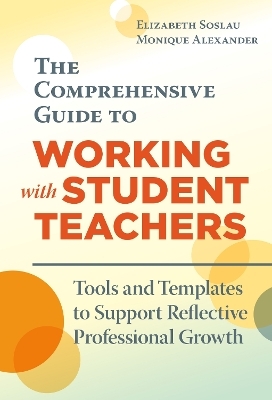
The Comprehensive Guide to Working with Student Teachers
Teachers' College Press (Verlag)
978-0-8077-6494-7 (ISBN)
- Titel z.Zt. nicht lieferbar
- Versandkostenfrei
- Auch auf Rechnung
- Artikel merken
This is a must-have resource for clinical and field experience coordinators and all educators who find themselves in the position of guiding teacher candidates. The authors provide a comprehensive toolkit for the complex work of field instruction, including mentoring approaches; conversation stems; conferencing techniques; lesson debriefing questions; understandings of programmatic goals; observation, assessment, and feedback methods; and more. They also demonstrate how to use video viewing and conferencing to adapt support for candidate growth in digital environments. The book clearly defines what field instruction entails and show how to move from a pre-prescribed technical approach toward one that fosters candidates' abilities to embody the roles of empowered, self-directed, and agentic teachers. With the help of this text, new and seasoned teacher educators will guide candidates to not only learn how to meaningfully reflect on practice, but also internalize these competencies for their own future professional development and continuous self-improvement. Chapters are accessibly written and filled with concrete examples, tips, worksheets, and activities. Book Features:
Clear directions, tools, templates, and protocols for how to do the job of field instruction.
A "Voices from the Field" chapter with practical advice from field instructors across multiple programs.
Annotated sample conversation with candidates.
Elizabeth Soslau is associate professor of education at the University of Delaware. Monique Alexander is assistant professor of elementary and early childhood education at Slippery Rock University.
Contents
Acknowledgments xi
Introduction 1
Focus on Empowerment 2
Social Justice and Equity 3
How Do I UseThis Book? 5
1. What Is Field Instruction? 11
Field Instructor or Supervisor: What’s In a Name? 11
Purpose of Field Instruction 12
Necessary Conditions to Support Candidate Learning 15
“Seeing” Growth Competence, Collaborative Expertise, and Adaptive Teaching Expertise 17
2. Roles and Responsibilities: Bridging the PK12–University Divide 19
Introduction 19
Key Roles and Responsibilities of Field Instructors 19
Field Instructor as Coach 21
Field Instructor as Broker 25
Field Instructor as Humanizing Pedagogue 30
3. Orienting Your Teacher Candidate to Student Teaching 34
Introduction 34
Pitfall 1: Candidate Does Not See the Practicum as a Course Governed by Clear Expectations 34
Pitfall 2: Candidate Believes the Myth That Teachers Are “Born to Be Great” 43
Pitfall 3: Candidate Is Overwhelmed Before the Experience Starts 48
Pitfall 4: Candidate Makes Assumptions About the School and the Surrounding Community 51
Pitfall 5: Candidate Does Not Feel a Sense of Belonging 56
Pitfall 6: Candidate’s Decisionmaking Is Unprofessional 58
Pitfall 7: Candidate’s Communication Is Unprofessional 61
4. Helping Candidates Audit and Explore Their Professional Emotional Needs 65
Introduction 65
Wait, I’m Not a Mental Health Counselor.
I’m Not Qualified to Unpack Emotions With My Candidate! 65
Teacher Candidates’ Professional Emotional Needs 66
Okay, I’m With You. So, How Do I Do That? 67
Really Though, How Important Is Unpacking Emotionality? It Feels Too Touchy- Feely 71
What Are You Talking About? I Need an Example! 73
Wow, That Sounds Great, But I Don’t Have Time for All That 78
5. Tools for Observation 82
Introduction 82
From the “Trip Sheet”’ to the Framework: Paradigm Shifts in Field Instruction 82
Getting Started: The Pre-Observation Conference 84
Selecting an Observation Instrument 85
6. Post-Observation Debriefing Conference 99
Introduction 99
What Do Candidates Learn From My Feedback? 100
One-on-One Conferencing After Observing a Lesson 104
The Protocol: A Living, Breathing, and Ever-Changing Document 106
7. Assessing Lesson Effectiveness 119
Introduction 119
The Problem With University-Based Evaluation Forms for Summative Evaluation 120
The Problem With University-Based Evaluation Forms for Formative Evaluation 122
Improvement Plan Document 124
Advice for Balancing Your Roles: Evaluative Gatekeeper and Instructor 124
Advice for Communicating About the Value of University-Based Scores and Ratings 127
8. Video-Based Debriefing Tools for Virtual and Face-to-Face Placements 128
Introduction 128
Candidates Can Complete Pre-Orientation Preparation Work Online 128
Parallel Conferencing 130
Okay, I’m Convinced. How Do I Do It? 131
How to Conduct a Parallel Conference 133
Remote Field Instruction: Recorded Teaching Without Live Pupils 136
Remote Field Instruction: Recorded Teaching 141
9. Voices From the Field 148
Introduction 148
When the Student Becomes the Teacher: A Less Than Ideal Clinical Educator 149
How Did It Go? Great! Uh Oh, No It Did Not: Candidates Lack of Focus on Pupil Learning 150
A Lesson in Communication: Candidates’ Use of Problematic Langauge 151
Mentoring Mismatch: Navigating Ill-Paired Partnerships (CE/TC Dyads) 151
When Supportive Accommodations Are Insufficient: Two Tales 153
Never Underestimate the Power of Belonging: Advocating for Candidates’ Inclusion in the School Community 155
When Good Teaching Is Not Enough: Problematic Performance Assessments 156
Community Immersive Field Placements: Reeducation of Candidates 157
10. Finding Your Voice 159
Introduction 159
Developing Inquiry as Stance 160
Unpacking My Personal Theories of Field Instruction 162
Deepening Your Understanding of Self Through Self-Study 162
Getting Started With Self-Study 164
Preparing for the Self-Study Journey 164
Defining Your Inquiry 165
Identifying Critical Friends for Your Inquiry Journey 165
Collecting and Making Sense of Evidence During Your Self-Study:
Assessing, Planning, Implementing, and Evaluating 167
Why Is Developing Your Voice Through Self-Study Important? 169
References 171
Index 179
About the Authors 189
| Erscheinungsdatum | 06.04.2021 |
|---|---|
| Verlagsort | New York |
| Sprache | englisch |
| Maße | 175 x 254 mm |
| Gewicht | 375 g |
| Themenwelt | Sozialwissenschaften ► Pädagogik ► Schulpädagogik / Grundschule |
| ISBN-10 | 0-8077-6494-9 / 0807764949 |
| ISBN-13 | 978-0-8077-6494-7 / 9780807764947 |
| Zustand | Neuware |
| Informationen gemäß Produktsicherheitsverordnung (GPSR) | |
| Haben Sie eine Frage zum Produkt? |
aus dem Bereich