


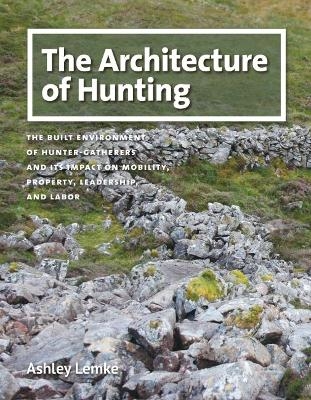
The Architecture of Hunting
The Built Environment of Hunter-Gatherers and Its Impact on Mobility, Property, Leadership, and Labor
Seiten
2022
Texas A & M University Press (Verlag)
978-1-62349-922-8 (ISBN)
Texas A & M University Press (Verlag)
978-1-62349-922-8 (ISBN)
- Titel z.Zt. nicht lieferbar
- Versandkostenfrei
- Auch auf Rechnung
- Artikel merken
As one of the most significant economic innovations in prehistory, hunting architecture radically altered life and society for hunter-gatherers. The development of these structures indicates that foragers designed their environments, had a deep knowledge of animal behavior, and interacted with each other in complex ways that reach beyond previous assumptions.Combining underwater archaeology, terrestrial archaeology, and ethnographic and historical research, The Architecture of Hunting investigates the creation and use of hunting architecture by hunter-gatherers. Hunting architecture-including blinds, drive lanes, and fishing weirs-is a global phenomenon found across a broad spectrum of cultures, time, geography, and environments. Relying on similar behaviors in species such as caribou, bison, guanacos, antelope, and gazelles, cultures as diverse as Sami reindeer herders, the Inka, and ancient bison hunters on the North American plains have employed such structures, combined with strategically situated landforms, to ensure adequate food supplies while maintaining a nomadic way of life.
Using examples of hunting architecture from across the globe and how they influence forager mobility, territoriality, property, leadership, and labor aggregation, Ashley Lemke explores this architecture as a form of human niche construction and considers the myriad ways such built structures affect hunter-gatherer lifeways. Bringing together diverse sources under the single category of 'hunting architecture,' The Architecture of Hunting serves as the new standard guide for anyone interested in hunter-gatherers and their built environment.
Using examples of hunting architecture from across the globe and how they influence forager mobility, territoriality, property, leadership, and labor aggregation, Ashley Lemke explores this architecture as a form of human niche construction and considers the myriad ways such built structures affect hunter-gatherer lifeways. Bringing together diverse sources under the single category of 'hunting architecture,' The Architecture of Hunting serves as the new standard guide for anyone interested in hunter-gatherers and their built environment.
Ashley Lemke, an assistant professor of anthropology at the University of Texas at Arlington, is the editor of Foraging in the Past: Archaeological Studies of Hunter-Gatherer Diversity and coeditor of Caribou Hunting in the Upper Great Lakes: Archaeological, Ethnographic, and Paleoenvironmental Perspectives. She resides in Fort Worth, Texas.
| Erscheinungsdatum | 10.03.2022 |
|---|---|
| Reihe/Serie | Peopling of the Americas Publications |
| Zusatzinfo | 106 colour, 7 b&w photos, 17 line art, 8 maps, 45 tables |
| Verlagsort | College Station |
| Sprache | englisch |
| Maße | 218 x 281 mm |
| Gewicht | 928 g |
| Themenwelt | Geisteswissenschaften ► Archäologie |
| Sozialwissenschaften ► Ethnologie | |
| Sozialwissenschaften ► Soziologie | |
| ISBN-10 | 1-62349-922-4 / 1623499224 |
| ISBN-13 | 978-1-62349-922-8 / 9781623499228 |
| Zustand | Neuware |
| Informationen gemäß Produktsicherheitsverordnung (GPSR) | |
| Haben Sie eine Frage zum Produkt? |
Mehr entdecken
aus dem Bereich


aus dem Bereich
maternal health science and the reproduction of harm
Buch | Softcover (2024)
University of California Press (Verlag)
CHF 52,35
long-lasting legacies of colonialism and nationalism in Israel, …
Buch | Softcover (2025)
Vernon Press (Verlag)
CHF 109,95


