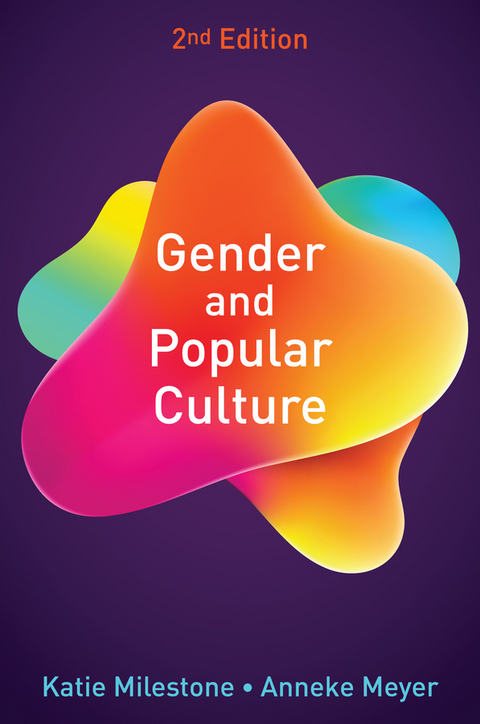
Gender and Popular Culture (eBook)
John Wiley & Sons (Verlag)
978-0-7456-9830-4 (ISBN)
Blending primary and secondary research, Milestone and Meyer introduce key theories and concepts in gender studies and popular culture, which are made accessible and interesting through their application to topical examples such as the #MeToo campaign, intensive mothering and social media, discourses about women and binge drinking, and gender and popular music.
Included in this revised edition is a new chapter on digital culture, examining the connection between digital platforms and gender identities, relations and activism, as well as a new chapter on cultural work in digital contexts. All chapters have been updated to acknowledge recent changes in gender images and relations as well as media culture. Additionally, there is new material on the Fourth Wave Women's Movement, audiences and prosumers, and the role of social media.
Gender and Popular Culture is the go-to textbook for students of gender studies, media and communication, and popular culture.
Katie Milestone is Senior Lecturer in the Department of Sociology at Manchester Metropolitan University.
Anneke Meyer is Principal Lecturer in the Department of Sociology at Manchester Metropolitan University.
This fully updated second edition of Gender and Popular Culture examines the role of popular culture in the construction of gendered identities in contemporary society. It draws on a wide range of cultural forms including popular music, social media, television and magazines to illustrate how femininity and masculinity are produced, represented, used and consumed. Blending primary and secondary research, Milestone and Meyer introduce key theories and concepts in gender studies and popular culture, which are made accessible and interesting through their application to topical examples such as the #MeToo campaign, intensive mothering and social media, discourses about women and binge drinking, and gender and popular music. Included in this revised edition is a new chapter on digital culture, examining the connection between digital platforms and gender identities, relations and activism, as well as a new chapter on cultural work in digital contexts. All chapters have been updated to acknowledge recent changes in gender images and relations as well as media culture. Additionally, there is new material on the Fourth Wave Women's Movement, audiences and prosumers, and the role of social media. Gender and Popular Culture is the go-to textbook for students of gender studies, media and communication, and popular culture.
Katie Milestone is Senior Lecturer in the Department of Sociology at Manchester Metropolitan University. Anneke Meyer is Principal Lecturer in the Department of Sociology at Manchester Metropolitan University.
Acknowledgements
1 Introduction
PART I: GENDER AND THE PRODUCTION OF POPULAR CULTURE
2 Gender and Cultural Work: Post-War to the Late Twentieth Century
3 Gender and Cultural Work in the Digital Age
PART II: DISCOURSES, GENDER AND POPULAR CULTURE
4 Discourses and Femininity
5 Discourses and Masculinity
PART III: MEDIA AND DIGITAL CULTURE, GENDER AND POWER
6 Consumer Culture, Audiences and Identity
7 Digital Culture, Social Media and Gender
8 Gender and Popular Culture in Everyday Spaces
9 Conclusion: Prisoners of Gender?
References
Index
?The second edition of this useful volume broadens its already expansive terrain and impressive list of examples to include up-to-the minute developments particularly in digital and social media. This heightens its relevance and readability for those who want to develop a better understanding of critical media studies through a gendered lens.?
Diane Negra, University College Dublin
?Offering an extensive overview of the gendered experience cultural production (including digital performativity and labour), representation and media discourse, and lived lives, Gender and Popular Culture remains essential reading for scholars and students of contemporary culture.?
Susan Luckman, University of South Australia
2
Gender and Cultural Work: Post-War to the Late Twentieth Century
Cultural production is an area that has been frequently overlooked by media and cultural studies researchers but one that provides much material and evidence for discussions about gender, power and inequality. We begin this chapter by highlighting the dominant concerns in media and cultural studies research since the 1940s, when this type of research began to gain momentum. We will demonstrate that the area of cultural work/ers is one that seems to have evaded the concerns of most media scholars. In the vast body of work on media and popular culture there are remarkably few qualitative studies of creative businesses and the experiences of workers within these organizations. However, the area of cultural work is a rich terrain in terms of discussing gender politics in the workplace and the gendering of creativity and cultural production. There is a large body of theoretical work on media audiences, genres, media texts and representation, but markedly less research on the individuals and groups who actually make media and culture.
Early studies of popular culture tended to concentrate on examining ‘what the media do to people’ rather than ‘what people do with the media’ (Halloran 1970). A range of perspectives, from the ideas of the Frankfurt School through to the ‘media effects’ approach, assumed that consumers/audiences were passive dupes willingly accepting the ideologies encoded in cultural products. The Frankfurt School saw the ‘culture industry’ as an agent of capitalism – destroying radical possibilities by distracting the masses with mindlessly insipid popular culture. The ‘culture industry’ played a vital role in the new system of monopoly capitalism and its exploitation of the working class. Adorno and Horkheimer (1993) argued that popular culture, especially that emerging from America, was being used to control modern workers both at work and during their leisure time. Culture, like other goods, was being produced along Fordisttype mass production techniques, rendering it bland and standardized. Adorno and Horkheimer looked at a range of examples from the newly emerging popular culture of the period – film, radio and popular music – to illustrate their arguments. Crucially for them and for other Marxist thinkers, not only were these cultural products dull and unchallenging, they were also laden with ideological messages all aimed at securing a compliant workforce of willing consumers.
Furthermore, as Marxist feminists argue, there are ideologies about gender that are engrained in popular culture that also contribute to the success of capitalism. Marxist feminists argue that for capitalism to work efficiently there needs to be a gendered division of labour – women need to produce the workforce and nurture them so they are fit to work, and men need to work. It is therefore in the interest of capitalism to reinforce ideologies about the ‘naturalness’ of gender roles and to imply that there are universal qualities of masculinity and femininity that neatly assign men and women to their rightful place in the world. The opposing argument is that there is nothing natural about gender roles: we have been brainwashed to believe that they are so, dutifully accepting our roles and contribution to the capitalist system, whereas in fact these roles are cultural constructs. These theories about the media were developed by analysing structural patterns of inequality. In this early work on ideology and media/popular culture there was an absence of in-depth research on both cultural producers and cultural consumers, although many assumptions were made about producers as agents of capitalist ideologies and consumers as willing believers. As Mark Banks notes, views about the ideological force of the culture industry were not informed by empirical research: ‘[W]hile Marcuse often wrote about the alienating effects of labour, his observations that work “cripples all human faculties and enjoins satisfaction” … and that industrial production instils a “drugging rhythm” … were not backed by substantive empirical observations’ (2007: 25). Of course, we must consider the context in which the arguments of the Frankfurt School were located, which was in an era that saw the rise of fascism and the highly effective mobilization of popular culture by the fascists as a powerful ideological tool.
As with the work of the Frankfurt School, the ‘media effects’ theories of the 1950s and 1960s were also based on the premise that the relationship between cultural products and consumers was a ‘one-way street’. It was not until the 1970s that an emphasis on exploring active, as opposed to passive, consumption began to emerge. Inspired by Antonio Gramsci’s work on hegemony, cultural theorists including Stuart Hall (1980), David Morley (1986) and Janice Radway (1984) championed an analysis of cultural consumption that acknowledged the agency of the audience. This kind of emphasis on consumption was in response to an absence of audience-focused research in earlier media and cultural studies work. New work on cultural consumption challenged standard assumptions, and in-depth qualitative research was undertaken with audiences in order to demonstrate the multifarious ways that consumers interpreted and resisted the messages they were receiving. Stuart Hall’s (1980) encoding/decoding model, and subsequent work by Charlotte Brunsdon and David Morley (1978) paved the way for a new body of work that emphasized the fact that consumption needs to be located in the context of the consumer’s identity, gender, race, social class, and so on. In particular, the emphasis on consumption came from a number of feminist academics, and their important work is highlighted later in this book. The possibility of pleasurable readings of ‘low’ popular culture also became increasingly acknowledged (e.g. Fiske 1989a; Radway 1984). Rather than dismissing women’s cultural consumption as unworthy and assuming the effects of the media upon them, researchers gave women the space to articulate their negotiations with popular culture. The type of material studied within the paradigm of women’s genres – soap opera, romance fiction, lifestyle magazines – was labelled as ‘low’ culture. Highlighting Celia Lury’s work (1993), Sue Thornham notes:
The high culture/low culture divide … is a thoroughly gendered one, corresponding to a division between mainstream cultural activity and public professionalism on the one hand, and a critically marginalized, privatized and less ‘original’ form of production on the other … Thus the ‘feminization’ of ‘mass’ cultural forms (the romance novel, the woman’s magazine), in opposition to ‘authored’ writing, does not simply reflect gendered social divisions. It also helps construct notions of the feminine, which align it with commodification, standardization and passivity, and which maintain it within the sphere of the private, understood as subordinate, emotional and domestic. (2007: 13)
It is not surprising that feminist academics focused on women’s consumption, as this was the principal – indeed almost the only – way that women were linked to popular culture. As we shall see below, women were hugely underrepresented in the realm of cultural production.
While not wishing to undermine the importance of audience ethnographies and the active consumer approach, we also want to encourage an analysis of gender and popular culture that looks at cultural production. We seek to examine cultural work – cultural jobs in the creative (Hartley 2005) or cultural industries (see Hesmondhalgh 2007; O’Connor 2000).
Cultural products do not emerge from a value-free vacuum; they are the result of the ideas and imagination of individuals and institutions – each with differing agendas, perspectives, resources, freedoms and constraints. Detailed research into the area of cultural production is a field that has frequently been overlooked, but one that we argue is vital to consider in terms of the entire complex cultural circuit of production, representation and consumption. Cultural work is a field that reveals massive inequalities in terms of gender and power, yet, as Banks argued, ‘cultural workplace studies remain rare’ (2007: 26). This is starting to change and a growing body of creative production studies have emerged in the past decade (see Banks 2009 and Erigha 2019). In this chapter we will look at a series of case studies of cultural industries and cultural producers and consider what role gender has to play in the dynamics of cultural production. Quite simply, who is responsible for producing popular culture? Whose ideas, dreams and agendas, are being prioritized? What impact does gender have on the type of cultural products that are circulating in the public domain? What can we make of the anomaly that although women are often described as being more creative than men (apparently using the creative left side of the brain more frequently), the majority of frontline cultural producers are male?
We deal with these questions in two ways. In this chapter we focus on cultural production that has predominantly emanated from large, well-established media and cultural industries – from the pre-digital age (from the post-war period to the late twentieth century). Part of...
| Erscheint lt. Verlag | 22.10.2020 |
|---|---|
| Sprache | englisch |
| Themenwelt | Sozialwissenschaften ► Kommunikation / Medien ► Medienwissenschaft |
| Sozialwissenschaften ► Politik / Verwaltung | |
| Sozialwissenschaften ► Soziologie ► Gender Studies | |
| Schlagworte | Anneke Meyer • Communication • Communication & Media Studies • Communication Studies • Cultural Studies • Digital Media • Frauenforschung • Gender • gender and popular culture • gender identities • Gender Studies • Geschlechterforschung • Identities • Katie Milestone • Kommunikation u. Medienforschung • Kulturwissenschaften • media • media culture • Media Studies • Medienforschung • popular culture • Queer Culture • Sexuality • Social Media • Transgender • women's studies |
| ISBN-10 | 0-7456-9830-1 / 0745698301 |
| ISBN-13 | 978-0-7456-9830-4 / 9780745698304 |
| Informationen gemäß Produktsicherheitsverordnung (GPSR) | |
| Haben Sie eine Frage zum Produkt? |
 EPUB (Adobe DRM)
Kopierschutz: Adobe-DRM
Adobe-DRM ist ein Kopierschutz, der das eBook vor Mißbrauch schützen soll. Dabei wird das eBook bereits beim Download auf Ihre persönliche Adobe-ID autorisiert. Lesen können Sie das eBook dann nur auf den Geräten, welche ebenfalls auf Ihre Adobe-ID registriert sind.
Details zum Adobe-DRM
Dateiformat: EPUB (Electronic Publication)
EPUB ist ein offener Standard für eBooks und eignet sich besonders zur Darstellung von Belletristik und Sachbüchern. Der Fließtext wird dynamisch an die Display- und Schriftgröße angepasst. Auch für mobile Lesegeräte ist EPUB daher gut geeignet.
Systemvoraussetzungen:
PC/Mac: Mit einem PC oder Mac können Sie dieses eBook lesen. Sie benötigen eine
eReader: Dieses eBook kann mit (fast) allen eBook-Readern gelesen werden. Mit dem amazon-Kindle ist es aber nicht kompatibel.
Smartphone/Tablet: Egal ob Apple oder Android, dieses eBook können Sie lesen. Sie benötigen eine
Geräteliste und zusätzliche Hinweise
Buying eBooks from abroad
For tax law reasons we can sell eBooks just within Germany and Switzerland. Regrettably we cannot fulfill eBook-orders from other countries.
aus dem Bereich