


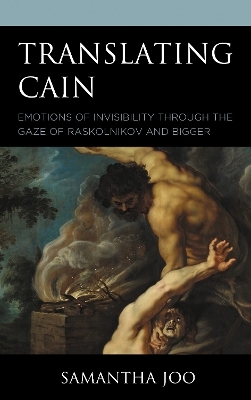
Translating Cain
Emotions of Invisibility through the Gaze of Raskolnikov and Bigger
Seiten
2020
Lexington Books/Fortress Academic (Verlag)
978-1-9787-0984-3 (ISBN)
Lexington Books/Fortress Academic (Verlag)
978-1-9787-0984-3 (ISBN)
In this book, Samantha Joo argues that Cain’s anger and shame in Genesis 4 arise from the social marginalization of the Kenites of whom he functions narratively as an ancestor. In order to understand and experience his emotions, she reads the biblical story through modern analogies from Crime and Punishment and Native Son.
Unless we recognize the cultural context embedded in the Genesis story of Cain and Abel, the significance of Cain’s rejection and consequent violence is often lost in translation. While many interpreters highlight the theme of sibling rivalry to explain Cain’s murderous violence, Samantha Joo relates Cain’s anger and shame to the social marginalization of Kenites in ancient Israel, for whom Cain functions narratively as an ancestor.
To better understand and experience Cain’s emotions in the narrative, Joo provides a method for re-contextualizing an ancient story in modern contexts. Drawing from post-colonial theories of Latin America translators, Joo focuses on analogies which simulate the “moveable event” of a story. She shows that novels like Fyodor Dostoevsky’s Crime and Punishment and Richard Wright’s Native Son, in which protagonists kill to escape their invisibility, capture the “event” of Cain and Abel. Consequently, readers can empathize with the anger and shame resulting from the social marginalization of Cain through the alienation of a poor, ex-university student, Raskolnikov, and the oppression of a young black man, Bigger Thomas.
Unless we recognize the cultural context embedded in the Genesis story of Cain and Abel, the significance of Cain’s rejection and consequent violence is often lost in translation. While many interpreters highlight the theme of sibling rivalry to explain Cain’s murderous violence, Samantha Joo relates Cain’s anger and shame to the social marginalization of Kenites in ancient Israel, for whom Cain functions narratively as an ancestor.
To better understand and experience Cain’s emotions in the narrative, Joo provides a method for re-contextualizing an ancient story in modern contexts. Drawing from post-colonial theories of Latin America translators, Joo focuses on analogies which simulate the “moveable event” of a story. She shows that novels like Fyodor Dostoevsky’s Crime and Punishment and Richard Wright’s Native Son, in which protagonists kill to escape their invisibility, capture the “event” of Cain and Abel. Consequently, readers can empathize with the anger and shame resulting from the social marginalization of Cain through the alienation of a poor, ex-university student, Raskolnikov, and the oppression of a young black man, Bigger Thomas.
Samantha Joo is the academic advisor and adjunct faculty at the Iliff School of Theology.
Chapter 1 Introduction
Chapter 2 Methodology
Chapter 3 Cain and Abel
Chapter 4 Crime and Punishment
Chapter 5 Native Son
Chapter 6 Conclusion
| Erscheinungsdatum | 10.05.2021 |
|---|---|
| Zusatzinfo | 10 b/w photos; |
| Sprache | englisch |
| Maße | 163 x 237 mm |
| Gewicht | 426 g |
| Themenwelt | Religion / Theologie ► Christentum ► Bibelausgaben / Bibelkommentare |
| Religion / Theologie ► Christentum ► Kirchengeschichte | |
| Geisteswissenschaften ► Religion / Theologie ► Judentum | |
| Sozialwissenschaften ► Ethnologie | |
| Sozialwissenschaften ► Soziologie | |
| ISBN-10 | 1-9787-0984-6 / 1978709846 |
| ISBN-13 | 978-1-9787-0984-3 / 9781978709843 |
| Zustand | Neuware |
| Informationen gemäß Produktsicherheitsverordnung (GPSR) | |
| Haben Sie eine Frage zum Produkt? |
Mehr entdecken
aus dem Bereich

aus dem Bereich
Buch | Softcover (2021)
De Gruyter (Verlag)
CHF 44,90


