


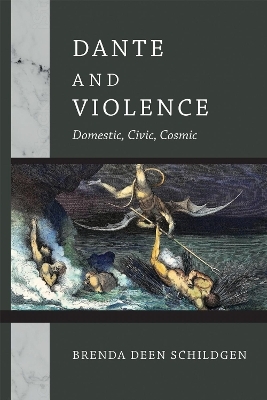
Dante and Violence
Domestic, Civic, Cosmic
Seiten
2021
|
New edition
University of Notre Dame Press (Verlag)
978-0-268-20064-0 (ISBN)
University of Notre Dame Press (Verlag)
978-0-268-20064-0 (ISBN)
This study explores how Dante represents violence in the Comedy and reveals the connection between contemporary private and public violence and civic and canon law violations.
Although a number of articles have addressed particular aspects of violence in discrete parts of Dante's oeuvre, a systematic treatment of violence in the Commedia is lacking. This ambitious overview of violence in Dante's literary works and his world examines cases of violence in the domestic, communal, and cosmic spheres while taking into account medieval legal approaches to rights and human freedom that resonate with the economy of justice developed in the Commedia. Exploring medieval concerns with violence both in the home and in just war theory, as well as the Christian theology of the Incarnation and Redemption, Brenda Deen Schildgen examines violence in connection to the natural rights theory expounded by canon lawyers beginning in the twelfth century. Partially due to the increased attention to its Greco-Roman cultural legacy, the twelfth-century Renaissance produced a number of startling intellectual developments, including the emergence of codified canon law and a renewed interest in civil law based on Justinian's sixth-century Corpus juris civilis. Schildgen argues that, in addition to "divine justice," Dante explores how the human system of justice, as exemplified in both canon and civil law and based on natural law and legal concepts of human freedom, was consistently violated in the society of his era. At the same time, the redemptive violence of the Crucifixion, understood by Dante as the free act of God in choosing the Incarnation and death on the cross, provides the model for self-sacrifice for the communal good. This study, primarily focused on Dante's representation of his contemporary reality, demonstrates that the punishments and rewards in Dante's heaven and hell, while ostensibly a staging of his vision of eternal justice, may in fact be a direct appeal to his readers to recognize the crimes that pervade their own world.
Dante and Violence will have a wide readership, including students and scholars of Dante, medieval culture, violence, and peace studies.
Although a number of articles have addressed particular aspects of violence in discrete parts of Dante's oeuvre, a systematic treatment of violence in the Commedia is lacking. This ambitious overview of violence in Dante's literary works and his world examines cases of violence in the domestic, communal, and cosmic spheres while taking into account medieval legal approaches to rights and human freedom that resonate with the economy of justice developed in the Commedia. Exploring medieval concerns with violence both in the home and in just war theory, as well as the Christian theology of the Incarnation and Redemption, Brenda Deen Schildgen examines violence in connection to the natural rights theory expounded by canon lawyers beginning in the twelfth century. Partially due to the increased attention to its Greco-Roman cultural legacy, the twelfth-century Renaissance produced a number of startling intellectual developments, including the emergence of codified canon law and a renewed interest in civil law based on Justinian's sixth-century Corpus juris civilis. Schildgen argues that, in addition to "divine justice," Dante explores how the human system of justice, as exemplified in both canon and civil law and based on natural law and legal concepts of human freedom, was consistently violated in the society of his era. At the same time, the redemptive violence of the Crucifixion, understood by Dante as the free act of God in choosing the Incarnation and death on the cross, provides the model for self-sacrifice for the communal good. This study, primarily focused on Dante's representation of his contemporary reality, demonstrates that the punishments and rewards in Dante's heaven and hell, while ostensibly a staging of his vision of eternal justice, may in fact be a direct appeal to his readers to recognize the crimes that pervade their own world.
Dante and Violence will have a wide readership, including students and scholars of Dante, medieval culture, violence, and peace studies.
Brenda Deen Schildgen is distinguished professor emerita of comparative literature at the University of California, Davis. Her previous books include Divine Providence: A History; The Bible, Virgil, Orosius, Augustine, and Dante and Dante and the Orient.
Introduction: Violence in the Commedia
1. Freedom, Natural Law, and Love
2. Violence in the Domestic Sphere in the Commedia
3. Killing Fields and the Cross in the Heavens
4. Redemptive Violence: The Cross, Sacrifice, and the "Giusta Vendetta"
Conclusion: Violence, Poetry, and History
| Erscheinungsdatum | 26.03.2021 |
|---|---|
| Reihe/Serie | The William and Katherine Devers Series in Dante and Medieval Italian Literature |
| Zusatzinfo | 7 b&w illustrations - 7 Halftones, black and white |
| Verlagsort | Notre Dame IN |
| Sprache | englisch |
| Maße | 152 x 229 mm |
| Themenwelt | Geisteswissenschaften ► Sprach- / Literaturwissenschaft ► Anglistik / Amerikanistik |
| Geisteswissenschaften ► Sprach- / Literaturwissenschaft ► Literaturwissenschaft | |
| Sozialwissenschaften ► Soziologie | |
| ISBN-10 | 0-268-20064-5 / 0268200645 |
| ISBN-13 | 978-0-268-20064-0 / 9780268200640 |
| Zustand | Neuware |
| Informationen gemäß Produktsicherheitsverordnung (GPSR) | |
| Haben Sie eine Frage zum Produkt? |
Mehr entdecken
aus dem Bereich


aus dem Bereich
Poetik eines sozialen Urteils
Buch | Hardcover (2023)
De Gruyter (Verlag)
CHF 83,90


