


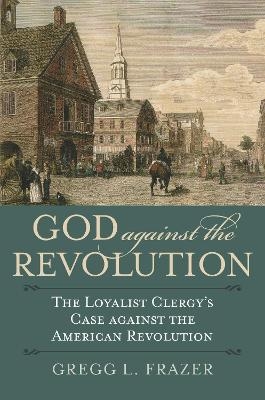
God Against the Revolution
The Loyalist Clergy's Case Against the American Revolution
Seiten
2020
University Press of Kansas (Verlag)
978-0-7006-3058-5 (ISBN)
University Press of Kansas (Verlag)
978-0-7006-3058-5 (ISBN)
We know plenty about the Patriots' cause in the American Revolution. But what about the one-third of the population who opposed independence? Their position is largely missing from our understanding of Revolution-era American political thought. With God against the Revolution, Gregg L. Frazer seeks to close this gap.
Because, it's said, history is written by the victors, we know plenty about the Patriots' cause in the American Revolution. But what about the perhaps one-third of the population who opposed independence? They too were Americans who loved the land they lived in, but their position is largely missing from our understanding of Revolution-era American political thought. With God against the Revolution, the first comprehensive account of the political thought of the American Loyalists, Gregg L. Frazer seeks to close this gap.
Because the Loyalists' position was most clearly expressed by clergymen, God against the Revolution investigates the biblical, philosophical, and legal arguments articulated in Loyalist ministers' writings, pamphlets, and sermons. The Loyalist ministers Frazer consults were not blind apologists for Great Britain; they criticized British excesses. But they challenged the Patriots claiming rights as Englishmen to be subject to English law. This is one of the many instances identified by Frazer in which the Loyalist arguments mirrored or inverted those of the Patriots, who demanded natural and English rights while denying freedom of religion, expression, and assembly, and due process of law to those with opposing views. Similarly the Loyalist ministers' biblical arguments against revolution and in favor of subjection to authority resonate oddly with still familiar notions of Bible-invoking patriotism.
For a revolution built on demands for liberty, equality, and fairness of representation, God against Revolution raises sobering questions-about whether the Patriots were rational, legitimate representatives of the people, working in the best interests of Americans. A critical amendment to the history of American political thought, the book also serves as a cautionary tale in the heated political atmosphere of our time.
Because, it's said, history is written by the victors, we know plenty about the Patriots' cause in the American Revolution. But what about the perhaps one-third of the population who opposed independence? They too were Americans who loved the land they lived in, but their position is largely missing from our understanding of Revolution-era American political thought. With God against the Revolution, the first comprehensive account of the political thought of the American Loyalists, Gregg L. Frazer seeks to close this gap.
Because the Loyalists' position was most clearly expressed by clergymen, God against the Revolution investigates the biblical, philosophical, and legal arguments articulated in Loyalist ministers' writings, pamphlets, and sermons. The Loyalist ministers Frazer consults were not blind apologists for Great Britain; they criticized British excesses. But they challenged the Patriots claiming rights as Englishmen to be subject to English law. This is one of the many instances identified by Frazer in which the Loyalist arguments mirrored or inverted those of the Patriots, who demanded natural and English rights while denying freedom of religion, expression, and assembly, and due process of law to those with opposing views. Similarly the Loyalist ministers' biblical arguments against revolution and in favor of subjection to authority resonate oddly with still familiar notions of Bible-invoking patriotism.
For a revolution built on demands for liberty, equality, and fairness of representation, God against Revolution raises sobering questions-about whether the Patriots were rational, legitimate representatives of the people, working in the best interests of Americans. A critical amendment to the history of American political thought, the book also serves as a cautionary tale in the heated political atmosphere of our time.
Gregg L. Frazer is professor of history and political studies and Dean of the School of Humanities at the Master's University. He is the author of The Religious Beliefs of America's Founders: Reason, Revelation, and Revolution, also from Kansas.
Acknowledgments
1. The Context for the Loyalist Argument
2. Biblical Arguments
3. Theoretical Arguments from the Nature of Government
4. Legal Arguments
5. Rational Arguments Regarding the American Situation
6. Rational Arguments Based on Colonial Actions
Epilogue
Notes
Bibliography
Index
| Erscheinungsdatum | 01.09.2020 |
|---|---|
| Verlagsort | Kansas |
| Sprache | englisch |
| Maße | 152 x 228 mm |
| Gewicht | 389 g |
| Themenwelt | Sachbuch/Ratgeber ► Geschichte / Politik ► Allgemeines / Lexika |
| Geisteswissenschaften ► Geschichte ► Regional- / Ländergeschichte | |
| Geisteswissenschaften ► Religion / Theologie ► Christentum | |
| Sozialwissenschaften ► Politik / Verwaltung ► Politische Systeme | |
| Sozialwissenschaften ► Politik / Verwaltung ► Politische Theorie | |
| ISBN-10 | 0-7006-3058-9 / 0700630589 |
| ISBN-13 | 978-0-7006-3058-5 / 9780700630585 |
| Zustand | Neuware |
| Informationen gemäß Produktsicherheitsverordnung (GPSR) | |
| Haben Sie eine Frage zum Produkt? |
Mehr entdecken
aus dem Bereich



aus dem Bereich
Handbuch zum Lesen des Himmels
Buch | Hardcover (2025)
Harpercollins (Verlag)
CHF 30,80
historische Porträts von George Washington bis Donald Trump
Buch | Softcover (2025)
C.H.Beck (Verlag)
CHF 33,55


