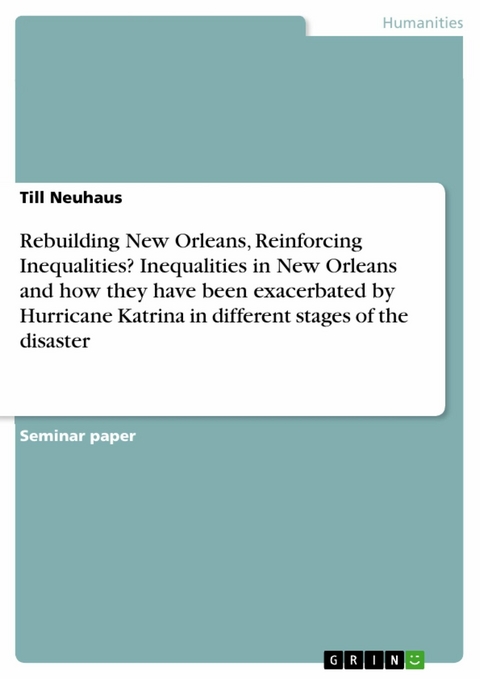
Rebuilding New Orleans, Reinforcing Inequalities? Inequalities in New Orleans and how they have been exacerbated by Hurricane Katrina in different stages of the disaster (eBook)
Some scholars argue that “[c]limate change has become part of high politics”. The scientific community agrees that climate change is partly responsible for the increase of extreme weather phenomena even though climate change’s impact factor cannot be exactly determined. People all around the world are exposed to extreme weather conditions and it can generally be assumed that “[t]here will always be crisis, catastrophes and uncertainty”. People try to lessen the impact of natural hazards and while almost all communities and countries are statistically affected by those hazards, their responses differ massively. One strategy to lessen the impact of those “[r]are, if not unique, and as striking rarely and without warning” phenomena is migration. “Environmental migration is not a new phenomenom. [...] However, global climate change threatens to significantly increase human movement, both within states and across international borders”.
A lot of research has been dedicated to identifying and differentiating between mitigation and adaption strategies, however, less attention has been invested into the resettlement of and in urban areas. Further, it should be noticed that due to the on-going trend of urbanization, the city as a matter of analysis of climate-induced migration will steadily gain importance and due to rising sea levels, coastal cities are more affected by climate change and thereby by climate-induced migration than the inland. Even though numbers vary massively depending on the employed definitions concerning climate-induced migration, it can nonetheless be stated that “the populations of coastal megacities have skyrocketed” in the last couple decades and, on the basis of those tendencies, it can be concluded that more people will consequently be affected by climate-related phenomena in the future.
| Erscheint lt. Verlag | 8.6.2020 |
|---|---|
| Verlagsort | München |
| Sprache | englisch |
| Themenwelt | Sozialwissenschaften ► Politik / Verwaltung |
| Sozialwissenschaften ► Soziologie ► Spezielle Soziologien | |
| Schlagworte | climate change migration disaster mitigation hurricane Katrina inequalities inequality race gender |
| ISBN-13 | 9783346177223 / 9783346177223 |
| Informationen gemäß Produktsicherheitsverordnung (GPSR) | |
| Haben Sie eine Frage zum Produkt? |
 PDF (Ohne DRM)
Digital Rights Management: ohne DRM
Dieses eBook enthält kein DRM oder Kopierschutz. Eine Weitergabe an Dritte ist jedoch rechtlich nicht zulässig, weil Sie beim Kauf nur die Rechte an der persönlichen Nutzung erwerben.
Dateiformat: PDF (Portable Document Format)
Mit einem festen Seitenlayout eignet sich die PDF besonders für Fachbücher mit Spalten, Tabellen und Abbildungen. Eine PDF kann auf fast allen Geräten angezeigt werden, ist aber für kleine Displays (Smartphone, eReader) nur eingeschränkt geeignet.
Systemvoraussetzungen:
PC/Mac: Mit einem PC oder Mac können Sie dieses eBook lesen. Sie benötigen dafür einen PDF-Viewer - z.B. den Adobe Reader oder Adobe Digital Editions.
eReader: Dieses eBook kann mit (fast) allen eBook-Readern gelesen werden. Mit dem amazon-Kindle ist es aber nicht kompatibel.
Smartphone/Tablet: Egal ob Apple oder Android, dieses eBook können Sie lesen. Sie benötigen dafür einen PDF-Viewer - z.B. die kostenlose Adobe Digital Editions-App.
Buying eBooks from abroad
For tax law reasons we can sell eBooks just within Germany and Switzerland. Regrettably we cannot fulfill eBook-orders from other countries.
aus dem Bereich