


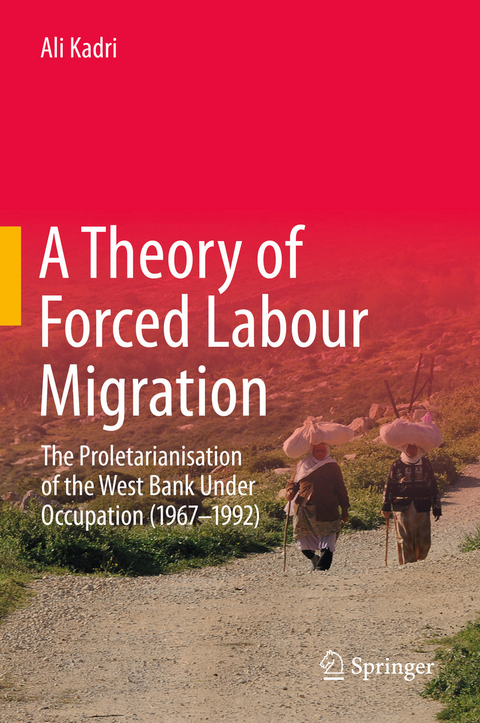
A Theory of Forced Labour Migration (eBook)
XIII, 230 Seiten
Springer Singapore (Verlag)
978-981-15-3200-9 (ISBN)
This book focuses on labour dislocation and migration of Palestinians between 1967 and 1992. In particular, it highlights the social transformations in the occupied Palestinian territory where Palestinian labour was permitted to work in Israel from 1968 onwards. Elaborating on the results of the policy which saw a gradual increase in the number of Palestinian workers commuting daily from a negligible proportion of the actively participating labour force, to 35 percent of all employed persons, and 60 percent of all wage paid workers, the book studies this unique case which embodies characteristics from permanent migration situations not only in the de-jure, but also the de-facto sense; insofar as it embeds higher risks and reallocates resources as if it was a permanent relocation scenario. Illustrated with tables and econometric results, the book identifies the determinants and implications of migrant labour from the West Bank using two broad methodologies: the neoclassical and the historical-structural method. Each of these methods is divided into two branches: the classical divided into price determined and a choice-theoretic framework,and the historical-structural divided into dependency and Marxist theory. In order to gain a comprehensive understanding of the situation, all four perspectives are employed in the investigation. In doing so, what emerges is a structure for the book which takes shape along the different lines of migration literature. The book provides new insights into the making of wage labour and labour migration theory.
| Erscheint lt. Verlag | 2.6.2020 |
|---|---|
| Zusatzinfo | XIII, 230 p. 1 illus. |
| Sprache | englisch |
| Themenwelt | Sozialwissenschaften ► Politik / Verwaltung ► Europäische / Internationale Politik |
| Sozialwissenschaften ► Politik / Verwaltung ► Staat / Verwaltung | |
| Sozialwissenschaften ► Soziologie | |
| Wirtschaft ► Volkswirtschaftslehre ► Makroökonomie | |
| Schlagworte | Arab-Israeli Conflict • Development Economics • Labour Migration • Palestine • Political Economy |
| ISBN-10 | 981-15-3200-1 / 9811532001 |
| ISBN-13 | 978-981-15-3200-9 / 9789811532009 |
| Informationen gemäß Produktsicherheitsverordnung (GPSR) | |
| Haben Sie eine Frage zum Produkt? |
 PDF (Wasserzeichen)
DRM: Digitales Wasserzeichen
Dieses eBook enthält ein digitales Wasserzeichen und ist damit für Sie personalisiert. Bei einer missbräuchlichen Weitergabe des eBooks an Dritte ist eine Rückverfolgung an die Quelle möglich.
Dateiformat: PDF (Portable Document Format)
Mit einem festen Seitenlayout eignet sich die PDF besonders für Fachbücher mit Spalten, Tabellen und Abbildungen. Eine PDF kann auf fast allen Geräten angezeigt werden, ist aber für kleine Displays (Smartphone, eReader) nur eingeschränkt geeignet.
Systemvoraussetzungen:
PC/Mac: Mit einem PC oder Mac können Sie dieses eBook lesen. Sie benötigen dafür einen PDF-Viewer - z.B. den Adobe Reader oder Adobe Digital Editions.
eReader: Dieses eBook kann mit (fast) allen eBook-Readern gelesen werden. Mit dem amazon-Kindle ist es aber nicht kompatibel.
Smartphone/Tablet: Egal ob Apple oder Android, dieses eBook können Sie lesen. Sie benötigen dafür einen PDF-Viewer - z.B. die kostenlose Adobe Digital Editions-App.
Buying eBooks from abroad
For tax law reasons we can sell eBooks just within Germany and Switzerland. Regrettably we cannot fulfill eBook-orders from other countries.


