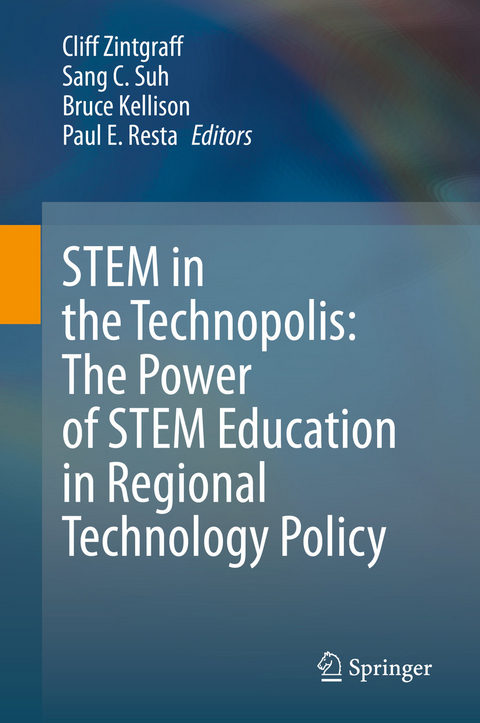
STEM in the Technopolis: The Power of STEM Education in Regional Technology Policy (eBook)
XVIII, 323 Seiten
Springer International Publishing (Verlag)
9783030398514 (ISBN)
This book addresses how forward-thinking local communities are integrating pre-college STEM education, STEM pedagogy, industry clusters, college programs, and local, state and national policies to improve educational experiences, drive local development, gain competitive advantage for the communities, and lead students to rewarding careers. This book consists of three sections: foundational principles, city/regional case studies from across the globe, and state and national context. The authors explore the hypothesis that when pre-college STEM education is integrated with city and regional development, regions can drive a virtuous cycle of education, economic development, and quality of life.
Why should pre-college STEM education be included in regional technology policy? When local leaders talk about regional policy, they usually talk about how government, universities and industry should work together. This relationship is important, but what about the hundreds of millions of pre-college students, taught by tens of millions of teachers, supported by hundreds of thousands of volunteers, who deliver STEM education around the world? Leaders in the communities featured in STEM in the Technopolis have recognized the need to prepare students at an early age, and the power of real-world connections in the process. The authors advocate for this approach to be expanded. They describe how STEM pedagogy, priority industry clusters, cross-sector collaboration, and the local incarnations of global development challenges can be made to work together for the good of all citizens in local communities.
This book will be of interest to government policymakers, school administrators, industry executives, and non-profit executives. The book will be useful as a reference to teachers, professors, industry professional volunteers, non-profit staff, and program leaders who are developing, running, or teaching in STEM programs or working to improve quality of life in their communities.
Dr. Cliff Zintgraff recently completed ten years leading innovation, regional development, and STEM education programs for the IC2 Institute, a think-and-do tank at The University of Texas at Austin. He is now Executive Director of the San Antonio Museum of Science and Technology (SAMSAT), a museum and STEM education center in San Antonio, Texas, U.S. serving 10,000 students a year in education programs working with local government and industry partners. He continues to advance research interests in affiliation with the IC2 Institute. Dr. Zintgraff's core research concerns inquiry learning. He studies the intersection of entrepreneurship, technology commercialization, STEM education, and STEM education's role in regional economic development. Across fifty international trips, he has trained innovators and advised policymakers in Colombia, Portugal, India, Czechia, Germany, the UK, Hungary and Nepal. In his first career, he led software development efforts building medical imaging and secure telecommunications products, and he founded an educational technology company building STEM-focused education products. He holds a B.S. in Computer Science from Trinity University, an M.S. in Technology Commercialization from The University of Texas at Austin, and a Ph.D. in Learning Technologies from the University of North Texas.
Dr. Sang Suh is a Professor of Computer Science at Texas A&M University - Commerce. His primary research interests are in the areas of artificial intelligence, human computer interaction, data mining, knowledge and data engineering, big data and visual analytics. Dr. Suh has over 20 years of experience in scholarly and research activities developing practical industrial applications in the areas of data mining, big data and visual analytics with special focus on convergence in transdisciplinary areas. He has been recognized for his international leadership in building strong computational and transdisciplinary science and education community through the founding of SDPS, a professional society established with the support of the IC2 Institute at the University of Texas at Austin in 1995. SDPS has successfully developed into a world organization, and Dr. Suh has dedicated service in various capacities over 20 years, including international conference host, president, journal editorin-chief, steering committee, and board member.
Dr. Bruce Kellison is Director of the Bureau of Business Research, an applied economic research unit of the IC2 Institute at The University of Texas at Austin that focuses on the competitiveness of Texas industries. He is former editor of Texas Business Review, a bi-monthly journal that disseminated business research to a wide readership of policymakers and business leaders. Under his leadership, the Bureau has won a number of research grants and contracts from a variety of sponsors, including the National Science Foundation, NASA, and the State of Texas. He writes frequently on topics like the economic impact of technology incubators, human trafficking, the barriers facing minority-owned firms in Texas, and regional economic development strategies involving technology and the knowledge economy. He recently served as president of the Association for University Business and Economic Research.
Dr. Paul Resta holds the Ruth Knight Millikan Centennial Professorship in Learning Technology at the College of Education, The University of Texas at Austin. He teaches advanced graduate courses in learning technology, instructional systems design, online learning, technology planning, and computer-supported collaborative learning. His current work focuses on Web-based learning environments, computer-supported collaborative learning, and national planning and policy issues in the use of information and communication technologies in teacher education. Dr. Resta is the Founding President of the International Society for Technology in Education, the world's largest educational technology organization. Dr. Resta currently serves as the President of the International Jury for the UNESCO King Hamad Bin Isa Al-Khalifa Prize for the Use of ICT in Education. He is widely published, and has chaired and served in numerous leading roles exploring learning technology and digital equity worldwide. He has received numerous awards, among them honors from UNESCO, a lifetime achievement award from the Society for Information Technology and Teacher Education, and the Texas State Senate honor of the Texas flag flown over the Capitol Building for outstanding leadership in technology in education within the state.
| Erscheint lt. Verlag | 27.5.2020 |
|---|---|
| Zusatzinfo | XVIII, 323 p. 56 illus., 50 illus. in color. |
| Sprache | englisch |
| Themenwelt | Sozialwissenschaften ► Pädagogik ► Erwachsenenbildung |
| Schlagworte | China • Education • Educational Philosophy • Educational technology • Fundão, Portugal • India • industry clusters • Medellín, Colombia • Mexico • Regional Economic Development • San Antonio • São Carlos, Brazil • smart cities • Steam • stem • STEM professional volunteers • STEM workforce • Taipei, Taiwan • talent pipeline • Technology Policy • Texas, USA |
| ISBN-13 | 9783030398514 / 9783030398514 |
| Informationen gemäß Produktsicherheitsverordnung (GPSR) | |
| Haben Sie eine Frage zum Produkt? |
 PDF (Wasserzeichen)
DRM: Digitales Wasserzeichen
Dieses eBook enthält ein digitales Wasserzeichen und ist damit für Sie personalisiert. Bei einer missbräuchlichen Weitergabe des eBooks an Dritte ist eine Rückverfolgung an die Quelle möglich.
Dateiformat: PDF (Portable Document Format)
Mit einem festen Seitenlayout eignet sich die PDF besonders für Fachbücher mit Spalten, Tabellen und Abbildungen. Eine PDF kann auf fast allen Geräten angezeigt werden, ist aber für kleine Displays (Smartphone, eReader) nur eingeschränkt geeignet.
Systemvoraussetzungen:
PC/Mac: Mit einem PC oder Mac können Sie dieses eBook lesen. Sie benötigen dafür einen PDF-Viewer - z.B. den Adobe Reader oder Adobe Digital Editions.
eReader: Dieses eBook kann mit (fast) allen eBook-Readern gelesen werden. Mit dem amazon-Kindle ist es aber nicht kompatibel.
Smartphone/Tablet: Egal ob Apple oder Android, dieses eBook können Sie lesen. Sie benötigen dafür einen PDF-Viewer - z.B. die kostenlose Adobe Digital Editions-App.
Buying eBooks from abroad
For tax law reasons we can sell eBooks just within Germany and Switzerland. Regrettably we cannot fulfill eBook-orders from other countries.
aus dem Bereich