


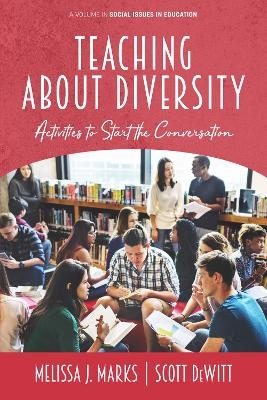
Teaching About Diversity
Activities to Start the Conversation
Seiten
2020
Information Age Publishing (Verlag)
978-1-64802-076-6 (ISBN)
Information Age Publishing (Verlag)
978-1-64802-076-6 (ISBN)
This book provides strategies for secondary and undergraduate students to engage with diversity and social justice. It covers effective pedagogical techniques to help students question assumptions, think critically, and discuss issues like race, religion, gender, and socioeconomic status.
This book offers easily implemented strategies for use with secondary and undergraduate students to promote greater engagement with the realities of diversity and commitment to social justice within their classrooms. Defining diversity broadly, the book provides effective pedagogical techniques to help students question their own assumptions, think critically, and discuss issues within race, religion, ethnicity, gender, sexual orientation, socioeconomic status, and ability.
The K-12 student population is increasingly diverse in terms of race, ethnicity, language, religion, socio-economic status, and family structure. However, the overwhelming majority of teachers continues to come from White, non-urban, middle class backgrounds (Fletcher, 2014; Hughes et al., 2011) These differences can have serious repercussions for student learning. Non-majority students who feel that their culture or background is not acknowledged or accepted at school are likely to disengage from expected academic and social activities (Hughes et al., 2011). Concurrently, the majority students remain unaware of privilege and ignorant of societal systemic discrimination.
In order to teach for social justice, ideas regarding power structure, privilege, and oppression need to be discussed openly. Fear of upsetting students or not knowing how to handle the issue of social justice are commonly heard reasons for not discussing “difficult” subjects (Marks, Binkley, & Daly, 2014). However, when teachers choose not to discuss topics within diversity, students assume that the topics are taboo, dangerous, or unimportant. These assumptions impede students’ abilities to ask important questions, learn how to speak about issues effectively and comprehend the complex challenges woven into current national conversations.
This book offers easily implemented strategies for use with secondary and undergraduate students to promote greater engagement with the realities of diversity and commitment to social justice within their classrooms. Defining diversity broadly, the book provides effective pedagogical techniques to help students question their own assumptions, think critically, and discuss issues within race, religion, ethnicity, gender, sexual orientation, socioeconomic status, and ability.
The K-12 student population is increasingly diverse in terms of race, ethnicity, language, religion, socio-economic status, and family structure. However, the overwhelming majority of teachers continues to come from White, non-urban, middle class backgrounds (Fletcher, 2014; Hughes et al., 2011) These differences can have serious repercussions for student learning. Non-majority students who feel that their culture or background is not acknowledged or accepted at school are likely to disengage from expected academic and social activities (Hughes et al., 2011). Concurrently, the majority students remain unaware of privilege and ignorant of societal systemic discrimination.
In order to teach for social justice, ideas regarding power structure, privilege, and oppression need to be discussed openly. Fear of upsetting students or not knowing how to handle the issue of social justice are commonly heard reasons for not discussing “difficult” subjects (Marks, Binkley, & Daly, 2014). However, when teachers choose not to discuss topics within diversity, students assume that the topics are taboo, dangerous, or unimportant. These assumptions impede students’ abilities to ask important questions, learn how to speak about issues effectively and comprehend the complex challenges woven into current national conversations.
Melissa J. Marks, University of Pittsburgh-Greensburg Scott DeWitt, Knox College
Preface.
Section I. Overview Of Diversity.
Chapter 1. Why Is It Necessary To Teach Diversity?
Chapter 2. Overarching Themes Within Diversity.
Chapter 3. Student Defensiveness.
Section II. Aspects Of Diversity And Techniques To Discuss Them.
Chapter 4. Getting Students Talking.
Chapter 5. Starting to Reflect.
Chapter 6. Culture.
Chapter 7. Race.
Chapter 8. Immigration Status and Citizenship.
Chapter 9. Religion.
Chapter 10. Gender.
Chapter 11. Sexual Orientation.
Chapter 12. Ability/Disability.
Chapter 13. Social Class and Socioeconomic Status.
Section III. Where Do We Go From Here?
Chapter 14. Activity: Social Justice Project.
About the Authors.
| Erscheinungsdatum | 01.05.2020 |
|---|---|
| Reihe/Serie | Social Issues in Education Series |
| Sprache | englisch |
| Maße | 156 x 234 mm |
| Gewicht | 294 g |
| Themenwelt | Sozialwissenschaften ► Pädagogik ► Allgemeines / Lexika |
| Sozialwissenschaften ► Pädagogik ► Bildungstheorie | |
| ISBN-10 | 1-64802-076-3 / 1648020763 |
| ISBN-13 | 978-1-64802-076-6 / 9781648020766 |
| Zustand | Neuware |
| Informationen gemäß Produktsicherheitsverordnung (GPSR) | |
| Haben Sie eine Frage zum Produkt? |
Mehr entdecken
aus dem Bereich



aus dem Bereich
ihr individueller Weg: von der Themensuche zum Doktortitel
Buch | Softcover (2025)
UTB (Verlag)
CHF 26,45
Einführung in die Theorie transformatorischer Bildungsprozesse
Buch | Softcover (2023)
Kohlhammer (Verlag)
CHF 47,60


