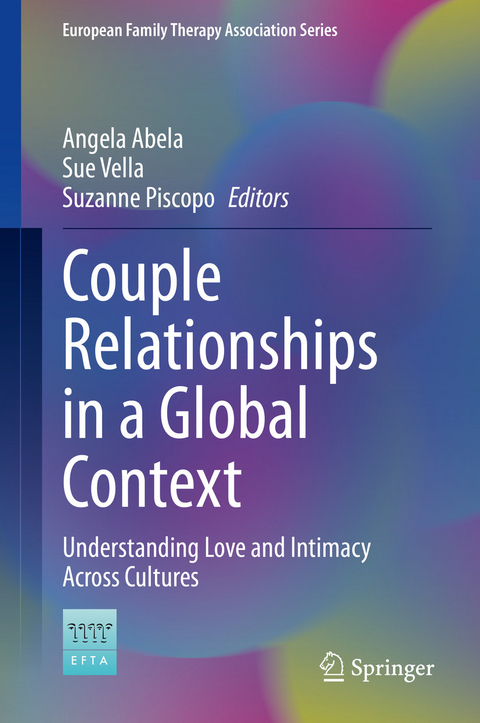
Couple Relationships in a Global Context (eBook)
XXVII, 435 Seiten
Springer International Publishing (Verlag)
978-3-030-37712-0 (ISBN)
This book examines the significance of the couple relationship in the 21st century, exploring in depth how couple relationships are changing in different parts of the world. It highlights global trends and cultural variations that are shaping couple relationships. The book discusses diverse relationships, such as intercultural couples, same sex couples, long distance couples, polygynous marriages, and later life couples. In addition, chapters offer suggestions for ways to best support couples through policy, clinical practices, and community support. The book also investigates aspects of a relationship that help predict fidelity and stability.
Topics featured in this book include:- Couple relationships when one partner has an acquired physical disability.
- Impact of smartphones on relationships.
- Online dating and its implications for couple relationships.
- Assessment and intervention in situations of infidelity and non-monogamy.
- Parenting interventions for the transition from partnership to parenthood.
- Online couple psychotherapy to support emotional links between long distance partners.
Couple Relationships in a Global Context is an essential resource for researchers, professors, and graduate students as well as clinicians and practitioners in family therapy, clinical psychology, general practice/family medicine, social work, and related psychology and medical disciplines.
Angela Abela, PhD, is a Professor and founding Head of the Department of Family Studies at the University of Malta, where she teaches clinical psychology and family therapy trainees, Master students in Family Studies, and supervises research. She chairs the National Centre for Family Research of the Malta Foundation for the Wellbeing of Society. As a clinical psychologist, family therapist and systemic supervisor she works with couples, children and their families and supervises practitioners working in this area. She is a consultant for Parliament and the Maltese government. She is lead author of the Strategic Policy on Positive Parenting for Malta launched in 2016. Angela has served as an expert for the Council of Europe in the area of children and families for many years. Her research projects include studies on marital satisfaction, couple conflict and family violence, families living in poverty, lone parent families, parenting, and children in out-of-home care. In 2014, she co-edited Contemporary Issues in Family Studies: Global Perspectives on Partnerships, Parenting and Support in a Changing World with Wiley-Blackwell and coauthored Intervening after violence, Therapy for couples and families with Springer (2017). She is an associate editor of Clinical Child Psychology and Psychiatry, an international advisory editor of Contemporary Family Therapy and is on the editorial board of Children Australia.
Sue Vella, PhD, is a senior lecturer in the Department of Social Policy and Social Work at the University of Malta, where she lectures in social policy. Prior to joining University, Sue had almost twenty years' experience in the public sector. After graduating, she was a founder member of the Domestic Violence Unit in what is today known as the Foundation for Social Welfare Services. She has since held top management positions at the Employment and Training Corporation and Malta Enterprise and has served on various organisational boards and policy committees. She was a member of the EU's Employment Committee for seven years, including two years as Vice-President and Chair of the Committee's technical group. Sue is currently a member of the National Centre for Family Research, Chairperson of the Church's Institute for Research in Malta, and a member of the Board of Trustees of Richmond Malta. Her research interests include families, the mixed economy of care, housing, employment and migration, and has recently published on long-term care; poverty in the media; and wellbeing.
Suzanne Piscopo, PhD, is the founding Head of the Department of Health, Physical Education and Consumer Studies in the Faculty of Education, University of Malta. She is an Associate Professor in Nutrition, Family and Consumer Studies, mainly training prospective Home Economists, teachers and early childhood educators. Professor Piscopo is a Registered Nutritionist and Registered European Health Promotion Practitioner and is frequently invited as a guest speaker in school and community events and on the media, tackling subjects related to food, health, consumption and finance within the family and societal context. She is currently involved in various international and national projects addressing social determinants of health, the Mediterranean Diet, elderly health, prison health and sustainability education. Over the years, Professor Piscopo has been appointed to multiple national Councils and Advisory Committees. She is a member of the National Centre for Family Research within the Malta Foundation for the Wellbeing of Society and is co-researcher in studies on couple relationships and on access to quality food.
Foreword 6
Preface 10
Acknowledgements 12
Contents 13
About the Editors 16
About the Contributors 18
Part I: The Significance of the Couple Relationship 27
Chapter 1: Understanding Love Relationships in a Global Context: Supporting Couples Across Cultures 28
1.1 Introduction 28
1.2 The Influence of Culture on Couple Relationships 29
1.3 Love and Intimacy Across Cultures 30
1.4 Couple Diversity as a Hallmark of the Twenty-First Century 32
1.5 Power and Gender in Couple Relationships Across Cultures 35
1.6 The Impact of Technology and the Media on the Couple Relationship 38
1.7 Supporting Couple Relationships 39
1.8 Conclusion 40
References 40
Chapter 2: The Significance of the Couple Relationship in the Twenty-First Century 43
2.1 Introduction 43
2.1.1 The Rise in Singledom 44
2.1.2 The Predominance of the Couple Relationship 45
2.2 Good Quality Couple Relationships Enhance Well-being 46
2.2.1 What Makes a Good Quality Couple Relationship 46
2.2.2 Is There Such a Thing as a “Good Fit” in the Couple Relationship? 47
2.3 How Do Couple Relationships Unfold? 49
2.4 Children and the Couple Relationship 50
2.4.1 The Desire for Children 50
2.4.2 The Impact of the Couple Relationship on Children 51
2.5 Couple Satisfaction over Time 52
2.5.1 Older Couples 53
2.6 The Fragility of the Couple Relationship 53
2.7 The Meaning of Love and Intimacy 55
2.8 Conclusion 56
References 56
Part II: How Couple Relationships Are Changing in Different Parts of the World 62
Chapter 3: The Existential and Relational Meaning of Intimacy and Love for Couples in Scandinavia: Through a Lens of Scandinavian Fiction and Drama 63
3.1 Introduction 63
3.1.1 Scandinavia as Context 63
3.1.2 A Scandinavian Discourse About Scandinavians? 64
3.1.3 Sociopolitical Structures 65
3.2 Courtly Love in Conflict with a Passionate–Romantic Discourse 65
3.2.1 Historical Courtly Love and a more Contemporary Discourse of Love as Virtue 66
3.2.2 The Intrigue: Courtly Love in Conflict with Passionate Being-in-Love 67
3.2.3 The Romantic Dream—Encountering Modern Times, Liberation, and Progress Toward the “Pure Relationship” 68
3.2.4 The Romantic Discourse Squeezed Between the Demands of Nostalgia and Desire for Liberty and Choice 70
3.3 The Pure Relationship, the Plot, and Longing Depicted in the Swedish Novel, Willful Disregard 71
3.3.1 Dialogical Love and the Emphasis on Being Seen as a Psychological–Relational Being 73
3.4 Scandinavia Today: A Crucible of Discourses and Experiences and the Movement Between Nostalgia and New Ways of Being Intimate 74
References 75
Chapter 4: The Evolution of the Couple in France over the Past 30 Years 76
4.1 Introduction 76
4.2 A Historical Perspective on the Couple and the Law in France 77
4.3 How Do People Enter Into Life as Couples in France Today? 79
4.3.1 Age at Time of Marriage or Entering Couplehood 79
4.3.2 Moving in Together 80
4.3.3 Previous Experience as a Couple 80
4.4 The Evolution of Couple Formation and Dissolution in More Recent Years 81
4.5 The Couple and Division of Responsibilities 82
4.6 Changes in the Needs of Couples in Therapy over the Past 30 Years 84
4.6.1 Consulting a Couple Therapist 84
4.6.2 Needs Expressed During Couple Therapy 84
4.6.3 Divorce as a Symptom of Dysfunction 85
4.6.4 Perspectives on Extra-Marital Relationships 86
4.6.5 Recently Formed Couples Who Request Consultation 88
4.6.6 Homosexuals Seeking Therapy 88
4.6.7 Contemporary Views on Couplehood and Parenthood 89
4.7 Conclusion 89
References 90
Chapter 5: Changing Couple Relationships in India 92
5.1 Introduction 92
5.2 ‘Gandharva Vivah’ or Self-Chosen Marriages in Ancient India 93
5.3 Arranged Marriages in Traditional Indian Society 94
5.4 Arranged Marriages in Contemporary Times 97
5.4.1 Students’ Perception of Marriage 97
5.4.2 Students’ Views on Arranged and Love Marriages 98
5.4.3 Students’ Expectations from Marriage 99
5.4.4 Summary Overview of Evolving Attitudes and Practices with Respect to Marriage 100
5.5 Conclusion 103
References 103
Chapter 6: Couple Relationships in the Arab Region: Changes and Renegotiations 105
6.1 Introduction 105
6.2 Positioning of Marriage Among Other Forms of Couple Relationships 107
6.2.1 Dominance of Marriage Unions 107
6.2.2 New Forms of Couple Relationships 111
6.3 Marriage Dynamics: Power and Closeness Within Marital Unions 113
6.3.1 Attitudes Around Gender Equity 113
6.4 Marriage Satisfaction 119
6.5 A Framework of Conscious Choice 120
6.6 Conclusion 123
References 123
Chapter 7: Couple Relationships in China 126
7.1 Introduction 126
7.2 Meaning of Love, Intimacy, and Sexuality 127
7.3 Romantic Ideal and Mate Selection 128
7.3.1 Personal Traits and Characteristics 128
7.3.2 Parental Preferences 129
7.3.3 Biased Social Context 129
7.3.4 Intercultural Couples and Same-Sex Couples 129
7.4 Marriage and Same-Sex Couple Relationships 130
7.4.1 Marriage Registration and Wedding 130
7.4.2 Low Marriage Rate and Late Marriage 131
7.4.3 Same-Sex Relationships 132
7.5 Couple Relationship Satisfaction 133
7.5.1 Power and Decision-Making 133
7.5.2 Communication 133
7.5.3 Parenting and the Relationship with the Extended Family 134
7.6 Couple Relationship Challenges 135
7.6.1 Gender Inequality 135
7.6.2 Intimate Partner Violence 136
7.7 Conclusion 138
References 139
Chapter 8: Couple Relationships in Mediterranean Malta 144
8.1 Introduction 144
8.2 The Couple Relationship in Europe and Its Southern Countries 145
8.3 A Focus on Malta 146
8.3.1 What Are the Trends in Couple Relationships in Malta? 147
8.3.2 What Makes for Satisfying Couple Relationships in Malta? 148
8.3.3 An Ecosystem Analysis 151
8.3.3.1 Factors Influencing Couple Relationships: The Macro Level 152
8.3.3.2 Factors Influencing Couple Relationships: The Meso Level 154
8.3.3.3 Factors Influencing Couple Relationships: The Micro Level 156
8.4 Implications for Practice 158
8.5 Conclusion 159
References 159
Part III: Couples in Diversity 162
Chapter 9: Home Is Where the Heart Is: Aporias of Love and Belonging in Intercultural Couples 163
9.1 Introduction 163
9.1.1 Systemic Theoretical Frameworks 164
9.2 Sociopolitical Contexts 167
9.3 The Meaning of Home 168
9.4 The Meaning of Love 169
9.5 Clinical Implications 172
References 173
Chapter 10: Stigma, Social Change and the Well-Being of Same-Sex Couples 176
10.1 Introduction 176
10.2 Similarities and Differences Between Same-Sex and Mixed-Sex Relationships 177
10.2.1 Unique Experiences of Same-Sex Couples 177
10.3 The Damaging Discourse Surrounding the Social Value of Same-Sex Couples in Shifting Policy Climates 180
10.4 Minority Stress in the Lives of Same-Sex Couples 181
10.4.1 Minority Stress Experienced by Individual Members of Same-Sex Couples 182
10.4.2 Couple-Level Minority Stressors 182
10.4.3 Dyadic Minority Stress Processes 183
10.5 Beyond Access to Equal Marriage 184
10.6 Resilience Resources Relevant to the Experience of Couple-Level Minority Stress 186
10.7 Implications and Conclusions 188
References 189
Chapter 11: Falling in Love in Later Life 193
11.1 Introduction 193
11.2 Attraction and Dating 197
11.3 Sexuality and Sensuality 198
11.4 Relationship Status: Personal and Social 200
11.4.1 Partnered but Living Separately 200
11.4.2 Cohabitation 201
11.4.3 Remarriage 202
11.5 Finding Love in Later Life 205
References 206
Chapter 12: Polygamous Marriages: An Arab-Islamic Perspective 208
12.1 Introduction 208
12.2 The Social, Mental–Emotional, and Well-Being Basis for Polygynous Marriage 209
12.3 The Social Influence of Religion on Middle Eastern Polygynous Marriage 211
12.4 Characteristics of the Family Structure in Polygynous Marriages 212
12.5 The Psychosocial Manifestations of Polygynous Marriage in Middle Eastern Society 212
12.6 Perceptions of the Current and Future Direction of Polygynous Marriage 215
12.7 Implications for Practice and Future Directions 216
12.8 Conclusion 217
References 218
Chapter 13: The Couple Relationship When One of the Partners Has an Acquired Physical Disability 221
13.1 Introduction 221
13.2 What Leads to an Acquired Physical Disability? 222
13.3 What Are the Implications of an Acquired Physical Disability on the Individual Parties and Couples? 223
13.4 How Does Systems Theory Support Us in Understanding and Working with These Couples? 227
13.5 Gender Differences in the Context of Disability and the Couple Relationship 228
13.6 What Supports Partners to Adjust Post-Disability? 229
13.7 How Can Practitioners and Clinicians Support Couple Adjustment Post-Disability? 231
13.8 Conclusion 233
References 234
Part IV: Global Trends in Couple Relationships 238
Chapter 14: Framing Couples in the Media: Coupledom, Well-Being and Comedy 239
14.1 Introduction 239
14.2 Couples and Humour 240
14.2.1 Couples and Couple Identity: The Ideology of Definitions 240
14.2.2 Coupledom and Well-Being: Coupledom Is Good for Us 241
14.2.3 Humour and Well-Being: Humour Is Good for Us 242
14.2.4 Onscreen Humour and Laughter 242
14.2.5 Comedy and Coupledom Are Good for Us … Couples and Humour on Screen 243
14.3 Framing Couples: Decoding Comedy 244
14.3.1 Informing the Story: Methods and Standpoints 245
14.3.2 Excavating Comedy: Locating Coupledom 245
14.3.3 Something About Semiotics… 246
14.3.3.1 The Odd Couple 246
14.3.3.2 The Middle 247
14.3.3.3 Speechless 248
14.3.3.4 The Carmichael Show 249
14.3.3.5 Boy Meets Girl 249
14.3.3.6 Grace and Frankie 250
14.4 Concluding Scenes: Fin 252
14.4.1 Normalising Effects Authentic Framing
14.4.2 Media Sins: Commodification and Objectification 253
14.4.3 Media Portrayal and Representation of the Couple Relationship 253
14.4.4 Final Cut or Finale 254
References 255
Chapter 15: Keeping Couples Together when Apart, and Driving Them Apart when Together: Exploring the Impact of Smartphones on Relationships in the UK 257
15.1 Introduction 257
15.2 Technology, Smartphones, Sex, and Relationships 258
15.3 Changing Sexual Norms 259
15.4 Situating Leisure Sex and Technological Change in Sociological Theorizing 260
15.5 A Note on Methods 261
15.6 Results 262
15.6.1 The Benefits of Smartphones in Relationships 262
15.6.2 The Costs of Smartphones on Relationships 264
15.6.3 Strategies to Deal with Smartphones in Relationships 266
15.7 A Qualitative Perspective on Technology and Relationships 267
15.8 Conclusion 268
References 269
Chapter 16: Online Dating: Modern Options of Searching for a Partner and Its Implications for Psychotherapy 272
16.1 Introduction 272
16.2 Types and Motives of Online Dating 273
16.3 A Theoretical Framework to Understand Relationships on the Internet 275
16.3.1 Disinhibition Effect 275
16.3.2 Hyperpersonal Theory 275
16.3.3 Object Relation Theories 275
16.3.4 Attachment Theory 276
16.4 The Online Dating Itinerary 276
16.5 The Further Development of a Relationship Initiated Online 278
16.6 Advantages and Risks of Online Dating 279
16.7 Negative Trends in the Context of Online Dating 280
16.8 Conclusion 283
References 284
Chapter 17: Fidelity, Infidelity, and Non-monogamy 290
17.1 Introduction 290
17.2 Desire, Infidelity, and Non-monogamy 292
17.3 Sexual Communication 297
17.4 Assessment 297
17.4.1 Individual Interviewing 298
17.4.2 Infidelity Specific Assessment 299
17.4.3 Relationship History 300
17.4.4 Current Relationship 300
17.4.5 Family of Origin 301
17.4.6 Societal Influences 301
17.5 Non-monogamous Relationships 301
17.5.1 LGBTQ Couples 304
17.6 Conclusion 304
References 304
Chapter 18: Understanding Long-Term Couple Relationships 306
18.1 Introduction 306
18.1.1 The Need for Relationship Science 306
18.1.2 Overview of the Scientific Research 307
18.2 A Scientific Theory of Relationships: The Sound Relationship House 308
18.2.1 The Theory in Practice: The Friendship System 310
18.2.2 The Theory in Practice: Conflict Management System 311
18.2.2.1 The Six Skills for Effective Conflict Management 312
Skill Number 1: Softened Startup 313
Skill Number 2: Repair and De-escalation 313
Skill Number 3: Physiological Self-Soothing 313
Skill Number 4: Accepting Influence 314
Skill Number 5: Honoring Life Dreams 314
Skill Number 6: Compromise 315
18.3 The Theory in Practice: Shared Meaning 315
18.4 The Theory in Practice: Trust and Commitment 315
18.5 Moving from Theory to Practice 316
18.6 What About Sex? 317
18.7 What About Stress? 318
18.8 What About the Fights? 319
18.9 Conclusion 319
References 320
Chapter 19: Why and How Couples Leave Relationships: A Twenty-First Century Landscape 321
19.1 Introduction 321
19.2 Factors Shaping the Character of Twenty-First Century Couple Life 322
19.2.1 The Mobile Telephone, the Internet and Social Media 322
19.2.2 The ‘Saturated’ Character of Postmodern Couple and Family Life 325
19.2.3 Sex and the Cyberworld in Contemporary Couple Life 325
19.2.4 Global Workers in a Global Economy 326
19.2.5 A Changing Set of Power Relations Between Men and Women in Domestic and Social Domains 326
19.2.6 Income Level and the Fate of Couple Relationship 327
19.3 Events and Processes Within Contemporary Couple Separation 327
19.3.1 The Disappearance of Feelings: Paul and Hilda 328
19.3.2 Domestic Violence and the Transnational Couple: Naomi and Emmanuel 329
19.4 Transnational Divorce Processes 332
19.4.1 Infidelity and Its Wounds: Hannah and Roger 333
19.5 Concluding Reflections on the Vignettes in the Context of Postmodern Couple Life 335
References 336
Chapter 20: Between the Couple and Living Alone 339
20.1 Introduction 339
20.2 Orientations to Couple Relationships Among Young Adults Living Alone 342
20.3 How Living Alone Changes Becoming a Couple 345
20.4 Idealising Coupledom and the Gendered Stigmatising of Living Alone 349
20.5 Conclusion 351
References 353
Part V: Supporting Couple Relationships 355
Chapter 21: Systemic Therapy and Narratives of Attachment 356
21.1 Introduction 356
21.2 Attachment Strategies as Attempted Solutions: Styles of Protective and Defensive Processes 357
21.3 Attachments as Representations 361
21.4 Intergenerational Attachments: Corrective and Replicative Scripts 362
21.5 Creating the Secure Base in Therapy 363
21.6 Comfort and Reassurance 365
21.7 Conclusion 366
References 366
Chapter 22: Supporting Parents as Partners: The Couple Context of Parenting, a Personal and Academic Journey 368
22.1 The Journey 368
22.1.1 The Personal Story 368
22.1.2 The Intellectual Journey 369
22.2 The Destination: An Evidence-Based Integrative Couples Group for Parents 374
22.2.1 The Transition to Parenthood: Becoming a Family (BAF, C. P. Cowan & Cowan, 2000)
22.2.1.1 Schoolchildren and Their Families (SAF, Cowan et al., 2005) 377
22.2.1.2 Supporting Father Involvement (SFI, Cowan et al., 2009) 378
22.2.1.3 Participants’ Evaluations of the Groups 380
22.3 Conceptual Significance of Our Intervention Approach 380
22.4 Ending on a Personal Note 381
References 382
Chapter 23: Supporting Links Between Living Apart Together (LAT) Couples Through Online Couple Therapy 384
23.1 Introduction 384
23.2 The Therapeutic Model 385
23.3 Cautiously Venturing into Cyberspace 386
23.4 Living Apart Together 387
23.5 LAT Couples Seeking Online Relationship Support 389
23.5.1 Couples Transitioning from LAT to a Shared Living Arrangement 389
23.5.2 Couples in the Process of Establishing an LAT Lifestyle 392
23.5.3 LAT Couples Troubled by Togetherness 394
23.6 The Management of Risk in Online Couple Psychotherapy 396
23.7 The Effect of Technology on the Therapeutic Process 397
23.8 Final Thoughts 398
References 398
Chapter 24: No Couple Is an Island: Communities of Support in Couple Relationships 400
24.1 Introduction: No Couple Is an Island 400
24.2 Need for Support 401
24.3 Types of Support 403
24.4 Benefits and Limitations 404
24.5 Two Further Questions 407
24.6 Conclusion 409
References 409
Chapter 25: Policy Perspectives on Couple Relationships 412
25.1 Introduction 412
25.2 Equal Status 413
25.3 Consent 417
25.4 Relational Capability 419
25.5 Commitment 423
25.6 Due Care 426
25.7 Concluding Note 429
References 429
Index 433
| Erscheint lt. Verlag | 3.4.2020 |
|---|---|
| Reihe/Serie | European Family Therapy Association Series | European Family Therapy Association Series |
| Zusatzinfo | XXVII, 435 p. 11 illus., 6 illus. in color. |
| Sprache | englisch |
| Themenwelt | Medizin / Pharmazie ► Medizinische Fachgebiete ► Psychiatrie / Psychotherapie |
| Sozialwissenschaften ► Pädagogik ► Sozialpädagogik | |
| Sozialwissenschaften ► Soziologie | |
| Schlagworte | changing couple relationships • Couple relationships • couple relationships in the 21st century • couple support in the community • Couple therapy • diversity in couples • intercultural couple relationships • Living apart together • love relationships in later life • policy and practice in couple relationships • Polyamorous Relationships • Polyandry • Polygamy • rise in singledom • same sex couple relationships • supporting couples |
| ISBN-10 | 3-030-37712-1 / 3030377121 |
| ISBN-13 | 978-3-030-37712-0 / 9783030377120 |
| Informationen gemäß Produktsicherheitsverordnung (GPSR) | |
| Haben Sie eine Frage zum Produkt? |
 PDF (Wasserzeichen)
DRM: Digitales Wasserzeichen
Dieses eBook enthält ein digitales Wasserzeichen und ist damit für Sie personalisiert. Bei einer missbräuchlichen Weitergabe des eBooks an Dritte ist eine Rückverfolgung an die Quelle möglich.
Dateiformat: PDF (Portable Document Format)
Mit einem festen Seitenlayout eignet sich die PDF besonders für Fachbücher mit Spalten, Tabellen und Abbildungen. Eine PDF kann auf fast allen Geräten angezeigt werden, ist aber für kleine Displays (Smartphone, eReader) nur eingeschränkt geeignet.
Systemvoraussetzungen:
PC/Mac: Mit einem PC oder Mac können Sie dieses eBook lesen. Sie benötigen dafür einen PDF-Viewer - z.B. den Adobe Reader oder Adobe Digital Editions.
eReader: Dieses eBook kann mit (fast) allen eBook-Readern gelesen werden. Mit dem amazon-Kindle ist es aber nicht kompatibel.
Smartphone/Tablet: Egal ob Apple oder Android, dieses eBook können Sie lesen. Sie benötigen dafür einen PDF-Viewer - z.B. die kostenlose Adobe Digital Editions-App.
Buying eBooks from abroad
For tax law reasons we can sell eBooks just within Germany and Switzerland. Regrettably we cannot fulfill eBook-orders from other countries.
aus dem Bereich