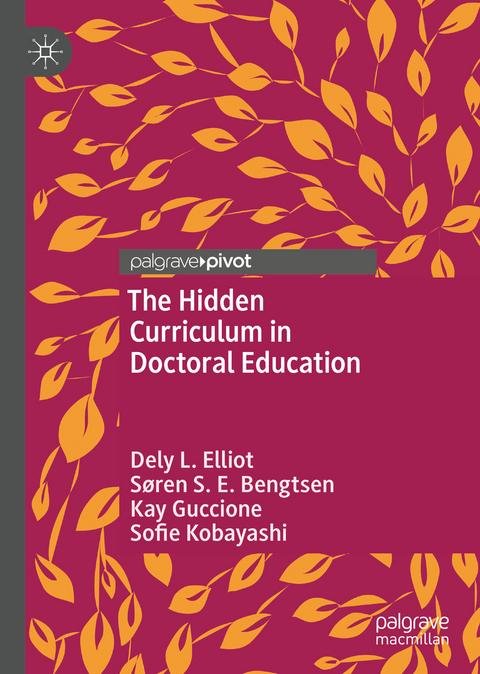
The Hidden Curriculum in Doctoral Education (eBook)
XIX, 156 Seiten
Springer International Publishing (Verlag)
9783030414979 (ISBN)
Overview of the Book 6
Whom Is This Book For? 6
Why Write a Book on the Hidden Curriculum? 8
How We Structured This Book 9
References 11
Contents 12
List of Figures 14
List of Tables 16
List of Boxes 17
Part I: The Hidden Curriculum in Doctoral Contexts 18
Chapter 1: What Is the Hidden Curriculum? 19
What Do ‘Learning’ and ‘Hidden Curriculum’ Mean in the Doctoral Studies Context? 20
Scenario 1 21
Scenario 2 21
Scenario 3 21
What Makes Unofficial Mechanisms for ‘Learning’ Crucial Among Doctoral Researchers? 22
How Are the Formal and the Hidden Curricula Interlinked in Doctoral Studies? 23
What Framework Can Facilitate the Harnessing of the Hidden Curriculum? 25
Unconscious Incompetence 26
Conscious Incompetence 26
Conscious Competence 27
Unconscious Competence 27
What Are the Final Key Messages? 28
References 32
Chapter 2: Exposing the Hidden Curriculum in the Context of Doctoral Education 33
What Is the Contemporary State of Play in Doctoral Education? 34
What Are the Added Expectations Among Contemporary Doctoral Researchers? 34
What Are the Implications of Differing Models in Doctoral Education? 36
How Can the Formal and Hidden Curricula Address the Learning Goals in Doctoral Education? 37
How Are Formal and Hidden Curricula Similar and Different? 38
Academic- or Institution-Led vs Doctoral Researcher-Led 40
Academic Staff and Non-Academic Staff as Mediators of the Curriculum 41
Instrumental Roles and By-Products of Formal and Hidden Curricula 42
What Are the Final Key Messages? 43
References 43
Chapter 3: Recognising the Hidden Curriculum Within International Doctoral Education 45
Is There a Warrant for Focusing on International Doctoral Researchers? 46
How Can the ‘Educational Sojourn’ Create a Novel Experience? 47
What Can the Hidden Curriculum Arising from the Co-Existing Ecological Systems Offer? 49
How Can International Doctoral Researchers Harness the Hidden Curriculum? 50
The REPAIRS Model 51
Receptivity 51
Embrace 52
Passion 52
Active Engagement 52
Innovation 52
Routine 52
Self-Reflection 53
What Might Be Examples of Opportunities and Pitfalls When International Doctoral Researchers Draw Upon the Lessons of the Hidden Curriculum? 53
What Are the Final Key Messages? 55
References 56
Part II: The Hidden Facets and Players in the Formal and Informal Doctoral Curriculum 58
Chapter 4: Navigating the Hidden Curriculum: A Person-Centred Approach to Developing Doctoral Researchers 59
A Collaborative Framework for Doctoral Development 60
Navigating a Rich Tapestry of Opportunity 61
Negotiating Learning from the Outset: Transition to Doctoral Study 62
A Person-Centred Approach for Navigating the Formal and the Hidden Curricula 63
Embedding Personal Development Within Professional Development 64
What Are the Final Key Messages? 72
References 73
Chapter 5: Personal Pursuit of the Hidden Curriculum, Value, Choice, and Ownership 75
Exploring Doctoral Values 76
‘Tour Guides’ on the Route to Research Independence 78
Enabling ‘Agents’ to Choose Their Own Adventure 80
Approach to Personal Development Planning 83
A Doctoral Researcher’s Personal Reflection 86
References 90
Chapter 6: Harnessing the Hidden Curriculum, Adopting and Adapting 91
Training and Development for Doctoral Researchers 92
The Hidden Curriculum of Attending ‘Training and Development’ 93
Coaching and Mentoring Doctoral Researchers 94
Harnessing the Hidden Curriculum Through Dialogic Initiatives 96
Visual Expression of Transitions to Doctoral Studies 97
Doctoral Peer Mentoring 97
Thesis Mentoring 98
Shared Experience Networks 99
Writing Retreats 101
Creative Writing and the Journal of Imaginary Research 102
Backstage Seminars 102
Amateur Journal Club 102
‘Coffee and Cake’ Mentoring 103
A Doctoral Blog 104
Post-PhD Profiles 105
Community Gardening 106
Worry Club: Getting Fears Out in the Open 106
References 108
Part III: The Hidden Curriculum and Wider Doctoral Learning Ecology 109
Chapter 7: A ‘Doctoral Learning Ecology Model’ 110
What Is a Doctoral Learning Ecology? 111
Scenario 1: The Disciplinary/Knowledge Context 113
Scenario 2: The Institutional/Systemic Context 114
Scenario 3: The Workplace/Cultural Context 114
Scenario 4: The Person/Lifeworld Context 115
How Do the Four Domains of the Doctoral Ecology Model Intersect and Influence Each Other in Doctoral Education Practice? 116
(Un)Conscious (In)Competences as a Framework for Conceptualising Support Within the Doctoral Ecology 117
(Un)Conscious Incompetence 118
(Un)Conscious Competence 120
What Are the Final Key Messages? 122
References 124
Chapter 8: The Hidden Curriculum: Educational Pillars for Doctoral Researchers’ Meaningful Experience and Successful Completion 125
An Expanded Doctoral Pedagogy 126
Scenario 1: Professional Support 129
Scenario 2: Moral Support 130
Scenario 3: Practical Support 131
Scenario 4: Emotional Support 131
(Un)Conscious (In)Competences as a Framework for Conceptualising Support Within Doctoral Pedagogies 132
(Un)Conscious Incompetence 132
(Un)Conscious Competence 135
What Are the Final Key Messages? 137
References 138
Chapter 9: Beyond Surviving: Towards Thriving in Doctoral Education 140
Aiming for a Holistic Picture of the Hidden Curriculum in Doctoral Education 141
Towards Thriving! 142
Constituting Elements of Thriving 144
Thriving in Graduate Schools 146
Researcher Identity 146
Academic Identity 147
Moral Identity 147
Social Identity 148
Leading the Hidden Curriculum 149
Being Visible 149
Shaping the Culture 150
Participating 150
Being an Active Researcher 151
Distributed Leadership 151
Final Questions for Reflection 152
References 155
Glossary 157
Index 163
| Erscheint lt. Verlag | 27.3.2020 |
|---|---|
| Zusatzinfo | XIX, 156 p. 10 illus. |
| Sprache | englisch |
| Themenwelt | Sozialwissenschaften ► Pädagogik ► Erwachsenenbildung |
| Schlagworte | doctoral education • hidden curriculum • International doctoral students • Research doctorates • Thesis supervision |
| ISBN-13 | 9783030414979 / 9783030414979 |
| Informationen gemäß Produktsicherheitsverordnung (GPSR) | |
| Haben Sie eine Frage zum Produkt? |
 PDF (Wasserzeichen)
DRM: Digitales Wasserzeichen
Dieses eBook enthält ein digitales Wasserzeichen und ist damit für Sie personalisiert. Bei einer missbräuchlichen Weitergabe des eBooks an Dritte ist eine Rückverfolgung an die Quelle möglich.
Dateiformat: PDF (Portable Document Format)
Mit einem festen Seitenlayout eignet sich die PDF besonders für Fachbücher mit Spalten, Tabellen und Abbildungen. Eine PDF kann auf fast allen Geräten angezeigt werden, ist aber für kleine Displays (Smartphone, eReader) nur eingeschränkt geeignet.
Systemvoraussetzungen:
PC/Mac: Mit einem PC oder Mac können Sie dieses eBook lesen. Sie benötigen dafür einen PDF-Viewer - z.B. den Adobe Reader oder Adobe Digital Editions.
eReader: Dieses eBook kann mit (fast) allen eBook-Readern gelesen werden. Mit dem amazon-Kindle ist es aber nicht kompatibel.
Smartphone/Tablet: Egal ob Apple oder Android, dieses eBook können Sie lesen. Sie benötigen dafür einen PDF-Viewer - z.B. die kostenlose Adobe Digital Editions-App.
Buying eBooks from abroad
For tax law reasons we can sell eBooks just within Germany and Switzerland. Regrettably we cannot fulfill eBook-orders from other countries.
aus dem Bereich