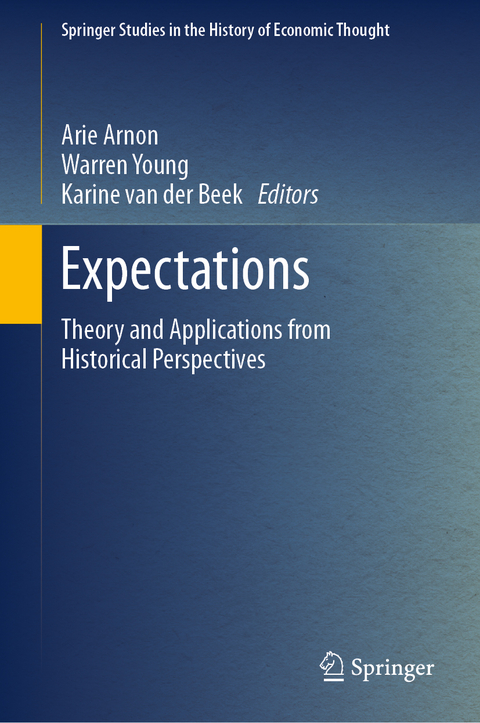
Expectations (eBook)
238 Seiten
Springer-Verlag
978-3-030-41357-6 (ISBN)
This book provides a unique historical perspective on expectations in economic theory, and applications of expectations models in economic history. Based on papers presented at the 2017 Thomas Guggenheim Conference, it brings together the work of economists, historians of economics, and economic historians on issues and events concerning expectations in economics and economic history. The contributions address: (i) the history of expectations models; (ii) growth, expectations and political economy; (iii) controversies regarding expectations methods and models; (iv) expectations in theory and reality; and (v) expectations in economic history.
The book opens with a lecture by Thomas Guggenheim Prize winner Duncan Foley on the evolution of expectations in modern economic thought. The remaining content is divided into two parts, the first of which focuses on the utilization of expectations in the “ancient” and “meso” periods of high theory, i.e., from Smithian to Keynesian approaches. The papers cover topics such as “modern” applications of expectations in both “Tobinesque-Phillips” and “Harrodian-Solowian” contexts, and the debate between Friedmanite and Keynesian approaches to expectation formation. In turn, the last part presents essays on the role of economic expectations in connection with historical events and contexts, ranging from the early 20th century to World War II, and on the application of expectations theory to hyperinflation and stabilization, taking Israel as a case study.
Foreword 6
Introduction 8
Contents 12
List of Participants 14
Part I Guggenheim Prize Lecture 15
Unfulfilled Expectations: One Economist's History 16
1 What Did You and I Expect? 16
2 M.I.T. and Miguel Sidrauski 17
3 Rational Expectations 20
4 Dynamics and Complexity 21
5 Two Sorts of Expectations 25
6 Boundedly Rational Expectations 26
7 Hindsight: Intellectual Odyssey or Wild Goose Chase? 28
References 30
Part II Expectations and Economic Thought: Classics and Moderns 31
Expectations and Its Variants: The Nuanced Role of Expectations in Classical Economics 32
1 Introduction 32
2 Expectational Fallacies 38
2.1 Expectations Regarding the Beneficial Nature of Competitive Institutions 38
2.2 Moral Expectations 42
2.3 A Note on the Dynamic Aspect of Expectations 47
3 Expectations and Anticipations in Smith’s Narrative 51
4 Conclusions 60
References 61
Expectations, Conjectures and Beliefs. The Legacy of Marshall, Kahn and Keynes 63
1 Introduction 63
2 Marshall 65
3 Kahn 66
4 Keynes 69
5 The Role of Expectations in Generating Market Instability 70
6 Observation-Based Expectations 72
7 Expectations as Dividing Issue 73
8 Some Concluding Remarks 75
References 75
Between Pigou and Keynes: Champernowne on Employment and Expectations 78
1 Sorting Out Cambridge Expectations 78
2 Labour Supply and Money-Wage Dynamics 81
3 Monetary Policy and the Trend of Real Wages 84
4 Keynes Versus Pigou on the Role of Expectations 88
5 The Champernowne Puzzle 91
References 92
Keynes and Friedman on Expectations Mismatches During the Great Depression 95
1 Introduction 95
2 Friedman and the Case for Purely Monetary Disorders 96
2.1 Friedman’s Narrative of the Great Depression 96
2.2 Expectations and Friedman’s Rationale for the Great Depression 99
3 Keynes and the Case for Self-feeding Real Disorders 103
3.1 1929–30 and Keynes’ Initial Diagnosis for an “Abnormal” Slump 103
3.2 1931–32 and the Developing of the Slump 106
3.3 From 1932 to 1933 Onwards: The Great Depression and Mismatches in Long-Term Expectations 110
4 Conclusion 113
References 114
Expectations in Tobin’s Macroeconomics: The Fisherian and Keynesian Roots of Tobin’s q and Corridor of Stability 117
1 Introduction 117
2 Keynes’s Q, Tobin’s q, Fisher’s Net Present Value 118
3 Liquidity Preference as Behavior Toward Risk 120
4 Expectations and Macroeconomic Instability: An “Old Keynesian” View 123
5 Conclusion 126
References 126
Growth Without Expectations: The Original Sin of Neoclassical Growth Models 129
1 Introduction 129
2 Stumbling Toward Instability: Harrod’s Attempt to Incorporate Expectations 131
3 Getting Rid of Expectations: The Original Sin of Neoclassical Growth Models 133
4 Conclusions 136
References 137
Inflation Expectations and the Phillips Curve: Then and Now 139
1 Inflation Expectations: Recent Importance and Interest 139
2 Different Types of Inflation Expectations 141
2.1 Static Expectations 141
2.2 Extrapolative Expectations 142
2.3 Adaptive Expectations 142
2.4 Rational Expectations 145
3 Historical Origins 145
4 Ways Ahead: Whose Expectations? 148
References 150
Part III Expectations and Applications: Economic Models and Case Studies 153
The War that Bond Markets Did not Perceive as Such 154
1 Introduction 154
2 The South African Republic on the Road to Annexation 156
3 Data 159
4 State Succession and Rothschild Guarantee 163
5 Conclusion 169
Appendix—The 1892 SAR Bond Certificate 171
References 172
Expectations and Planning at the FED: 1939–1941 175
1 Introduction 175
2 Expectations and Planning for War: September 1939–April 1940 178
3 Expectations and Planning for War: April–September 1940 182
4 Expectations and Planning for War: September 1940–December 1941 186
5 Summary and Conclusion 189
References 189
Israel’s Struggle Toward Macroeconomic Stability: Role of Inflationary Expectations 191
1 Introduction 191
2 Inflation Crisis 193
3 Political–Economy Policy Shift 195
4 Populism and Seigniorage Finance 196
5 The Distributive Effects of Inflation Stabilization 199
6 A Balance-of-Payment Crisis 200
7 Disinflation and Globalization 203
8 The Flattening of the Phillips Curve 205
9 Convergence of Inflation Rates 208
10 Depression–Deflation Resistance 210
11 Conclusion 215
Appendix: Globalization and the Phillips Curve 217
References 218
The Permanent-Transitory Confusion: Implications for Tests of Market Efficiency and for Expected Inflation During Turbulent and Tranquil Times 221
1 Introduction 222
2 Adaptive Expectations Through the Ages and Muth Model of the Permanent-Transitory Confusion 223
2.1 Adaptive Expectations 223
2.2 The Permanent-Transitory Confusion and Muth (1960) Statistical Foundations for It 224
2.3 Past Applications of Muth’s Predictor 226
3 Tests of Market Efficiency in the Treasury Bills and Foreign Exchange Markets 226
3.1 Fama (1975) Early Efficiency Test of Current Interest Rates as Predictors of Future Inflation 227
3.2 Efficiency Tests of Forward Premia as Predictors of Future Spot Exchange Rates 228
3.3 A More General Reformulation of Market Efficiency Tests 229
4 The Impact of Occasionally Large Permanent Shocks on the Serial Correlation in Forecast Errors: The Case of Finite Samples 230
5 Turbulent Times: The Behavior of Expected Inflation During Disinflation 233
5.1 An Empirical Application to the Israeli 1985 Cold Turkey Stabilization 233
5.2 Estimation of the Learning Parameter During the 1985 Stabilization 235
6 The Performance of Adaptive Expectations During Tranquil Times: Israel 2003–2018 236
6.1 Estimation of the Learning Parameter During the Tranquil 2003–2018 Period 236
7 Concluding Remarks 239
Appendix 240
Derivation of Equation (15) 240
Proof that Eut+1ut = 0 240
Derivation of ?j(?Ytp) (Eq. 20) 241
Derivation of Equation (23) 242
Proof that Using Observations on yt and yte or on ?t and ?te Yield Identical Estimates of ? and of ?ytp 2 242
References 243
| Erscheint lt. Verlag | 20.3.2020 |
|---|---|
| Reihe/Serie | Springer Studies in the History of Economic Thought | Springer Studies in the History of Economic Thought |
| Zusatzinfo | XIII, 238 p. 38 illus., 32 illus. in color. |
| Sprache | englisch |
| Themenwelt | Sozialwissenschaften ► Politik / Verwaltung |
| Wirtschaft ► Volkswirtschaftslehre | |
| Schlagworte | Economic History • Expectation Models • Expectations • Expectation theory • Guggenheim Conference • History of Economic Thought • inflation expectations • Keynesian Economics |
| ISBN-10 | 3-030-41357-8 / 3030413578 |
| ISBN-13 | 978-3-030-41357-6 / 9783030413576 |
| Informationen gemäß Produktsicherheitsverordnung (GPSR) | |
| Haben Sie eine Frage zum Produkt? |
 PDF (Wasserzeichen)
DRM: Digitales Wasserzeichen
Dieses eBook enthält ein digitales Wasserzeichen und ist damit für Sie personalisiert. Bei einer missbräuchlichen Weitergabe des eBooks an Dritte ist eine Rückverfolgung an die Quelle möglich.
Dateiformat: PDF (Portable Document Format)
Mit einem festen Seitenlayout eignet sich die PDF besonders für Fachbücher mit Spalten, Tabellen und Abbildungen. Eine PDF kann auf fast allen Geräten angezeigt werden, ist aber für kleine Displays (Smartphone, eReader) nur eingeschränkt geeignet.
Systemvoraussetzungen:
PC/Mac: Mit einem PC oder Mac können Sie dieses eBook lesen. Sie benötigen dafür einen PDF-Viewer - z.B. den Adobe Reader oder Adobe Digital Editions.
eReader: Dieses eBook kann mit (fast) allen eBook-Readern gelesen werden. Mit dem amazon-Kindle ist es aber nicht kompatibel.
Smartphone/Tablet: Egal ob Apple oder Android, dieses eBook können Sie lesen. Sie benötigen dafür einen PDF-Viewer - z.B. die kostenlose Adobe Digital Editions-App.
Buying eBooks from abroad
For tax law reasons we can sell eBooks just within Germany and Switzerland. Regrettably we cannot fulfill eBook-orders from other countries.
aus dem Bereich