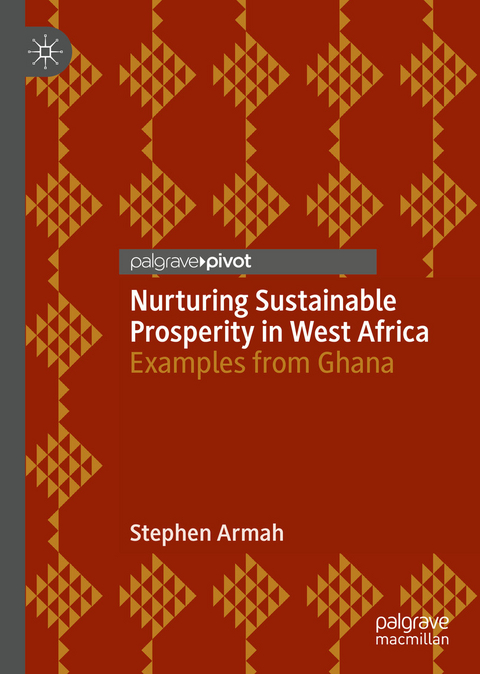
Nurturing Sustainable Prosperity in West Africa (eBook)
XVIII, 106 Seiten
Springer International Publishing (Verlag)
978-3-030-37490-7 (ISBN)
'Through the lens of personal experience, Dr. Armah walks us through the scholarly research on culture, corruption and economics as it applies to the Ghanaian experience. We are left with a partially disappointing picture of a country wealthy in people and resources, but poor in growth but cannot help but imagine that Ghana has turned a corner and that history may well turn out to be kind to the country Dr. Armah clearly loves.'
-Kenneth Leonard, Associate Professor, University of Maryland at College Park'Management consultants and corporate leadership experts have often verified Peter Drucker's observation that 'culture eats strategy for breakfast.' This book represents a heartfelt effort to recognize and grapple with the power of culture over economic strategy and development policy. Stephen Armah's reflections on Ghanaian experiences reveal how a deeper appreciation of culture and mindset can help us understand the persistence of corruption and elements of a path forward.'
-Alex Winter-Nelson, Director of ACES Office of International Programs, University of Illinois at Urbana-Champaign
'This book is an interesting introduction to the ways in which culture influences economic growth and productivity in Ghana. Using a combination of revealing anecdotes and citations from the literature Dr. Armah explores the ways that culture can positively, and negatively, impact the institutions that are necessary to allow a country to thrive. Aspects of culture that are a hindrance cannot be changed immediately, but can, over time, adapt to improve the country.'
-Erik Cheever, Professor, Department of Engineering, Swarthmore College
'An easy and thought provoking read! It contains a bold message that I expect will facilitate an important conversation not only in Ghana but across Africa.'
-Saweda Liverpool-Tasie, Associate Professor of Agricultural, Food, and Resource Economics, Michigan State University
'Armah's thesis is that corruption, economic inefficiency, and weak formal institutions are culturally rooted in Ghana, and that the real work of development involves changing the worldviews that give life events their meaning and determine how people respond to formal policies and institutions. This is a controversial argument that will provoke lively debate. Armah's book puts the literature on economic development and culture into dialogue with stories of life in post-independence Ghana.'
-Stephen A. O'Connell, Gil and Frank Mustin Professor of Economics, Swarthmore College
Using Ghana as a case study, this book argues that local culture and tradition play a role in shaping economic institutions that operate in a country. This book focuses on how certain cultural practices lead to an environment more susceptible to cronyism and corruption. The book then discusses the relationship between culture and rampant corruption, and how these in sum have harmed Ghana's economic development.
'I have no doubt that culture, in terms of attitudes, values, norms and behavior, is the single most important explanatory factor in Ghana's underdevelopment. It explains the widespread corruption, poor work ethic and indiscipline. These are the issues Stephen Armah courageously takes on in this book as needing to be addressed in Ghana's development.' -Stephen Adei, Professor Emeritus, Ashesi University
'Stephen Armah's Nurturing Sustainable Prosperity in West Africa explores and interprets the economics, transnational organizations, socio-cultural politics as contexts and processes for understanding corruption in Ghana, in particular and Africa as a whole. Focusing on the continuous transactions among Ghanaians with reference to their social and personal obligations against the backdrop of the pervasive corruption exemplified in his case studies, Armah clearly explains the process of constructing socio-political mores and policies to remedy or root out chronic corruption. Armah examines the institutionalized and non-formal customary practices that engender nepotism, absenteeism, lawlessness and general malaise that hamper development. The book provides an important analysis and solutions to corruption. It will be of interest to not only to scholars of economics but also, to the general reader, policymakers and servant- leaders in contemporary Africa.' -Pashington Obeng, Dean of the Faculty of Arts and Science, Ashesi University
Stephen Armah is Chair of the Business Administration Department at Ashesi University, Ghana. Stephen is also the Director of the Ashesi Economics Lecture Series, the Director for the Business Department's Capstone Research and the Institution's Liaison for the Global Liberal Arts Association. He is the author of several articles in development economics, focusing on institutions, inflation, foreign aid and the economics of the cocoa sector.
| Erscheint lt. Verlag | 18.2.2020 |
|---|---|
| Zusatzinfo | XVIII, 106 p. |
| Sprache | englisch |
| Themenwelt | Sozialwissenschaften ► Politik / Verwaltung |
| Wirtschaft ► Betriebswirtschaft / Management ► Unternehmensführung / Management | |
| Wirtschaft ► Volkswirtschaftslehre | |
| Schlagworte | African development • Chinese galamsey • Chinese investment • Corruption • Economic Development • Foreign Aid • Ghana • healthcare access • Inflation • Mining • Poverty • Taxes • West Africa |
| ISBN-10 | 3-030-37490-4 / 3030374904 |
| ISBN-13 | 978-3-030-37490-7 / 9783030374907 |
| Informationen gemäß Produktsicherheitsverordnung (GPSR) | |
| Haben Sie eine Frage zum Produkt? |
 PDF (Wasserzeichen)
DRM: Digitales Wasserzeichen
Dieses eBook enthält ein digitales Wasserzeichen und ist damit für Sie personalisiert. Bei einer missbräuchlichen Weitergabe des eBooks an Dritte ist eine Rückverfolgung an die Quelle möglich.
Dateiformat: PDF (Portable Document Format)
Mit einem festen Seitenlayout eignet sich die PDF besonders für Fachbücher mit Spalten, Tabellen und Abbildungen. Eine PDF kann auf fast allen Geräten angezeigt werden, ist aber für kleine Displays (Smartphone, eReader) nur eingeschränkt geeignet.
Systemvoraussetzungen:
PC/Mac: Mit einem PC oder Mac können Sie dieses eBook lesen. Sie benötigen dafür einen PDF-Viewer - z.B. den Adobe Reader oder Adobe Digital Editions.
eReader: Dieses eBook kann mit (fast) allen eBook-Readern gelesen werden. Mit dem amazon-Kindle ist es aber nicht kompatibel.
Smartphone/Tablet: Egal ob Apple oder Android, dieses eBook können Sie lesen. Sie benötigen dafür einen PDF-Viewer - z.B. die kostenlose Adobe Digital Editions-App.
Buying eBooks from abroad
For tax law reasons we can sell eBooks just within Germany and Switzerland. Regrettably we cannot fulfill eBook-orders from other countries.
aus dem Bereich