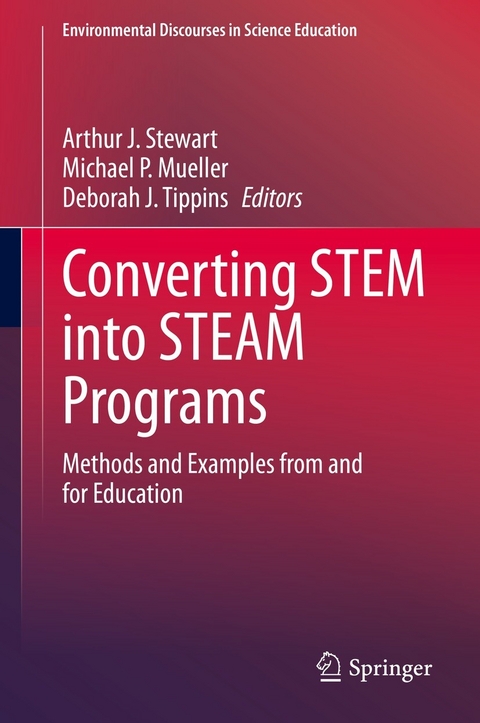
Converting STEM into STEAM Programs (eBook)
XVI, 305 Seiten
Springer International Publishing (Verlag)
9783030251017 (ISBN)
This book examines the push and pull of factors contributing to and constraining conversion of STEM (science, technology, engineering and math) education programs into STEAM (science, technology, engineering, math and arts) education programs. The chapters in this book offer thought-provoking examples, theory, and suggestions about the advantages, methods and challenges involved in making STEM to STEAM conversions, at levels ranging from K12 through graduate university programs. A large driving force for STEM-to-STEAM conversions is the emerging awareness that the scientific workforce finds itself less than ideally prepared when engaging with so-called 'wicked problems' - the complex suite of emerging, multifaceted issues such as global climate change, social injustice, and pandemic diseases. Dealing with these issues requires cross-disciplinary expertise and the ability to insert technical and scientific understanding effectively into areas of public planning and policy.
The different models and possibilities for STEAM, as the next phase of the STEM revolution, laid out in this book will promote research and further our understanding of STEAM as a forward-thinking approach to education.
Gillian Roehrig, STEM Education, University of Minnesota, USA
The ideal teacher sees opportunities for integrating ideas from multiple disciplines into every lesson. This book offers many worthwhile suggestions on how to do that deliberately and systematically
George DeBoer, Project 2061 of the American Association for the Advancement of Science, USA
For the last several years, calls for expanding STEM education have grown, but so too have concerns about technocratic approaches to STEM. This volume challenges the community to consider broader views on STEM by focusing on the place of arts education within this movement. The chapters offer much needed, new perspectives on the (re)integration of the arts and sciences
Troy Sadler, School of Education, University of North Carolina, USA
Arthur J. Stewart of Lenoir City, Tennessee, is a scientist, science educator, and poet. He earned his Ph.D. at Michigan State University in aquatic ecology and worked at the Department of Energy's Oak Ridge National Laboratory for 17 years as an ecologist and ecotoxicologist before becoming a science education project manager for Oak Ridge Associated Universities. In addition to publishing over a hundred scientific articles, book chapters, and technical reports, his science-inspired poetry has been published many literary magazines and in more than a dozen anthologies.
Michael P. Mueller is a professor of secondary education with expertise in environmental and science education in the College of Education at the University of Alaska Anchorage. His philosophy now focuses on how privileged cultural thinking frames our relationships with others, including nonhuman species and physical environments. He works with teachers to understand the significance of cultural diversity, biodiversity, and nature's harmony. He is the coeditor-in-chief of Cultural Studies of Science Education.
Deborah J. Tippins is currently a professor in the Department of Mathematics and Science Education at the University of Georgia. Her scholarly work focuses on encouraging meaningful discourses around environmental justice and sociocultural issues in science education.| Erscheint lt. Verlag | 27.2.2020 |
|---|---|
| Reihe/Serie | Environmental Discourses in Science Education | Environmental Discourses in Science Education |
| Zusatzinfo | XVI, 305 p. 126 illus. |
| Sprache | englisch |
| Themenwelt | Sozialwissenschaften ► Pädagogik ► Erwachsenenbildung |
| Schlagworte | Arts in Science Teaching • Arts Involvement in the classroom • conventional STEM-education objectives • Converting STEM Programs to STEAM Programs • cross-disciplinary education • cross-disciplinary expertise • cross-disciplinary expertise in research-team • Developing STEAM Curricula • Encouraging the arts in STEM programs • Integrating the Arts into STEM Curriculum • problem-solving skills • Project-Based Learning to Teach STEAM • science education reform • scientists with cross-disciplinary expertise • STEAM science education • STEM Education • STEM policy • teaching creative thinking • ways of envisioning complex problems • workforce with creative thinking |
| ISBN-13 | 9783030251017 / 9783030251017 |
| Informationen gemäß Produktsicherheitsverordnung (GPSR) | |
| Haben Sie eine Frage zum Produkt? |
 PDF (Wasserzeichen)
DRM: Digitales Wasserzeichen
Dieses eBook enthält ein digitales Wasserzeichen und ist damit für Sie personalisiert. Bei einer missbräuchlichen Weitergabe des eBooks an Dritte ist eine Rückverfolgung an die Quelle möglich.
Dateiformat: PDF (Portable Document Format)
Mit einem festen Seitenlayout eignet sich die PDF besonders für Fachbücher mit Spalten, Tabellen und Abbildungen. Eine PDF kann auf fast allen Geräten angezeigt werden, ist aber für kleine Displays (Smartphone, eReader) nur eingeschränkt geeignet.
Systemvoraussetzungen:
PC/Mac: Mit einem PC oder Mac können Sie dieses eBook lesen. Sie benötigen dafür einen PDF-Viewer - z.B. den Adobe Reader oder Adobe Digital Editions.
eReader: Dieses eBook kann mit (fast) allen eBook-Readern gelesen werden. Mit dem amazon-Kindle ist es aber nicht kompatibel.
Smartphone/Tablet: Egal ob Apple oder Android, dieses eBook können Sie lesen. Sie benötigen dafür einen PDF-Viewer - z.B. die kostenlose Adobe Digital Editions-App.
Buying eBooks from abroad
For tax law reasons we can sell eBooks just within Germany and Switzerland. Regrettably we cannot fulfill eBook-orders from other countries.
aus dem Bereich