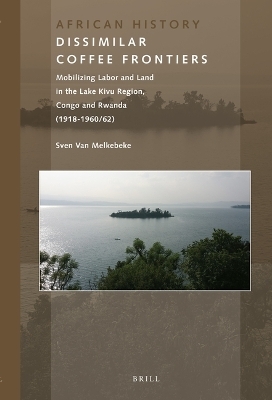
Dissimilar Coffee Frontiers
Brill (Verlag)
978-90-04-42815-7 (ISBN)
In Dissimilar Coffee Frontiers Sven Van Melkebeke compares the divergent development of coffee production in eastern Congo and western Rwanda during the colonial period. The Lake Kivu region offers a remarkable case-study to investigate diversity in economic development. In Rwanda, on the eastern side of the lake, coffee was mainly cultivated by smallholder families, while in the Congo, on the western side of the lake, European plantations were the dominant mode of production.
Making use of a wide array of largely untapped archival sources, Sven Van Melkebeke convincingly succeeds in moving the manuscript beyond a case-study of colonizers to a more nuanced history of interaction and in presenting an innovative new social history of labor and land processes.
Sven Van Melkebeke, Ph.D. (2017), Ghent University, is a postdoctoral fellow affiliated to the Department of History at that university. He has published articles and book chapters on various commodity frontiers (coffee, rubber, cotton).
List of Illustrations and Tables
Acknowledgments
Abbreviations
Introduction
1 Relevance of This Research
1.1 A Historiographical Sketch of Belgian Africa
1.2 Theoretical Framework
2 Geographical and Temporal Scope
3 Coffee Cultivation in Belgian Africa
4 Methodology and Sources
5 Administrative Note
6 Outline
Prelude: The Lake Kivu Region in the Nineteenth Century
1 Lake Kivu’s Communities
2 Peculiarities of the Region
Part 1
Structural Basis
1 Coffee Production: From the Global to the Local
1 The Roots
1.1 “Out of Africa”
1.2 African “Comeback” and the “Birth” of the Kivu Coffee
2 Producing for the Global Market
2.1 Global Coffee Production after World War I
2.2 Belgian Africa’s Capacity
2.3 The Kivu Region
3 Conclusion
2 Explaining the Divergence
1 Historiography: Divergence in Rural Production Systems
2 The Lake Kivu Region: Why Diversity?
2.1 Environmental Factors?
2.2 Successful Examples?
2.3 German Legacy?
2.4 Cost-Effectiveness?
2.5 Famine of 1928–1929?
2.6 Racially Defined Diversity?
2.7 Population Density – Land Availability?
2.8 Customary Land Tenure?
2.9 Mandate versus Colony?
2.10 Land, Locality and Legality as Prevailing Explanations
3 Diversity in Reverse
3.1 Smallholding in Eastern Congo
3.2 Plantations in Western Rwanda
4 Conclusion
Part 2
On the Ground
3 Mobilizing Land for the Coffee Sector
1 The Congolese Kivu: Customary Land Systems and the Early Colonial Period
1.1 Changing Access to Land
1.2 Disputes Over Land
1.3 The Role of the Local Administration
2 The Rwandan Kivu
2.1 Customary Land Tenure and the German Period
2.2 Belgium Enters the Scene
2.3 Land-related Tensions
2.4 Administrative Interventions
3 Conclusion
4 Mobilizing Coffee-Cultivating Labor
1 Colonial Coffee Labor
1.1 Entering the Plantations
1.2 It’s All about the Numbers
1.3 Plantations versus Mines
2 Coffee Labor in the Mandate
2.1 Customary Labor Mobilization and “Chiefly” Cultivation
2.2 Vulgarization and Mobilization of the Rural Masses
2.3 Other Kinds of Coffee Labor
3 Conclusion
5 Coffee Labor on the Spot
1 Workforce West of Lake Kivu
1.1 Dual Employment Categories?
1.2 Remunerating Laborers
1.3 Labor Conditions
2 Workforce East of Lake Kivu
2.1 Coffee Production at Household Level
2.2 Working Conditions in the Smallholder Sector
2.3 Rwandan Plantation Workers
3 Conclusion
6 African Feedback
1 “Weapons of the Weak”
1.1 The Cosyns Case
1.2 Migrations
1.3 Desertions and Absenteeism
1.4 Coffee Pilferage and “illegal” Trade
1.5 Various Kinds of Sabotage
2 Lake Kivu Peasants
2.1 How to Understand “Peasants”?
2.2 Household (Plantation) Land
2.3 Markets and Trade
2.4 Income Diversification and the Role of Women
3 Conclusion
Conclusion: A Merger Based on Diversity and Compromise
1 On Differentiation
2 On Compromise
Annex 1: Decree on Coffee Limitations (1938)
Archives
1 African Archives Brussels (AAB)
1.1 Belgian Congo
1.2 Ruanda-Urundi
2 Other Collections
References
Index
| Erscheinungsdatum | 06.07.2020 |
|---|---|
| Reihe/Serie | African History ; 9 |
| Verlagsort | Leiden |
| Sprache | englisch |
| Maße | 155 x 235 mm |
| Gewicht | 533 g |
| Themenwelt | Geisteswissenschaften ► Geschichte ► Regional- / Ländergeschichte |
| Geschichte ► Teilgebiete der Geschichte ► Kulturgeschichte | |
| Sozialwissenschaften ► Soziologie ► Spezielle Soziologien | |
| ISBN-10 | 90-04-42815-1 / 9004428151 |
| ISBN-13 | 978-90-04-42815-7 / 9789004428157 |
| Zustand | Neuware |
| Informationen gemäß Produktsicherheitsverordnung (GPSR) | |
| Haben Sie eine Frage zum Produkt? |
aus dem Bereich