


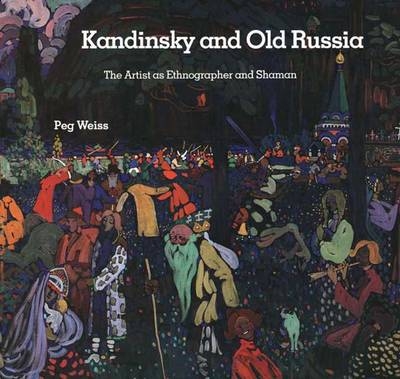
Kandinsky and Old Russia
The Artist as Ethnographer and Shaman
Seiten
1995
Yale University Press (Verlag)
978-0-300-05647-1 (ISBN)
Yale University Press (Verlag)
978-0-300-05647-1 (ISBN)
- Titel ist leider vergriffen;
keine Neuauflage - Artikel merken
Vasilii Kandinsky, whom many consider to be the father of abstract painting, was also a trained ethnographer with an abiding interest in the folklore of Old Russia. This work examines how a commitment to his ethnic Russian heritage influenced Kandinsky's work throughout his career.
Vasilii Kandinsky, whom many consider to be the father of abstract painting, was also a trained ethnographer with an abiding interest in the folklore of Old Russia. In this work, Peg Weiss provides an interpretation of Kandinsky's art by examining how this commitment to his ethnic Russian heritage influenced the painter's work throughout his career. Weiss describes Kandinsky's university training in ethnography, his expedition to Russia's Vologda province in 1889, his involvement as a student with the country's most influential ethnographic group - the Imperial Society of Friends of the Natural Sciences, Anthropology, and Ethnography - and the literature he read while writing reviews for the society's journal, "Ethnographic Review". Weiss shows that Kandinsky's knowledge of Finno-Ugric, Lapp and Siberian shamanism and folklore provided him with an indelible palette of iconographic references that resonated in his work - from his earliest paintings to his last.
Identifying specific ethnographic and folkloristic motifs in his iconography, Weiss argues that despite numerous stylistic changes, Kandinsky's paintings consistently reflected an underlying message: his belief in the shamanist calling of the artist to provide a means of cultural healing and regeneration.
Vasilii Kandinsky, whom many consider to be the father of abstract painting, was also a trained ethnographer with an abiding interest in the folklore of Old Russia. In this work, Peg Weiss provides an interpretation of Kandinsky's art by examining how this commitment to his ethnic Russian heritage influenced the painter's work throughout his career. Weiss describes Kandinsky's university training in ethnography, his expedition to Russia's Vologda province in 1889, his involvement as a student with the country's most influential ethnographic group - the Imperial Society of Friends of the Natural Sciences, Anthropology, and Ethnography - and the literature he read while writing reviews for the society's journal, "Ethnographic Review". Weiss shows that Kandinsky's knowledge of Finno-Ugric, Lapp and Siberian shamanism and folklore provided him with an indelible palette of iconographic references that resonated in his work - from his earliest paintings to his last.
Identifying specific ethnographic and folkloristic motifs in his iconography, Weiss argues that despite numerous stylistic changes, Kandinsky's paintings consistently reflected an underlying message: his belief in the shamanist calling of the artist to provide a means of cultural healing and regeneration.
Kandinsky as ethnographer; motifs of the ethnographic imagination; the artist as a shaman; painting as shamanizing; drum and canvas; metamorphosis and shaman's journey home.
| Erscheint lt. Verlag | 4.7.1995 |
|---|---|
| Zusatzinfo | 150 b&w illustrations, 52 colour plates, notes, bibliography, index |
| Sprache | englisch |
| Maße | 241 x 241 mm |
| Gewicht | 1540 g |
| Themenwelt | Kunst / Musik / Theater ► Kunstgeschichte / Kunststile |
| Kunst / Musik / Theater ► Malerei / Plastik | |
| Sozialwissenschaften ► Soziologie | |
| ISBN-10 | 0-300-05647-8 / 0300056478 |
| ISBN-13 | 978-0-300-05647-1 / 9780300056471 |
| Zustand | Neuware |
| Informationen gemäß Produktsicherheitsverordnung (GPSR) | |
| Haben Sie eine Frage zum Produkt? |
Mehr entdecken
aus dem Bereich

aus dem Bereich
kleine Kulturgeschichte einer brillanten Allianz
Buch | Softcover (2025)
Iudicium (Verlag)
CHF 33,90


