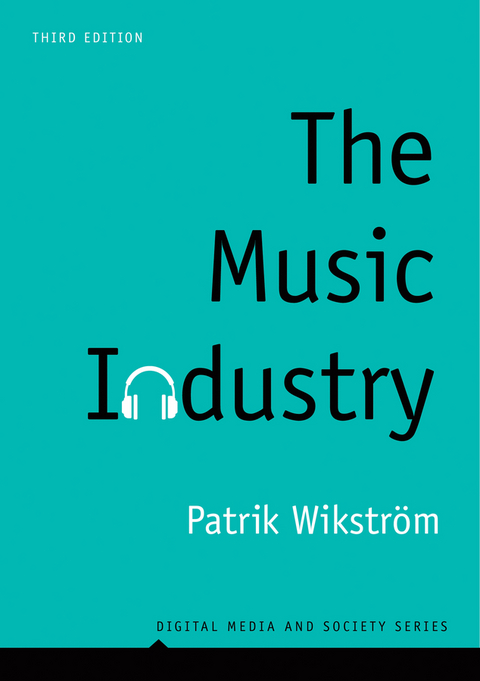
The Music Industry (eBook)
John Wiley & Sons (Verlag)
978-1-5095-3016-8 (ISBN)
The music industry has experienced two turbulent decades of immense change brought about in part by the digital revolution, How has the industry been transformed by these economic and technological upheavals, and how is it likely to change in the future? What is the role of music in this digital age? Wikström illuminates the workings of the industry, deftly capturing the dynamics at work in the production of musical culture between the transnational media conglomerates, the independent music companies and the public, New to this third edition are expanded sections on the changing structure of the music industry, the impact of digitization on music listening practices, and the evolution of music streaming platforms,
Engaging and comprehensive, The Music Industry is a must-read for students and scholars of media and communication studies, cultural studies, popular music, sociology and economics,
Patrik Wikström is Professor in the School of Communication at Queensland University of Technology,
Since the first edition was published in 2009, Patrik Wikstr m's The Music Industry has become a go-to text for students and scholars. This thoroughly updated third edition provides an international overview of the music industry and its future prospects in the world of global entertainment.The music industry has experienced two turbulent decades of immense change brought about in part by the digital revolution. How has the industry been transformed by these economic and technological upheavals, and how is it likely to change in the future? What is the role of music in this digital age? Wikstr m illuminates the workings of the industry, deftly capturing the dynamics at work in the production of musical culture between the transnational media conglomerates, the independent music companies and the public. New to this third edition are expanded sections on the changing structure of the music industry, the impact of digitization on music listening practices, and the evolution of music streaming platforms.Engaging and comprehensive, The Music Industry is a must-read for students and scholars of media and communication studies, cultural studies, popular music, sociology and economics.
Patrik Wikström is Professor in the School of Communication at Queensland University of Technology.
Introduction: Music in the Cloud
1 A Copyright Industry
2 Inside the Music Industry
3 Music and the Media
4 Making Music
5 The Social and Creative Music Fan
6 Future Sounds
Notes
References
Index
CHAPTER ONE
A Copyright Industry
In this chapter I argue that the contemporary music industry is best understood as a ‘copyright industry’. I explain why this is an important starting point for the conceptualization of the music economy in the digital age and I develop a theoretical platform to support the analysis, based on frameworks from organizational theory, social learning theory and the sociology of culture.
Defining industries
Most scholars, regardless of discipline, try to classify and label the objects they research. Music industry scholars do not deviate from this norm, and during the development of the field the music industry has been categorized as a ‘creative industry’, an ‘experience industry’ and a ‘cultural industry’, to name but a few. In this section I examine some of these labels, and I make an argument in favour of the term ‘copyright industry’.
The oldest label, the ‘culture industry’, is usually traced back to the Frankfurt School of Critical Theory and its most recognized scholars, Max Horkheimer and Theodor Adorno. Between 1935 and 1949 the research institute was relocated to Columbia University in New York, and it was during this period that Horkheimer and Adorno wrote their most important work, the Dialektik der Aufklärung (1944).1 In this very influential and pessimistic book, the authors outline how the world is moving closer to self-destruction. One of the chapters examines the ‘culture industry’, which, it is argued, is the result of a process whereby an increase in media and communication technologies leads to the industrial production, circulation and consumption of cultural commodities. The industrialization of these processes results in formulaic, standardized, repetitive, pre-digested products, which reduce the audience to a ‘child-like’ state (Adorno 1941; Hesmondhalgh 2002; Horkheimer and Adorno 1944; Negus 1996, 1997).
During the 1970s, French scholars (e.g., Miège 1979) and policymakers (e.g., Girard 1981) decided to pick up the term. However, they also decided to revise its meaning considerably. First, they changed its form from singular to plural (cultural industries) to denote the diversity between different cultural industries. Second, they rejected the pessimistic and nostalgic position assumed by the Frankfurt School. Instead, they argued that the commodification of culture, facilitated by new technologies, also had its positive sides. For instance, the new technologies enabled innovation and, in addition, ordinary people were allowed access to culture that had previously been out of their reach. Third, while Horkheimer and Adorno considered the field of popular, industrialized culture as frozen and static, these scholars argued that the cultural industries represent a dynamic zone of continuing struggle between commerce and art (Hesmondhalgh 2002: 15–17; Towse 2001: 25).
The early definitions of cultural industries and cultural products are not radically different from today. Hirsch defined cultural products as ‘nonmaterial goods directed at a public of consumers, for whom they generally serve an aesthetic or expressive, rather than utilitarian function’ (1972: 641) Three decades later, the definitions suggested by scholars such as Throsby (2001) and Hesmondhalgh (2002) were very similar to Hirsch’s explanation. Hesmondhalgh, for instance, considers the cultural industries as ‘industries based upon the industrial production and circulation of texts, and which are centrally reliant on the work of symbol creators’ (2002: 14).
Hesmondhalgh’s definition requires two comments. First, regarding the interpretation of the term ‘text’. All cultural artefacts could be considered as texts. However, some cultural artefacts can be mainly functional (e.g., cars, clothes, furniture) while others are mainly communicative (e.g., songs, images, stories, performances). In his definition of cultural industries, Hesmondhalgh is only referring to the latter, that is to say texts that are mainly communicative or symbolic in their nature (2002: 12). Second, instead of using the term ‘artist’, Hesmondhalgh uses the term ‘symbol creators’ for those who make up, interpret or rework these texts (2002: 4–5).
When explicitly defining which industries are cultural and which are not, Girard (1981) suggested that broadcasting, publishing, music and film should be included. Hesmondhalgh’s list of ‘core cultural industries’ is similar to Girard’s, but with the addition of advertising and interactive media (Hesmondhalgh 2002: 12).2 Girard did actually consider advertising as one of the cultural industries, and it is quite understandable why in 1981 he did not choose to add interactive media to the list.
The term ‘cultural industries’ is a rather appealing label with several strengths. The term has a long heritage and has been widely accepted by scholars. However, the term has also been criticized. For instance, Cunningham (2005) argues that ‘cultural industries’ is an out-dated term that is linked to analogue media, nationalistic cultural policies, neoclassical economics applied to the arts, etc. Several other alternative terms aimed at defining the same industries (including the music industry) have therefore been suggested. In policy circles, terms such as ‘creative industries’ and ‘experience industries’ have become widely popular. These definitions usually have a wider scope than the original term and include industries or activities such as architecture, design, fashion, performing arts, crafts and sometimes even tourism, sport and restaurants.
These newer concepts have radically changed the relationship between government and culture. As Hartley describes it:
The ‘creative industries’ idea brought creativity from the back door of government, where it had sat for decades holding out the tin cup for arts subsidy … to the front door, where it was introduced to the wealth-creating portfolios, the emergent industry departments, and the enterprise support programs …. Creative industries [helped] revitalize cities and regions that had moved out of heavy industry, had never developed a strong manufacturing base or who were overexposed to declining IT industries. (2005: 19)
Manchester and Liverpool in the UK are two examples of such governmental reform initiatives (O’Connor 2000). This focus on regional development has also led to an increased interest in these industries by economic geography scholars (e.g., Hallencreutz 2002; Leyshon 2001; Power 2003). In addition, the mapping of these industries has turned into a lucrative business for scholars and consultants alike. Many regions and nations decide they need healthy creative industries and, in order to achieve that goal, the definition of what is actually a part of these industries differs from nation to nation and region to region. For instance, pundits and policymakers in Sweden have decided to use the term ‘experience industry’, which also includes tourism and restaurants. These two sectors combined account for almost 40 per cent of the entire ‘experience industry’ in Sweden and make the definition quite incompatible with many other nations’ industry definitions (Almqvist and Dahl 2003).
The term ‘experience industry’ stems from Pine and Gilmore (1998) and, according to the creators, it may include many business sectors, including retailing, transportation, tourism, banking, media, etc. Pine and Gilmore did not use the term experience industry, but referred to the ‘experience economy’. The experience economy emphasizes how an activity is executed rather than what that activity is all about. The term ‘creative industries’ (Caves 2000; Hartley 2005; Howkins 2001) has, since the early 2000s, largely replaced ‘cultural industries’ as the most frequently used industry label, especially in Anglophone countries. It differs from ‘experience industry’ since it is not focused on how an activity is executed, but on the input required for that execution. However, the problem with this term is almost the same as with ‘experience industry’: it is far too inclusive. Most definitions of the creative industries include architecture, design and fashion. The same arguments motivating the inclusion of these industries could be used, for instance, to include the consumer electronics industry, the automotive industry or the pharmaceutical industry, where creativity also is of great importance. The scope of the definition is so wide that any attempt to produce knowledge which has validity across all the industries included becomes a futile endeavour. Proponents of the term answer this criticism by stating that creative processes are found across all industries, and it is not possible to define the ‘creative industries’ by their output, since it is focused upon the input of these processes (Hartley 2005: 27). That claim is true enough, but industries are not defined by input, or by the manner in which activities are performed. Industries are defined by the goods or services produced or supplied.
It is certainly true that creativity is an important part of many industries, perhaps it is even of growing importance to the entire economy, but, once again, it is questionable whether creativity is a useful label to delineate a part of the economy in order to...
| Erscheint lt. Verlag | 9.1.2020 |
|---|---|
| Reihe/Serie | Digital Media and Society |
| DMS - Digital Media and Society | DMS - Digital Media and Society |
| Sprache | englisch |
| Themenwelt | Kunst / Musik / Theater ► Musik ► Allgemeines / Lexika |
| Sozialwissenschaften ► Kommunikation / Medien ► Medienwissenschaft | |
| Schlagworte | Art & Applied Arts • Communication • Communication & Media Studies • Communication Studies • Cultural Studies • Digital Culture & the Information Age • Digitale Kultur im Informationszeitalter • Digital Media • Kommunikation u. Medienforschung • Kulturwissenschaften • Kunst u. Angewandte Kunst • Mass communication • Massenkommunikation • media • Media Studies • music • Music Industry • Musik • Musikindustrie |
| ISBN-10 | 1-5095-3016-9 / 1509530169 |
| ISBN-13 | 978-1-5095-3016-8 / 9781509530168 |
| Informationen gemäß Produktsicherheitsverordnung (GPSR) | |
| Haben Sie eine Frage zum Produkt? |
 EPUB (Adobe DRM)
Kopierschutz: Adobe-DRM
Adobe-DRM ist ein Kopierschutz, der das eBook vor Mißbrauch schützen soll. Dabei wird das eBook bereits beim Download auf Ihre persönliche Adobe-ID autorisiert. Lesen können Sie das eBook dann nur auf den Geräten, welche ebenfalls auf Ihre Adobe-ID registriert sind.
Details zum Adobe-DRM
Dateiformat: EPUB (Electronic Publication)
EPUB ist ein offener Standard für eBooks und eignet sich besonders zur Darstellung von Belletristik und Sachbüchern. Der Fließtext wird dynamisch an die Display- und Schriftgröße angepasst. Auch für mobile Lesegeräte ist EPUB daher gut geeignet.
Systemvoraussetzungen:
PC/Mac: Mit einem PC oder Mac können Sie dieses eBook lesen. Sie benötigen eine
eReader: Dieses eBook kann mit (fast) allen eBook-Readern gelesen werden. Mit dem amazon-Kindle ist es aber nicht kompatibel.
Smartphone/Tablet: Egal ob Apple oder Android, dieses eBook können Sie lesen. Sie benötigen eine
Geräteliste und zusätzliche Hinweise
Buying eBooks from abroad
For tax law reasons we can sell eBooks just within Germany and Switzerland. Regrettably we cannot fulfill eBook-orders from other countries.
aus dem Bereich