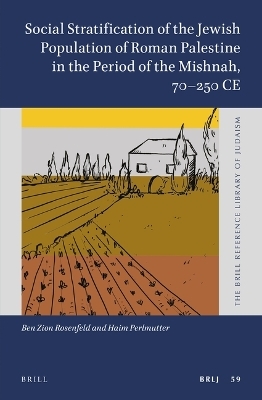
Social Stratification of the Jewish Population of Roman Palestine in the Period of the Mishnah, 70–250 CE
Brill (Verlag)
978-90-04-42213-1 (ISBN)
- Keine Verlagsinformationen verfügbar
- Artikel merken
This book analyzes Jewish society in Roman Palestine in the time of the Mishnah (70–250 CE) in a systematic way, carefully delineating the various economic groups living therein, from the destitute, to the poor, to the middling, to the rich, and to the superrich. It gleans the various socioeconomic strata from the terminology employed by contemporary literary sources via contextual, philological, and historical-critical analysis. It also takes a multidisciplinary approach to analyze and interpret relevant archeological and inscriptional evidence as well as numerous legal sources.
The research presented herein shows that various expressions in the sources have latent meanings that indicate socioeconomic status. “Rich,” for example, does not necessarily refer to the elite, and “poor” does not necessarily refer to the destitute. Jewish society consisted of groups on a continuum from extremely poor to extremely rich, and the various middling groups played a more important role in the economy than has hitherto been thought.
Prof. Ben Zion Rosenfeld is Professor Emeritus in the Department of Jewish History at Bar-Ilan University. He has published many articles and monographs including Torah Centers and Rabbinic Activity in Palestine 70–400 CE (Brill, 2010). Dr. Haim Perlmutter is lecturer at Bar-Ilan University and Ashkelon College. His books Grow with Gemara (Targum Press, 2005) and Tools for Tosafos (Targum Press, 1996) are used by students as a vital introduction to the study of the Talmud and its commentaries.
Contents
Abbreviations
1 Introduction
1 Methodology
2 Sources of the Study: Literature and Archeology
3 Historical Background and Chronology
4 The Roman Economy
5 Structure and Stratification in Roman Society
6 Outline and Structure
7 Sources and Translations
2 Dissecting the Poor Strata of Jewish Society in Roman Palestine, 70–250 CE
1 The Poor and Poverty in the Old Testament
2 The Poor in Non-Biblical Second Temple Literature
3 The Poor in the New Testament
4 Summary
5 The Poor and Poverty in Rabbinic Sources
6 Borderline Poor
7 “Poor” Can Be a Relative Term
8 Historical Background for the Spread of Poverty in Jewish Society
9 Summary
10 Substratification of the Poor in the Roman World
11 Rabbinic Attitudes toward the Poor after the Destruction of the Temple
3 The Laborer (Po’el): On Both Sides of the Poverty Line
1 The Use of the Word Po’el from the Bible to Second Temple Literature
2 The Laborer in Josephus and the New Testament
3 The Laborer in Rabbinic Sources
4 The Laborer’s Economic Situation
5 Summary
6 Laborers in the Roman World
4 Craftsmen and Artisans: the Low Middle Class
1 Crafts in the Roman Empire
2 The Craftsman in Archeological Finds in Roman Palestine
3 The Literary Sources
4 The Craftsman in the Old Testament
5 The Craftsmen in Non-Biblical Second Temple Literature
6 The Craftsmen in the New Testament
7 The Craftsmen in Rabbinic Literature
8 Further Development of Terminology of Craftsmen
9 Historical Background
10 Rabbinic Endorsement of Craftsmanship
11 Summary
5 The Independent Farmer (Ba’al Habayit)
1 The Term “Ba’al Habayit” (“Homeowner”) from Biblical Times until the First Century CE
2 New Testament: Home and Landowner
3 Development of Dominus in Roman Legal Vocabulary
4 Ba’al Habayit in Tannaitic Sources
5 Landowners Representing Members of a Social Group
6 The Economic Status of the Ba’al Habayit
7 Was the Landowner, Ba’al Habayit, Rich?
8 The “House” of the “Householder” (Ba’al Habayit) in Archeological Findings
9 Historical Background
10 The Small Landowner in the Roman Empire
11 Conclusion
6 The “Rich”
1 The “Rich” in the Old Testament and Second Temple Literature
2 The “Rich” in the New Testament
3 The Attitude toward the Rich in the New Testament
4 Summary
5 The Term “Wealthy” in Early Rabbinic Literature
6 Terminology for Wealth
7 Rabbinic Attitudes toward the Rich and Powerful
8 Summary
9 Subdivision of the Wealthy Stratum
10 The Wealthy in Rabbinic Narrative
11 Rich Individuals in Roman Palestine
12 Archeology of Wealth
13 Dwellings in the Vicinity of Roman Palestine: Southern Syria
14 Conclusion
Epilogue
Bibliography
| Erscheinungsdatum | 26.05.2020 |
|---|---|
| Reihe/Serie | The Brill Reference Library of Judaism ; 59 |
| Verlagsort | Leiden |
| Sprache | englisch |
| Maße | 155 x 235 mm |
| Gewicht | 496 g |
| Themenwelt | Geisteswissenschaften ► Religion / Theologie ► Judentum |
| Sozialwissenschaften ► Soziologie ► Makrosoziologie | |
| ISBN-10 | 90-04-42213-7 / 9004422137 |
| ISBN-13 | 978-90-04-42213-1 / 9789004422131 |
| Zustand | Neuware |
| Informationen gemäß Produktsicherheitsverordnung (GPSR) | |
| Haben Sie eine Frage zum Produkt? |
aus dem Bereich