


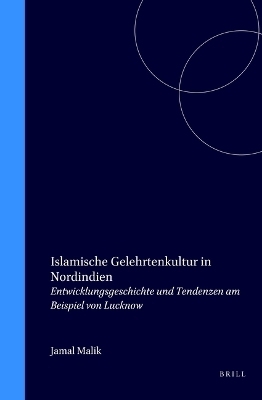
Islamische Gelehrtenkultur in Nordindien
Entwicklungsgeschichte und Tendenzen am Beispiel von Lucknow
Seiten
1997
Brill (Verlag)
978-90-04-10703-8 (ISBN)
Brill (Verlag)
978-90-04-10703-8 (ISBN)
- Titel ist leider vergriffen;
keine Neuauflage - Artikel merken
This volume on Islamic scholarship provides new insights into the social and intellectual history of the complex learned culture in Muslim North India from the fifteenth to the twentieth centuries, by analyzing popular and pietist, traditionalist and reformist movements and institutions.
This insightful volume treats the world of the learned classes in the region of Awadh, in Muslim North India, with its famous capital Lucknow, from the fifteenth to the twentieth centuries. It focusses on those circles which carried, promoted, and reflected acculturation and interference in traditional as well as colonial settings. Part I examines the qasbahs where the seeds are laid for the efflorescence of scholarship, connecting South Asia with the Middle East and Europe. Part II deals with the accommodation of Islamic religious culture in the newly-established territorial states in the 18th century. The last section studies the Learned Council of Islamic Scholars (Nadwat al-‘Ulamā’) in Lucknow, its historical growth and internal set-up as well as its interaction with colonialists and traditionalists. The study is based on rich biographical and chronological accounts, narrative material, archival data, curricula and European reports.
This insightful volume treats the world of the learned classes in the region of Awadh, in Muslim North India, with its famous capital Lucknow, from the fifteenth to the twentieth centuries. It focusses on those circles which carried, promoted, and reflected acculturation and interference in traditional as well as colonial settings. Part I examines the qasbahs where the seeds are laid for the efflorescence of scholarship, connecting South Asia with the Middle East and Europe. Part II deals with the accommodation of Islamic religious culture in the newly-established territorial states in the 18th century. The last section studies the Learned Council of Islamic Scholars (Nadwat al-‘Ulamā’) in Lucknow, its historical growth and internal set-up as well as its interaction with colonialists and traditionalists. The study is based on rich biographical and chronological accounts, narrative material, archival data, curricula and European reports.
Jamal Malik, Ph.D. (1989) in South Asian History, University of Heidelberg, post.doc. (1994) in Islamic Studies, University of Bamberg, has published extensively on the social history of South Asian Islam and literature, including The Colonialization of Islam (Delhi: Manohar, 1996).
| Erscheint lt. Verlag | 1.11.1997 |
|---|---|
| Reihe/Serie | Islamic History and Civilization ; 19 |
| Verlagsort | Leiden |
| Sprache | deutsch |
| Gewicht | 1237 g |
| Einbandart | Leinen |
| Themenwelt | Geschichte ► Allgemeine Geschichte ► Neuzeit (bis 1918) |
| Geisteswissenschaften ► Geschichte ► Regional- / Ländergeschichte | |
| Geschichte ► Teilgebiete der Geschichte ► Kulturgeschichte | |
| Sozialwissenschaften ► Soziologie ► Spezielle Soziologien | |
| ISBN-10 | 90-04-10703-7 / 9004107037 |
| ISBN-13 | 978-90-04-10703-8 / 9789004107038 |
| Zustand | Neuware |
| Informationen gemäß Produktsicherheitsverordnung (GPSR) | |
| Haben Sie eine Frage zum Produkt? |
Mehr entdecken
aus dem Bereich
aus dem Bereich
Geschichte einer wilden Handlung
Buch | Hardcover (2024)
C.H.Beck (Verlag)
CHF 47,60


