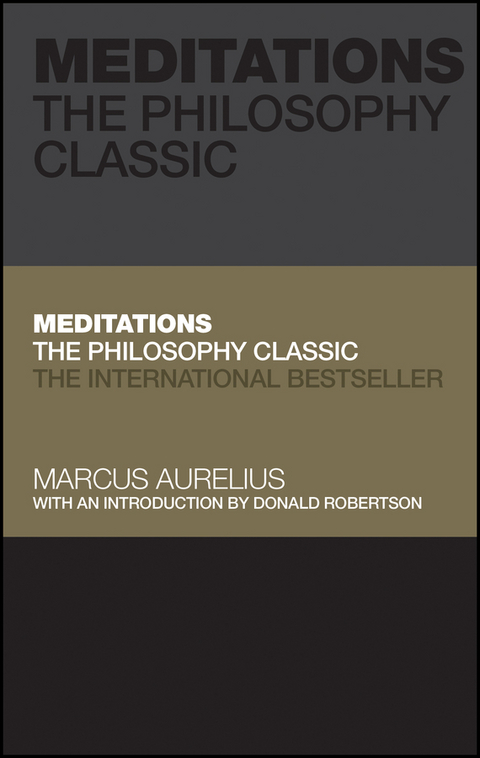
Meditations (eBook)
John Wiley & Sons (Verlag)
978-0-85708-841-3 (ISBN)
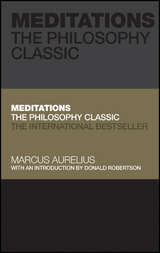
A deluxe special edition of the ancient classic written by the Roman Emperor known as 'The Philosopher'
Meditations is a series of personal journals written by Marcus Aurelius, Emperor of Rome from 169 to 180 AD, The last of the 'Five Good Emperors,' he was the most powerful and influential man in the Western world at the time, Marcus was one of the leaders of Stoicism, a philosophy of personal ethics which sought resilience and virtue through personal action and responsibility, Stoicism, viewed as a foundation of modern self-help, has inspired many personal development and psychotherapy approaches through to the present day,
Meditations is perhaps the most important source of our modern understanding of Stoic philosophy, Its twelve books chronicle different stages of Marcus Aurelius' life and ideas, Although he ruled during the Pax Romana, the age of relative peace and stability throughout the empire, his reign was marked by near-constant military conflict and a devastating plague which killed upwards of five million people, Aurelius' writings give modern readers an unprecedented look into the 'spiritual exercises' which helped him through his tumultuous life and strengthened his patience, empathy, generosity, self-knowledge and emotional health, The private reflections recorded in the Meditations were never meant to be published, rather they were a source for Marcus' own guidance and self-improvement, and jotted down by campfires or in military tents on the Roman front, The lessons, insights and perspectives contained within this remarkable work are just as relevant today as they were two millennia ago, This volume:
- Presents the timeless wisdom of Emperor Marcus Aurelius and his Stoic philosophy, with new research on his life and times
- Contains valuable insights on topics such as resilience, moderation and emotional control
- Discusses how to live 'in agreement with nature' and abide by strong ethical principles
Part of the bestselling Capstone Classics Series edited by Tom Butler-Bowdon, this attractive, high-quality hardcover volume includes:
- An original Introduction by Marcus Aurelius authority and Stoicism expert Donald Robertson, author of How To Think Like A Roman Emperor,
- A modernised, up to date version of the classic George Long translation,
Meditations: The Philosophy Classic is a volume which will occupy a prominent place in any library for years to come,
Marcus Aurelius was Emperor of the Roman Empire from 161 CE to 180 CE and one of the leaders of Stoicism, a philosophy of personal ethics which sought resilience and virtue through personal action and responsibility, His writing has inspired many personal development and psychotherapy approaches through to the present day,
Donald Robertson is a writer, trainer, and cognitive behavioural psychotherapist, He specializes in the relationship between ancient philosophy and modern evidence-based psychological therapy, Donald is the author of six books on philosophy and psychotherapy, including How to Think Like a Roman Emperor: The Stoic Philosophy of Marcus Aurelius (2019),
Tom Butler-Bowdon is series editor for the Capstone Classics series, He has written Introductions for Capstone editions of Plato's The Republic, Machiavelli's The Prince, Adam Smith's The Wealth of Nations, Sun Tzu's The Art of War, Lao Tzu's Tao Te Ching, and Napoleon Hill's Think and Grow Rich, Tom is the author of the 50 Classics series and is a graduate of the London School of Economics and the University of Sydney, www,Butler-Bowdon,com
A deluxe special edition of the ancient classic written by the Roman Emperor known as "e;The Philosopher"e; Meditations is a series of personal journals written by Marcus Aurelius, Emperor of Rome from 169 to 180 AD. The last of the "e;Five Good Emperors,"e; he was the most powerful and influential man in the Western world at the time. Marcus was one of the leaders of Stoicism, a philosophy of personal ethics which sought resilience and virtue through personal action and responsibility. Stoicism, viewed as a foundation of modern self-help, has inspired many personal development and psychotherapy approaches through to the present day. Meditations is perhaps the most important source of our modern understanding of Stoic philosophy. Its twelve books chronicle different stages of Marcus Aurelius life and ideas. Although he ruled during the Pax Romana, the age of relative peace and stability throughout the empire, his reign was marked by near-constant military conflict and a devastating plague which killed upwards of five million people. Aurelius' writings give modern readers an unprecedented look into the "e;spiritual exercises"e; which helped him through his tumultuous life and strengthened his patience, empathy, generosity, self-knowledge and emotional health. The private reflections recorded in the Meditations were never meant to be published, rather they were a source for Marcus' own guidance and self-improvement, and jotted down by campfires or in military tents on the Roman front. The lessons, insights and perspectives contained within this remarkable work are just as relevant today as they were two millennia ago. This volume: Presents the timeless wisdom of Emperor Marcus Aurelius and his Stoic philosophy, with new research on his life and times Contains valuable insights on topics such as resilience, moderation and emotional control Discusses how to live "e;in agreement with nature"e; and abide by strong ethical principles Part of the bestselling Capstone Classics Series edited by Tom Butler-Bowdon, this attractive, high-quality hardcover volume includes: An original Introduction by Marcus Aurelius authority and Stoicism expert Donald Robertson, author of How To Think Like A Roman Emperor. A modernised, up to date version of the classic George Long translation. Meditations: The Philosophy Classic is a volume which will occupy a prominent place in any library for years to come.
Marcus Aurelius was Emperor of the Roman Empire from 161 CE to 180 CE and one of the leaders of Stoicism, a philosophy of personal ethics which sought resilience and virtue through personal action and responsibility. His writing has inspired many personal development and psychotherapy approaches through to the present day. Donald Robertson is a writer, trainer, and cognitive behavioural psychotherapist. He specializes in the relationship between ancient philosophy and modern evidence-based psychological therapy. Donald is the author of six books on philosophy and psychotherapy, including How to Think Like a Roman Emperor: The Stoic Philosophy of Marcus Aurelius (2019). Tom Butler-Bowdon is series editor for the Capstone Classics series. He has written Introductions for Capstone editions of Plato's The Republic, Machiavelli's The Prince, Adam Smith's The Wealth of Nations, Sun Tzu's The Art of War, Lao Tzu's Tao Te Ching, and Napoleon Hill's Think and Grow Rich. Tom is the author of the 50 Classics series and is a graduate of the London School of Economics and the University of Sydney. www.Butler-Bowdon.com
An Introduction Donald Robertson vii
About Donald Robertson xxv
About Tom Butler-Bowdon xxv
Meditations 1
Book One
1. From my grandfather Verus I learned good morals and freedom from anger.
2. From the reputation and memory of my father, modesty and a manly character.
3. From my mother, piety and kindness, and abstinence, not only from evil deeds, but even from evil thoughts; and further, simplicity in my way of living, far removed from the habits of the rich.
4. From my great-grandfather, not to have frequented public schools, and to have had good teachers at home, and to know that on such things a man should spend liberally.
5. From my tutor, to be neither of the green nor of the blue party at the games in the Circus, nor a partisan either of the Parmularius or the Scutarius at the gladiators’ fights. I also learned endurance of labour from him, and to have few wants, and to work with my own hands, and not to meddle with other people's affairs, and to be unwilling to listen to slander.
6. From Diognetus, not to busy myself with trivial things, and not to give credit to what was said by miracle-workers and charlatans about incantations and the exorcism of demons and such things; and not to breed quails for fighting, nor to give myself up passionately to such things; and to endure freedom of speech; and to have become intimate with philosophy; and to attend the lectures, first of Bacchius, then of Tandasis and Marcianus; and to have written dialogues in my youth; and to have desired a plank bed with an animal skin cover, and whatever else of the kind belongs to the Grecian discipline.
7. From Rusticus I received the impression that my character required improvement and therapy; and from him I learned not to be led astray into the emulation of Sophists, nor to write on speculative matters, nor to deliver little moralizing speeches, nor to showing off as a man who practises much discipline, or to perform benevolent acts in order to make a display; and to abstain from rhetoric, and poetry, and fine writing; and not to walk about in the house in my ceremonial attire, nor to do other things of the kind; and to write my letters with simplicity, like the letter which Rusticus wrote from Sinuessa to my mother; and with respect to those who have offended me by words, or done me wrong, to be easily disposed to be pacified and reconciled, as soon as they have shown a readiness to be reconciled; and to read carefully, and not to be satisfied with a superficial understanding of a book; nor hastily to give my assent to those who talk overmuch; and I am indebted to him for being acquainted with the discourses of Epictetus, which he communicated to me out of his own collection.
8. From Apollonius I learned freedom of will and undeviating steadiness of purpose; and to look to nothing else, not even for a moment, except to reason; and to be always the same, in sharp pains, on the occasion of the loss of a child, and in long illness; and to see clearly in a living example that the same man can be both most resolute and yielding, and not irritable in giving instruction; and to have had before my eyes a man who clearly considered his experience and his skill in expounding philosophical principles as the least of his merits; and from him I learned how to receive what are considered favours from friends, without being either humbled by them or letting them pass unnoticed.
9. From Sextus, a benevolent disposition, and the example of a family governed in a fatherly manner, and the idea of living conformably to nature; and gravity without affectation, and to look carefully after the interests of friends, and to tolerate ignorant persons, and those who form opinions without consideration: he had the power of readily accommodating himself to all, so that conversation with him was more agreeable than any flattery; and at the same time he was most highly venerated by those who associated with him: and he had the ability both to discover and organize, in an intelligent and methodical way, the principles necessary for life; and he never showed anger or any other passion, but was entirely free from passion, and also most affectionate; and he could express approval without noisy display, and he possessed much knowledge without calling attention to it.
10. From Alexander the grammarian, to refrain from fault-finding, and not to correct or reproach those who uttered any barbarous or strange-sounding expression or solecism; but adeptly to introduce the very expression which ought to have been used, while replying or giving confirmation, or engaging in an inquiry about the topic itself rather than the word, or by some other tactful means of suggestion.
11. From Fronto I learned to observe what envy, and duplicity, and hypocrisy are in a tyrant, and that generally those among us who are called Patricians are rather deficient in paternal affection.
12. From Alexander the Platonist, not to say to anyone frequently or without necessity, or to write in a letter, that I have no time to spare; nor continually to excuse the neglect of duties required by our relation to those with whom we live, by claiming to have more urgent business.
13. From Catulus, not to be indifferent when a friend finds fault, even if he should find fault without reason, but to try to restore him to his usual disposition; and to be ready to speak well of teachers, as it is reported of Domitius and Athenodotus; and to love my children truly.
14. From my “brother” Severus, to love my kin, and to love truth, and to love justice; and through him I learned to know Thrasea, Helvidius, Cato, Dio, Brutus; and from him I received the idea of a political state in which there is the same law for all, one administered with regard to equal rights and equal freedom of speech, and the idea of a kingly government which respects most of all the freedom of the governed; I learned from him also consistency and undeviating steadiness in my regard for philosophy; and a disposition to do good, and to give to others readily, and to cherish good hopes, and to believe that I am loved by my friends; and in him I observed no attempt to conceal his opinions with respect to those of whom he disapproved, and that his friends had no need to speculate about what he wished or did not wish, but it was quite plain.
15. From Maximus I learned self-mastery, and not to be led aside by anything; and cheerfulness in all circumstances, as well as in illness; and a good mixture in of gentleness and dignity in one's character, and to do what was set before me without complaining. I noticed that everybody believed that what he said was what he thought, and that in all that he did he never had any bad intention; and he never showed amazement and surprise, and was never in a hurry, and never put off doing a thing, nor was perplexed nor dejected, nor did he ever laugh to disguise his vexation, nor, on the other hand, was he ever passionate or suspicious. He was accustomed to perform acts of kindness, and was ready to forgive, and was free from all falsehood; and he gave the appearance of a man who could not be diverted from the right path rather than of a man who had to be set right by others. I observed, too, that no man could ever think that he was looked down upon by Maximus, or ever venture to think himself a better man. He had also the art of being humorous in an agreeable way.
16. In my [adoptive] father [the emperor Antoninus Pius] I observed mildness of temper, and unchangeable resolution in the things which he had determined after due deliberation; and no vanity regarding those things which men call honours; and a love of hard work and perseverance; and readiness to listen to those who had anything to propose for the common good; and undeviating firmness in giving to every man according to his deserts; and knowing from experience when to undertake action vigorously and when to relax. And I observed that he had overcome all passion for boys; and he considered himself no more than any other citizen; and he released his friends from all obligation to dine with him or to attend him when he travelled, and those who had failed to accompany him, by reason of any urgent circumstances, always found him the same. I also observed his habit of careful inquiry in all matters of deliberation, and his persistence, and that he never stopped his investigation through being satisfied with appearances which first present themselves; and that his disposition was to keep his friends, and not to become quickly tired of them, nor to be extravagant in his displays of affection; and to be satisfied on all occasions, and cheerful; and to anticipate events in the distant future, and to provide for the smallest without display; and immediately to put a stop to popular applause and all flattery; and to be constantly watchful over the things which were necessary for the administration of the empire, and to be a good manager of public expenditure, and patiently to endure the blame which he got for such conduct; and he was neither superstitious with respect to the gods, nor did he court men by gifts or by trying to please them, or by flattering the populace; but he showed sobriety in all things and firmness, and never any mean thoughts or action, nor love of novelty for its own sake. And the things which contributed in any way to life's comfort, and of which fortune gives an abundant supply, he used without arrogance and without apology; so that when he had them, he enjoyed them without affectation, and when he did not have them, he did not desire them. No one could ever say of him that he was either a Sophist or servile or a pedant; but...
| Erscheint lt. Verlag | 16.12.2019 |
|---|---|
| Reihe/Serie | Capstone Classics |
| Capstone Classics | Capstone Classics |
| Einführung | Donald Robertson |
| Mitarbeit |
Herausgeber (Serie): Tom Butler-Bowdon |
| Sprache | englisch |
| Themenwelt | Geisteswissenschaften ► Philosophie ► Allgemeines / Lexika |
| Geisteswissenschaften ► Philosophie ► Geschichte der Philosophie | |
| Geisteswissenschaften ► Philosophie ► Östliche Philosophie | |
| Geisteswissenschaften ► Philosophie ► Philosophie der Neuzeit | |
| Sozialwissenschaften | |
| Schlagworte | Ancient Philosophy • Antike • Antike u. mittelalterliche Philosophie • <p>Marcus Aurelius • Marcus Aurelius • marcus aurelius meditations • Marcus Aurelius philosophy • Marcus Aurelius self-help • Marcus Aurelius self-improvement • marcus aurelius stoicism • Marcus Aurelius Stoics • modern stoicism • Philosophie • Philosophy • Philosophy Special Topics • Spezialthemen Philosophie • Stoic concepts • Stoic ethics • Stoic ethics</p> • Stoic Philosophy • Weltphilosophie • World philosophy |
| ISBN-10 | 0-85708-841-6 / 0857088416 |
| ISBN-13 | 978-0-85708-841-3 / 9780857088413 |
| Informationen gemäß Produktsicherheitsverordnung (GPSR) | |
| Haben Sie eine Frage zum Produkt? |
 EPUB (Adobe DRM)
Kopierschutz: Adobe-DRM
Adobe-DRM ist ein Kopierschutz, der das eBook vor Mißbrauch schützen soll. Dabei wird das eBook bereits beim Download auf Ihre persönliche Adobe-ID autorisiert. Lesen können Sie das eBook dann nur auf den Geräten, welche ebenfalls auf Ihre Adobe-ID registriert sind.
Details zum Adobe-DRM
Dateiformat: EPUB (Electronic Publication)
EPUB ist ein offener Standard für eBooks und eignet sich besonders zur Darstellung von Belletristik und Sachbüchern. Der Fließtext wird dynamisch an die Display- und Schriftgröße angepasst. Auch für mobile Lesegeräte ist EPUB daher gut geeignet.
Systemvoraussetzungen:
PC/Mac: Mit einem PC oder Mac können Sie dieses eBook lesen. Sie benötigen eine
eReader: Dieses eBook kann mit (fast) allen eBook-Readern gelesen werden. Mit dem amazon-Kindle ist es aber nicht kompatibel.
Smartphone/Tablet: Egal ob Apple oder Android, dieses eBook können Sie lesen. Sie benötigen eine
Geräteliste und zusätzliche Hinweise
Buying eBooks from abroad
For tax law reasons we can sell eBooks just within Germany and Switzerland. Regrettably we cannot fulfill eBook-orders from other countries.
aus dem Bereich