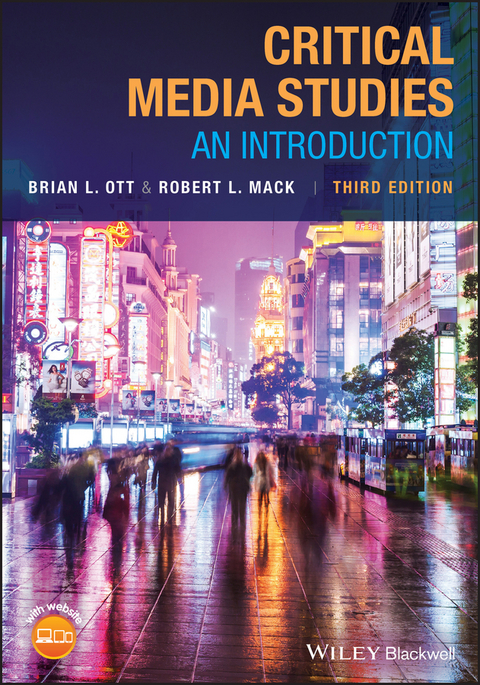
Critical Media Studies (eBook)
John Wiley & Sons (Verlag)
978-1-119-40628-0 (ISBN)
An engaging and accessible introduction to a broad range of critical approaches to contemporary mass media theory and research
A decade after its first publication, Critical Media Studies continues toshape and define the field of media studies, offering innovative approaches that enable readers to explore the modern media landscape from a wide variety of perspectives. Integrating foundational theory and contemporary research, this groundbreaking text offers the most comprehensive set of analytical approaches currently available. Twelve critical perspectives-pragmatic, rhetorical, sociological, erotic, ecological, and others-enable readers to assess and evaluate the social and cultural consequences of contemporary media in their daily lives.
The new third edition includes up-to-date content that reflects the current developments and cutting-edge research in the field. New or expanded material includes changing perceptions of race and gender, the impact of fandom on the media, the legacy of the television age, the importance of media literacy in the face of 'fake news', and developments in industry regulations and U.S. copyright law. This textbook:
- Presents clear, reader-friendly chapters organized by critical perspective
- Features up-to-date media references that resonate with modern readers
- Incorporates enhanced and updated pedagogical features throughout the text
- Offers extensively revised content for greater clarity, currency, and relevance
- Includes fully updated illustrations, examples, statistics, and further readings
Critical Media Studies, 3rd Edition is the ideal resource for undergraduate students in media studies, cultural studies, popular culture, communication, rhetoric, and sociology, graduate students new to critical perspectives on the media, and scholars in the field.
Brian L. Ott is Professor of Communication, Department of Communication Studies, Texas Tech University. He is author of The Twitter Presidency: Donald J. Trump and the Politics of White Rage, The Small Screen: How Television Equips Us to Live in the Information Age, and co-editor of It's Not TV: Watching HBO in the Post-Television Era.
Robert L. Mack is Honors Faculty Fellow Tempe at Barrett, The Honors College, at Arizona State University. His writing has appeared in appeared in The Journal of the Fantastic in the Arts, The Journal of Religion and Communication, and The Quarterly Review of Film and Video.
Brian L. Ott is Professor of Communication, Department of Communication Studies, Texas Tech University. He is author of The Twitter Presidency: Donald J. Trump and the Politics of White Rage, The Small Screen: How Television Equips Us to Live in the Information Age, and co-editor of It's Not TV: Watching HBO in the Post-Television Era. Robert L. Mack is Honors Faculty Fellow Tempe at Barrett, The Honors College, at Arizona State University. His writing has appeared in appeared in The Journal of the Fantastic in the Arts, The Journal of Religion and Communication, and The Quarterly Review of Film and Video.
Preface
1 - Introducing Critical Media Studies1
Part I Media Industries: Marxist, Organizational, and Pragmatic Perspectives
2 - Marxist Analysis
3 - Organizational Analysis
4 - Pragmatic Analysis
Part II Media Messages: Rhetorical, Cultural, Psychoanalytic, Feminist, and Queer Perspectives
5 - Rhetorical Analysis
6 - Cultural Analysis
7 - Psychoanalytic Analysis
8 - Feminist Analysis
9 - Queer Analysis
Part III Media Audiences: Reception, Sociological, Erotic, and Ecological Perspectives
10 - Reception Analysis
11 - Sociological Analysis
12 - Erotic Analysis
13 - Ecological Analysis
14 - Conclusion: the Partial Pachyderm
Appendix: Sample Student Essays
Glossary
Index
1
Introducing Critical Media Studies
KEY CONCEPTS
- CONVERGENCE
- CRITICAL MEDIA STUDIES
- FRAGMENTATION
- GLOBALIZATION
- MASS MEDIA
- MEDIUM
- MOBILITY
- POSTMODERNITY
- SOCIALIZATION
- THEORY
- SIMULATION
How We Know What We Know
Everything we know is learned in one of two ways.1 The first way is somatically. These are the things we know through direct sensory perception of our environment. We know what some things look, smell, feel, sound, or taste like because we personally have seen, smelled, felt, heard, or tasted them. One of the authors of this text knows, for example, that “Rocky Mountain oysters” (bull testicles) are especially chewy because he tried them once at a country and western bar. In short, some of what we know is based on first‐hand, unmediated experience. But the things we know through direct sensory perception make up a very small percentage of the total things we know. The vast majority of what we know comes to us a second way, symbolically. These are the things we know through someone or something, such as a parent, friend, teacher, museum, textbook, photograph, radio, film, television, or the internet. This type of information is mediated, meaning that it came to us via some indirect channel or medium. The word “medium” is derived from the Latin word medius, which means “middle” or that which comes between two things: the way that BBC’s Planet Earth production team might come between us and the animals of the Serengeti, for instance.
In the past 30 seconds, those readers who have never eaten Rocky Mountain oysters have come to know that they are chewy, as that information has been communicated to them through, or mediated by, this book. When we stop to think about all the things we know, we suddenly realize that the vast majority of what we know is mediated. We may know something about China even if we have never been there thanks to Wikipedia; we may know something about Winston Churchill despite our never having met him thanks to Darkest Hour (2017); we may even know something about the particulars of conducting a homicide investigation even though we have likely never conducted one thanks to the crime drama CSI. The mass media account, it would seem, for much of what we know (and do not know) today. But this has not always been the case.
Before the invention of mass media, the spoken or written word was the primary medium for conveying information and ideas. This method of communication had several significant and interrelated limitations. First, as the transmission of information was tied to the available means of transportation (foot, horse, buggy, boat, locomotive, or automobile, depending upon the time period), its dissemination was extraordinarily slow, especially over great distances such as across continents and oceans. Second, because information could not easily be reproduced and distributed, its scope was extremely limited. Third, since information often passed through multiple channels (people), each of which altered it, if only slightly, there was a high probability of message distortion. Simply put, there was no way to communicate a uniform message to a large group of people in distant places quickly prior to the advent of the modern mass media. What distinguishes mass media like print, radio, and television from individual media like human speech and hand‐written letters, then, is precisely their unique capacity to address large audiences in remote locations with relative efficiency.
Critical Media Studies is about the social and cultural consequences of that revolutionary capability. Recognizing that mass media are, first and foremost, communication technologies that increasingly mediate both what we know and how we know, this book surveys a variety of perspectives for evaluating and assessing the role of mass media in our daily lives. Whether listening to Spotify while walking across campus, sharing pictures with friends on Instagram, receiving the latest sports scores via your mobile phone, retweeting your favorite YouTube video, or binge watching popular Netflix series like Stranger Things or 13 Reasons Why, the mass media are regular fixtures of everyday life. But before beginning to explore the specific and complex roles that mass media play in our lives, it is worth looking at who they are, when they originated, and how they have developed.
Categorizing Mass Media
As is perhaps already evident, “media” is a very broad term that includes a diverse array of communication technologies, such as cave drawings, speech, smoke signals, letters, books, telegraphy, telephony, magazines, newspapers, radio, film, television, smartphones, video games, and networked computers, to name just a few. But this book is principally concerned with mass media, or those communication technologies that have the potential to reach a large audience in remote locations. What distinguishes mass media from individual media, then, is not merely audience size. While a graduation speaker or musician may address as many as 40 000 people at once in a stadium, they are not mass mediated because the audience is not remote. Now, of course, if an Ariana Grande concert is being broadcast live via satellite, those watching at home on their televisions or over the internet are experiencing it through mass media. Mass media collapse the distance between artist and audience, then. Working from this definition, we have organized the mass media into four subcategories: print media, motion picture and sound recording, broadcast media, and new media. These categories, like all acts of classification, are arbitrary, meaning that they emphasize certain features of the media they group together at the expense of others. Nonetheless, we offer them as one way of conceptually organizing mass communication technologies. As our media environment becomes increasingly digital, the utility and value of these categories is mostly historical.
Print media
In an electronically saturated world like the one in which we live today, it is easy to overlook the historical legacy and contemporary transformations of print media, the first mass medium. German printer Johannes Gutenberg invented the movable‐type printing press in 1450, sparking a revolution in the ways that human beings could disseminate, preserve, and ultimately relate to knowledge. Printed materials before the advent of the press were costly and rare, but the invention of movable type allowed for the (relatively) cheap production of a diverse array of pamphlets, books, and other items. This flourishing of printed materials touched almost every aspect of human life. Suddenly knowledge could be recorded for future generations in libraries or religious texts, and social power increasingly hinged upon literacy and ownership of printed materials. Most importantly, the press allowed for an unprecedented circulation of knowledge to far‐flung cities across Europe. Though still limited by class distinctions, access to information from outside of one’s immediate context was a real possibility. Mass media was born.
Not long after the settlement of Jamestown in 1607, the new American colonies established their first printing press. Located in Cambridge, Massachusetts, the press was printing popular religious tracts – such as the Bay Psalm Book, a 148‐page collection of English translations of Hebrew – by 1640.2 Though much of the early printing in the colonies was religion‐oriented, novels such as Robinson Crusoe (1719) and Tom Jones (1749), imported from England, were also popular. Religious tracts were eventually followed by almanacs, newspapers, and magazines. The most well‐known early almanac, Poor Richard’s Almanack, which included information on the weather along with some political opinions, was printed by Benjamin Franklin in Philadelphia from 1733 to 1757. Though various cities had short‐lived or local non‐daily newspapers in the 1700s, the New York Sun, which is considered the first successful mass‐circulation newspaper, did not begin operations until 1833.3 The failure of earlier newspapers is often attributed to the fact that they were small operations run by local printers. It was not until newspapers began using editors and receiving substantial financial backing – first from political parties and later from wealthy elites like Joseph Pulitzer and William Randolph Hearst – that the newspaper industry mushroomed.
During the 19th and 20th centuries, the newspaper industry experienced rapid growth. This trend continued until 1973, at which point there were 1774 daily newspapers with a combined circulation of 63.1 million copies. This meant that about 92 percent of US households were subscribing to a daily newspaper in 1973. Since then, however, newspaper production and circulation have steadily declined, and, as of 2016, there were only 1286 daily newspapers in the United States, with a total estimated circulation 30.9 million in 2017: a more than 50 percent drop from the high water point in 1973.4
In many ways, the history of the magazine industry in the United States mirrors that of the newspaper industry. It began somewhat unsteadily, underwent tremendous growth, and is currently experiencing a period of instability. The...
| Erscheint lt. Verlag | 9.12.2019 |
|---|---|
| Sprache | englisch |
| Themenwelt | Sozialwissenschaften ► Kommunikation / Medien ► Medienwissenschaft |
| Sozialwissenschaften ► Politik / Verwaltung | |
| Schlagworte | Communication & Media Studies • Critical Media Studies • critical media studies intro • Critical theory • Cultural Studies • Cultural Theory • Kommunikation • Kommunikation u. Medienforschung • <p>critical media studies textbook • Mass media • mass media research • mass media textbook • mass media theory • Media Analysis • media criticism</p> • media reference • Media Studies • Medienforschung • Mediensoziologie • Sociology • Sociology of the Media • Soziologie |
| ISBN-10 | 1-119-40628-5 / 1119406285 |
| ISBN-13 | 978-1-119-40628-0 / 9781119406280 |
| Informationen gemäß Produktsicherheitsverordnung (GPSR) | |
| Haben Sie eine Frage zum Produkt? |
 EPUB (Adobe DRM)
Größe: 7,2 MB
Kopierschutz: Adobe-DRM
Adobe-DRM ist ein Kopierschutz, der das eBook vor Mißbrauch schützen soll. Dabei wird das eBook bereits beim Download auf Ihre persönliche Adobe-ID autorisiert. Lesen können Sie das eBook dann nur auf den Geräten, welche ebenfalls auf Ihre Adobe-ID registriert sind.
Details zum Adobe-DRM
Dateiformat: EPUB (Electronic Publication)
EPUB ist ein offener Standard für eBooks und eignet sich besonders zur Darstellung von Belletristik und Sachbüchern. Der Fließtext wird dynamisch an die Display- und Schriftgröße angepasst. Auch für mobile Lesegeräte ist EPUB daher gut geeignet.
Systemvoraussetzungen:
PC/Mac: Mit einem PC oder Mac können Sie dieses eBook lesen. Sie benötigen eine
eReader: Dieses eBook kann mit (fast) allen eBook-Readern gelesen werden. Mit dem amazon-Kindle ist es aber nicht kompatibel.
Smartphone/Tablet: Egal ob Apple oder Android, dieses eBook können Sie lesen. Sie benötigen eine
Geräteliste und zusätzliche Hinweise
Buying eBooks from abroad
For tax law reasons we can sell eBooks just within Germany and Switzerland. Regrettably we cannot fulfill eBook-orders from other countries.
aus dem Bereich