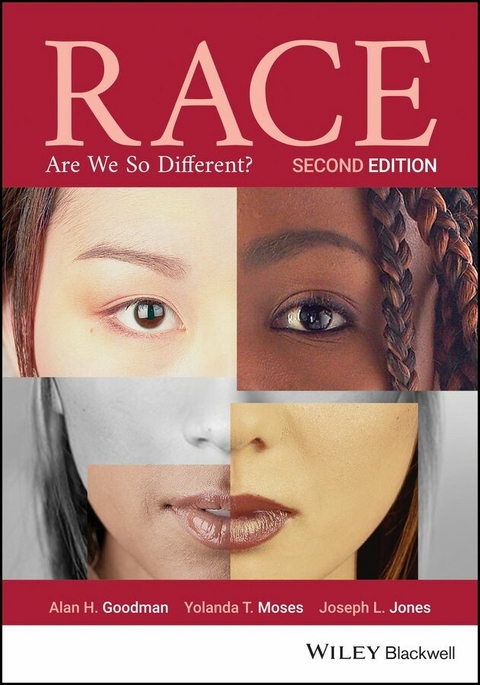
Race (eBook)
John Wiley & Sons (Verlag)
978-1-119-47241-4 (ISBN)
The second edition of the bestselling title on modern notions of race, providing timely examination of perspectives on race, racism, and human biological variation
In this fully updated second edition of this popular text on the study of race, Alan Goodman, Yolanda Moses, and Joseph Jones take a timely look at modern ideas surrounding race, racism, and human diversity, and consider the ways that ideas about race have changed over time. New material in the second edition covers recent history and emerging topics in the study of race. The second edition has also been updated to account for advancements in the study of human genetic variation, which provide further evidence that race is an entirely social phenomenon. RACE compels readers to carefully consider their own ideas about race and the role that race plays in the world around them.
- Examines the ways perceptions of race influence laws, customs, and social institutions in the US and around the world
- Explores the impact of race and racism on health, wealth, education, and other domains of life
- Includes guest essays by noted scholars, a complete bibliography, and a full glossary
- Stands as an ideal text for courses on race, racism, and cultural and economic divides
- Combines insights and examples from science, history, and personal narrative
- Includes engaging photos, illustrations, timelines, and diagrams to illustrate important concepts
To read author Alan Goodman's recent blog post on the complicated relationship between race and biology, please click here.
Alan H. Goodman is Professor of Biological Anthropology at Hampshire College and former Vice President of Academic Affairs and Dean of Faculty. He has written extensively on human variation and the biological consequences of inequality and poverty and co-leads the RACE national public education project sponsored by the AAA and funded by NSF and the Ford Foundation. Goodman is a former President of the AAA.
Yolanda T. Moses is Professor of Anthropology and recent Associate Vice Chancellor for Diversity, Excellence and Equity at the University of California, Riverside. A cultural anthropologist, she has published extensively on issues of social inequality in complex societies and cultural diversity in higher education. She co-leads the RACE national education project and is a former President of the AAA.
Joseph L. Jones is Assistant Professor of Anthropology at the College of William & Mary. A biological anthropologist, his work involves descendant community engagement and skeletal research on African diasporic biohistory and health. He has published on slavery and environmental lead exposure at the New York African Burial Ground in Lower Manhattan. Jones is former RACE project manager for the American Anthropological Association.
Sponsored by the American Anthropological Association (AAA). Based out of Washington DC, the American Anthropological Association is a professional association for anthropologists working across the four major fields of anthropology - biological anthropology, archaeology, linguistic anthropology, and cultural anthropology. With approximately 10,000 members, the AAA supports researchers, higher education professionals, students, and individuals working in the public, private, and non-governmental sectors. The AAA publishes a portfolio of more than 20 journals, stages annual research conferences, and supports anthropologists at all stages of their careers through awards and fellowships, career planning services, and internship and summer field school programs.
The second edition of the bestselling title on modern notions of race, providing timely examination of perspectives on race, racism, and human biological variation In this fully updated second edition of this popular text on the study of race, Alan Goodman, Yolanda Moses, and Joseph Jones take a timely look at modern ideas surrounding race, racism, and human diversity, and consider the ways that ideas about race have changed over time. New material in the second edition covers recent history and emerging topics in the study of race. The second edition has also been updated to account for advancements in the study of human genetic variation, which provide further evidence that race is an entirely social phenomenon. RACE compels readers to carefully consider their own ideas about race and the role that race plays in the world around them. Examines the ways perceptions of race influence laws, customs, and social institutions in the US and around the world Explores the impact of race and racism on health, wealth, education, and other domains of life Includes guest essays by noted scholars, a complete bibliography, and a full glossary Stands as an ideal text for courses on race, racism, and cultural and economic divides Combines insights and examples from science, history, and personal narrative Includes engaging photos, illustrations, timelines, and diagrams to illustrate important concepts To read author Alan Goodman's recent blog post on the complicated relationship between race and biology, please click here.
Alan H. Goodman is Professor of Biological Anthropology at Hampshire College and former Vice President of Academic Affairs and Dean of Faculty. He has written extensively on human variation and the biological consequences of inequality and poverty and co-leads the RACE national public education project sponsored by the AAA and funded by NSF and the Ford Foundation. Goodman is a former President of the AAA. Yolanda T. Moses is Professor of Anthropology and recent Associate Vice Chancellor for Diversity, Excellence and Equity at the University of California, Riverside. A cultural anthropologist, she has published extensively on issues of social inequality in complex societies and cultural diversity in higher education. She co-leads the RACE national education project and is a former President of the AAA. Joseph L. Jones is Assistant Professor of Anthropology at the College of William & Mary. A biological anthropologist, his work involves descendant community engagement and skeletal research on African diasporic biohistory and health. He has published on slavery and environmental lead exposure at the New York African Burial Ground in Lower Manhattan. Jones is former RACE project manager for the American Anthropological Association. Sponsored by the American Anthropological Association (AAA). Based out of Washington DC, the American Anthropological Association is a professional association for anthropologists working across the four major fields of anthropology - biological anthropology, archaeology, linguistic anthropology, and cultural anthropology. With approximately 10,000 members, the AAA supports researchers, higher education professionals, students, and individuals working in the public, private, and non-governmental sectors. The AAA publishes a portfolio of more than 20 journals, stages annual research conferences, and supports anthropologists at all stages of their careers through awards and fellowships, career planning services, and internship and summer field school programs.
List of Illustrations
| 1.1 | White supremacists in Charlottesville, VA, 2017 |
| The imaginary of whiteness |
| 3.1 | The “Great Chain of Being” |
| 3.2 | Lorenz Fries’ Caribbean cannibals |
| 3.3 | The Landing of the Pilgrims at Plymouth |
| 3.4 | Pocahontas |
| 3.5 | The first Africans arrive in Jamestown |
| 3.6 | Metacom, or King Philip |
| 3.7 | Carolus Linnaeus |
| 3.8 | Systema Naturae |
| 3.9 | Thomas Jefferson |
| 4.1 | Blumenbach’s five races |
| 4.2 | Samuel Morton |
| 4.3 | Nott and Gliddon’s Types of Mankind |
| 4.4 | Frederick Douglass |
| 4.5 | Native American lifeways display c. 1902 |
| 4.6 | Anténor Firmin |
| 4.7 | Minik |
| 4.8 | Franz Boas |
| 4.9 | 1917 Army Beta test for “innate intelligence” |
| 4.10 | Jesse Owens at the start of his record‐breaking 200‐meter race in the 1936 Olympics |
| 4.11 | “The Inheritance of Racial Features” |
| 4.12 | Kennewick Man |
| 5.1 | Map of the distribution of the European race |
| 5.2 | Caricature of the unassimilable Irish |
| 5.3 | Visit of the Ku‐Klux |
| 5.4 | Native children forced to attend boarding school |
| 5.5 | Anti‐Chinese “Workingmen’s Party” poster |
| 5.6 | The Cliff Dwellers’ Village at the 1904 World’s Fair |
| 5.7 | Booker T. Washington |
| 5.8 | The Birth of a Nation |
| 5.9 | Lucky Brown Pressing Oil |
| 5.10 | The cast of Leave It to Beaver |
| 5.11 | “Race tag” |
| 6.1 | Slave auction advertisement |
| 6.2 | Harriet Tubman |
| 6.3 | Dred Scott |
| 6.4 | Mid‐19th‐century advertisement encouraging westward migration |
| 6.5 | “Some reasons for Chinese exclusion” |
| 6.6 | Wong Kim Ark |
| 6.7 | Composite photograph of the heads of justices from various years |
| 6.8 | Thurgood Marshall |
| 6.9 | Social Security poster |
| 6.10 | Japanese Americans bound for Manzanar |
| 6.11 | George McLaurin, required to sit apart from white students |
| 6.12 | Rosa Parks following her arrest for violating segregation law |
| 6.13 | President Johnson signs the Civil Rights Act into law |
| 6.14 | U.S. presidents to 2016 |
| Race is not “in the blood” |
| 7.1 | Jeff Van Gundy and Yao Ming |
| 7.2 | Race is like a gun |
| 7.3 | Kenyan children |
| 7.4 | Girls from Oslo |
| 7.5 | Cube of variation |
| 7.6 | “The Tall and Short of It” |
| 7.7 | Silhouettes of individuals, from short to tall |
| 8.1 | Rainbow of human skin colors |
| 8.2 | Vitamin D metabolism |
| 8.3 | Map of human skin color distribution |
| 8.4 | The layers of human skin |
| 8.5 | Inuit children |
| 8.6 | Radiograph of a child with rickets |
| 8.7 | Von Luschan color tiles |
| 8.8 | Skin reflectance spectrophotometer |
| 8.9 | Walk from Nairobi to Oslo |
| 9.1 | Normal and sickled red blood cells |
| 9.2 | The structure of hemoglobin |
| 9.3 | Cross‐section of a blood vessel with normal and sickled red blood cells |
| 9.4 | How individuals might inherit sickle cell disease and sickle cell trait |
| 9.5 | Pathway by which individuals contract malaria |
| 9.6 | Farming in humid climates, producing pools of stagnant water |
| 9.7 | Anopheles minimus |
| 9.8 | Distributions of malaria and sickle cell allele |
| 9.9 | Frank Giacomazza and his daughter, Angelina |
| 10.1 | Venn diagrams representing three views of human genetic variation |
| 10.2 | Bar graph of the average genetic differences within and between “races” or continental groups |
| 10.3 | Venn diagram of human genetic diversity |
| 11.1 | “21 A Bus” |
| 11.2 | Dominos as a metaphor for the spread of genetic variation |
| 11.3 | A pointillist view of human evolution and variation |
| 11.4 | Major routes of migration |
| 11.5 | Trade routes ca. 800 to 1000 years ago |
| 11.6 | Ear ornament made of seashell from the Gulf Coast |
| 11.7 | Costa Rican jade pendant |
| 11.8 | Henry Greely |
| 11.9 | Alondra Nelson |
| 11.10 | Kim TallBear |
| 11.11 | Duana Fullwiley |
| “Chief Illiniwek,” the mascot of the University of Illinois at Urbana‐Champaign |
| 12.1 | Taking a knee |
| 13.1 | Students and a faculty advisor from Macalester College in St. Paul, Minnesota |
| 13.2 | U.S. census race categories, 1790–2010 |
| 13.3 | Enslaved African American family |
| 13.4 | Closing the gate on racially undesirable Chinese immigrants |
| 13.5 | Japanese Americans being relocated to internment camps |
| 13.6 | Alabama physician Josiah Nott |
| 13.7 | Asian immigrants arriving at Angel Island, about 1910 |
| 13.8 | Romina Takimoto |
| 13.9 | South Asian girl |
| 13.10 | Deportees waiting at a train station in Los Angeles, March 9, 1932 |
| 13.11 | Immigration reform activists protest in Washington, DC |
| 13.12 | The children in this family can now choose how the census classifies them |
| 13.13 | Kemi Adeyemi |
| 13.14 | “I am a person” |
| 13.15 | “I’m a grown man who just exposed my breasts to a complete stranger” |
| 13.16 | A wide range of people are... |
| Erscheint lt. Verlag | 5.12.2019 |
|---|---|
| Sprache | englisch |
| Themenwelt | Sozialwissenschaften ► Ethnologie |
| Sozialwissenschaften ► Politik / Verwaltung | |
| Sozialwissenschaften ► Soziologie | |
| Schlagworte | Anthropologie • Anthropologie / Rassen- u. Volkszugehörigkeit, Identität • Anthropology • Anthropology of Race, Ethnicity & Identity • Cultural Studies • evolution variation • history of race • History of Racism • Human genetics • human variation • Institutional Racism • Kulturwissenschaften • Race & Ethnicity Studies • race and education • Race and Health • race and wealth • race anthropology • race racism • race textbook • racism anthropology • Rasse • Rassen- u. Ethnienforschung |
| ISBN-10 | 1-119-47241-5 / 1119472415 |
| ISBN-13 | 978-1-119-47241-4 / 9781119472414 |
| Informationen gemäß Produktsicherheitsverordnung (GPSR) | |
| Haben Sie eine Frage zum Produkt? |
 EPUB (Adobe DRM)
Kopierschutz: Adobe-DRM
Adobe-DRM ist ein Kopierschutz, der das eBook vor Mißbrauch schützen soll. Dabei wird das eBook bereits beim Download auf Ihre persönliche Adobe-ID autorisiert. Lesen können Sie das eBook dann nur auf den Geräten, welche ebenfalls auf Ihre Adobe-ID registriert sind.
Details zum Adobe-DRM
Dateiformat: EPUB (Electronic Publication)
EPUB ist ein offener Standard für eBooks und eignet sich besonders zur Darstellung von Belletristik und Sachbüchern. Der Fließtext wird dynamisch an die Display- und Schriftgröße angepasst. Auch für mobile Lesegeräte ist EPUB daher gut geeignet.
Systemvoraussetzungen:
PC/Mac: Mit einem PC oder Mac können Sie dieses eBook lesen. Sie benötigen eine
eReader: Dieses eBook kann mit (fast) allen eBook-Readern gelesen werden. Mit dem amazon-Kindle ist es aber nicht kompatibel.
Smartphone/Tablet: Egal ob Apple oder Android, dieses eBook können Sie lesen. Sie benötigen eine
Geräteliste und zusätzliche Hinweise
Buying eBooks from abroad
For tax law reasons we can sell eBooks just within Germany and Switzerland. Regrettably we cannot fulfill eBook-orders from other countries.
aus dem Bereich