


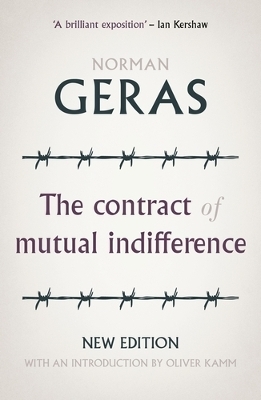
The Contract of Mutual Indifference
Political Philosophy After the Holocaust
Seiten
2020
Manchester University Press (Verlag)
978-1-5261-4952-7 (ISBN)
Manchester University Press (Verlag)
978-1-5261-4952-7 (ISBN)
Norman Geras discusses a central aspect of the experience of the Holocaust with a view to exploring its most important contemporary implications. Geras’s argument focuses on the figure of the bystander to consider the moral consequences of looking on without active responses at persecution and great suffering. -- .
'The idea which I shall present here came to me more or less out of the blue. I was on a train some five years ago, on my way to spend a day at Headingley, and I was reading a book about the death camp Sobibor... The particular, not very appropriate, conjunction involved for me in this train journey...had the effect of fixing my thoughts on one of the more dreadful features of human coexistence, when in the shape of a simple five-word phrase the idea occurred to me.'
The contract of mutual indifference
In this classic work, newly reissued here with a preface by Oliver Kamm, Norman Geras discusses a central aspect of the experience of the Holocaust with a view to exploring its most important contemporary implications. A bold and powerful synthesis of memorial, literary record, historical reflection and political theory, Geras’s argument focuses on the figure of the bystander – the bystander to the destruction of the Jews of Europe and the bystander to more recent atrocity – to consider the moral consequences of looking on without active responses at persecution and great suffering. This book argues that we owe a duty of help to those who are suffering under terrible oppression.
Geras contends that the tragedy of European Jewry – so widely pondered by historians, social scientists, psychologists, theologians and others – has not yet found its proper reflection within political philosophy. Attempting to fill the gap, he adapts an old idea from within that tradition of enquiry, the idea of the social contract, to the task of thinking about the triangular relation between perpetrators, victims and bystanders, and draws a sombre conclusion from it. Geras goes on to ask how far this conclusion may be offset by the hypothesis of a universal duty to bring aid.
The contract of mutual indifference is an original and challenging work, aimed at the complacent abstraction of much contemporary theory-building. It is supplemented by three shorter essays on the implications of the Jewish catastrophe for conceptions of human nature and progress. -- .
'The idea which I shall present here came to me more or less out of the blue. I was on a train some five years ago, on my way to spend a day at Headingley, and I was reading a book about the death camp Sobibor... The particular, not very appropriate, conjunction involved for me in this train journey...had the effect of fixing my thoughts on one of the more dreadful features of human coexistence, when in the shape of a simple five-word phrase the idea occurred to me.'
The contract of mutual indifference
In this classic work, newly reissued here with a preface by Oliver Kamm, Norman Geras discusses a central aspect of the experience of the Holocaust with a view to exploring its most important contemporary implications. A bold and powerful synthesis of memorial, literary record, historical reflection and political theory, Geras’s argument focuses on the figure of the bystander – the bystander to the destruction of the Jews of Europe and the bystander to more recent atrocity – to consider the moral consequences of looking on without active responses at persecution and great suffering. This book argues that we owe a duty of help to those who are suffering under terrible oppression.
Geras contends that the tragedy of European Jewry – so widely pondered by historians, social scientists, psychologists, theologians and others – has not yet found its proper reflection within political philosophy. Attempting to fill the gap, he adapts an old idea from within that tradition of enquiry, the idea of the social contract, to the task of thinking about the triangular relation between perpetrators, victims and bystanders, and draws a sombre conclusion from it. Geras goes on to ask how far this conclusion may be offset by the hypothesis of a universal duty to bring aid.
The contract of mutual indifference is an original and challenging work, aimed at the complacent abstraction of much contemporary theory-building. It is supplemented by three shorter essays on the implications of the Jewish catastrophe for conceptions of human nature and progress. -- .
Norman Geras was Professor of Government at the University of Manchester -- .
Preface by Oliver Kamm
Foreword
Part I
1 The Contract of Mutual Indifference
I ‘Consider that this has been’
II A Different Kind of Contract
III The Duty to Bring Aid
IV An Open Structure of Value
Part II
2 Socialist Hope in the Shadow of Catastrophe
3 Progress Without Foundations?
4 Marxists before the Holocaust
Bibliography
Index -- .
| Erscheinungsdatum | 10.05.2021 |
|---|---|
| Reihe/Serie | Manchester University Press |
| Einführung | Oliver Kamm |
| Verlagsort | Manchester |
| Sprache | englisch |
| Maße | 138 x 216 mm |
| Gewicht | 376 g |
| Themenwelt | Geisteswissenschaften ► Philosophie ► Ethik |
| Sozialwissenschaften ► Soziologie | |
| ISBN-10 | 1-5261-4952-4 / 1526149524 |
| ISBN-13 | 978-1-5261-4952-7 / 9781526149527 |
| Zustand | Neuware |
| Informationen gemäß Produktsicherheitsverordnung (GPSR) | |
| Haben Sie eine Frage zum Produkt? |
Mehr entdecken
aus dem Bereich

aus dem Bereich
Buch | Hardcover (2025)
Suhrkamp (Verlag)
CHF 32,15
ein Versuch über Kardinaltugenden und Laster
Buch | Hardcover (2025)
De Gruyter (Verlag)
CHF 55,90


