


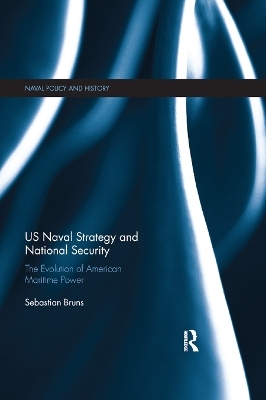
US Naval Strategy and National Security
The Evolution of American Maritime Power
Seiten
2019
Routledge (Verlag)
978-0-367-87754-5 (ISBN)
Routledge (Verlag)
978-0-367-87754-5 (ISBN)
This book examines the evolution of US naval strategy and the role of American seapower over three decades, from the late 20th century to the early 21st century.
This book examines US naval strategy and the role of American seapower over three decades, from the late 20th century to the early 21st century.
This study uses the concept of seapower as a framework to explain the military and political application of sea power and naval force for the United States of America. It addresses the context in which strategy, and in particular US naval strategy and naval power, evolves and how US naval strategy was developed and framed in the international and national security contexts. It explains what drove and what constrained US naval strategy and examines selected instances where American sea power was directed in support of US defense and security policy ends – and whether that could be tied to what a given strategy proposed. The work utilizes naval capstone documents in the framework of broader maritime conceptual and geopolitical thinking, and discusses whether these documents had lasting influences in the strategic mind-set, the force structure, and other areas of American sea power. Overall, this work provides a deeper understanding of the crafting of US naval strategy since the final decade of the Cold War, its contextual and structural framework setting, and its application. To that end, the work bridges the gap between the thinking of American naval officers and planners on the one hand and academic analyses of Navy strategy on the other hand. It also presents the trends in the use of naval force for foreign policy objectives and into strategy-making in the American policy context.
This book will be of much interest to students of naval power, maritime strategy, US national security and international relations in general.
This book examines US naval strategy and the role of American seapower over three decades, from the late 20th century to the early 21st century.
This study uses the concept of seapower as a framework to explain the military and political application of sea power and naval force for the United States of America. It addresses the context in which strategy, and in particular US naval strategy and naval power, evolves and how US naval strategy was developed and framed in the international and national security contexts. It explains what drove and what constrained US naval strategy and examines selected instances where American sea power was directed in support of US defense and security policy ends – and whether that could be tied to what a given strategy proposed. The work utilizes naval capstone documents in the framework of broader maritime conceptual and geopolitical thinking, and discusses whether these documents had lasting influences in the strategic mind-set, the force structure, and other areas of American sea power. Overall, this work provides a deeper understanding of the crafting of US naval strategy since the final decade of the Cold War, its contextual and structural framework setting, and its application. To that end, the work bridges the gap between the thinking of American naval officers and planners on the one hand and academic analyses of Navy strategy on the other hand. It also presents the trends in the use of naval force for foreign policy objectives and into strategy-making in the American policy context.
This book will be of much interest to students of naval power, maritime strategy, US national security and international relations in general.
Sebastian Bruns heads the Center for Maritime Strategy & Security (CMSS) at the Institute for Security Policy, University of Kiel (ISPK). He is co-editor of the Routledge Handbook of Naval Strategy and Security (Routledge, 2016).
1. Introduction: Seapower, Strategy, and the Particulars of the Maritime Operating Environment 2. Strategy: Its setting 3. Prelude: 1945-1980, a "naval baisse"? 4. A "Naval Renaissance" through "The Maritime Strategy" (1981-1989) 5. Managing Strategic Change and Embracing a New World Order (1989-2001) 6. A Sea Power Rationale for the 21st Century (2001-2008) 7. Sea Change: American National Security and U.S. Seapower in an Increasingly Chaotic World (2009-2016) 8. Conclusion
| Erscheinungsdatum | 16.12.2019 |
|---|---|
| Reihe/Serie | Cass Series: Naval Policy and History |
| Verlagsort | London |
| Sprache | englisch |
| Maße | 156 x 234 mm |
| Gewicht | 408 g |
| Themenwelt | Sozialwissenschaften ► Politik / Verwaltung ► Europäische / Internationale Politik |
| ISBN-10 | 0-367-87754-6 / 0367877546 |
| ISBN-13 | 978-0-367-87754-5 / 9780367877545 |
| Zustand | Neuware |
| Informationen gemäß Produktsicherheitsverordnung (GPSR) | |
| Haben Sie eine Frage zum Produkt? |
Mehr entdecken
aus dem Bereich



aus dem Bereich
kurze Geschichte einer langen Beziehung
Buch | Hardcover (2025)
Suhrkamp (Verlag)
CHF 36,40
Amerikas Strategie der Vorherrschaft und der Kampf um Eurasien
Buch | Softcover (2024)
NOMEN Verlag
CHF 27,95
erfolgreiche Interessenvertretung durch Prozesskompetenz im komplexen …
Buch | Hardcover (2023)
Wiley-VCH (Verlag)
CHF 58,75


