


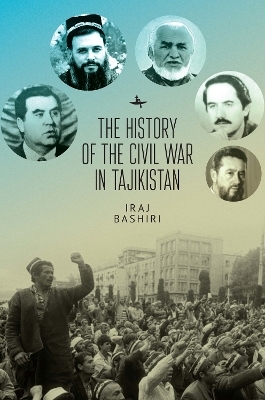
The History of the Civil War in Tajikistan
Seiten
2020
Academic Studies Press (Verlag)
978-1-64469-287-5 (ISBN)
Academic Studies Press (Verlag)
978-1-64469-287-5 (ISBN)
- Lieferbar
- Versandkostenfrei
- Auch auf Rechnung
- Artikel merken
While the Soviets could affect Tajiks' social status substantially, they failed in changing their ideology. Instead, they became involved in a conflict that pitted Soviet Tajiks against radical Muslim Tajiks. This volume traces the conflict from its roots in Bukhara to the establishment of an independent secular Tajik state (1997).
In the 10th century, the Turks separated the Tajiks, a Central Asian community, from their Iranian kinfolk. The Tajiks adopted the Hanafi faith and, alongside ethnicity, made it a pillar of their identity. Between 1920 and 1990, the Soviets tried to alter the Tajiks' identity. While they could affect the Tajiks' social status substantially (cf. Afghanistan), they failed in changing the Tajiks' ideology. Instead, they became involved in a conflict that pitted Soviet Tajiks against radical Muslim Tajiks, the latter intentionally misidentified as Wahhabis by the Soviets. The question was about the viability of enforcing the secular Soviet constitution versus the Islamic Shari'a. Inability to resolve the dispute led to civil war (1992). The volume traces the conflict from its roots in Bukhara to the establishment of an independent secular Tajik state (1997).
In the 10th century, the Turks separated the Tajiks, a Central Asian community, from their Iranian kinfolk. The Tajiks adopted the Hanafi faith and, alongside ethnicity, made it a pillar of their identity. Between 1920 and 1990, the Soviets tried to alter the Tajiks' identity. While they could affect the Tajiks' social status substantially (cf. Afghanistan), they failed in changing the Tajiks' ideology. Instead, they became involved in a conflict that pitted Soviet Tajiks against radical Muslim Tajiks, the latter intentionally misidentified as Wahhabis by the Soviets. The question was about the viability of enforcing the secular Soviet constitution versus the Islamic Shari'a. Inability to resolve the dispute led to civil war (1992). The volume traces the conflict from its roots in Bukhara to the establishment of an independent secular Tajik state (1997).
Iraj Bashiri is one of the leading scholars in the fields of Central Asian studies and Iranian studies with a focus on Tajik and Iranian identity. His extensive publications on Tajikistan include History of a National Catastrophe (ed.), The Samanids and the Revival of the Civilization of Iranian Peoples, and Prominent Tajik Figures of the 20th Century.
1. The War Year
2. The Emirate of Bukhara
3. The Sovietization of Tajikistan
4. End of an Era
5. The Government of National Reconciliation
6. Reinventing the Wheel
7. The Path to Recovery
Appendix
Glossary
List of abbreviations
Bibliography
Index
| Erscheinungsdatum | 15.04.2020 |
|---|---|
| Reihe/Serie | Central Asian Studies |
| Zusatzinfo | Illustrations |
| Verlagsort | Brighton |
| Sprache | englisch |
| Maße | 155 x 234 mm |
| Themenwelt | Sachbuch/Ratgeber ► Geschichte / Politik ► Allgemeines / Lexika |
| Geschichte ► Allgemeine Geschichte ► Neuzeit (bis 1918) | |
| Geisteswissenschaften ► Geschichte ► Regional- / Ländergeschichte | |
| Geschichte ► Teilgebiete der Geschichte ► Militärgeschichte | |
| Sozialwissenschaften ► Politik / Verwaltung ► Politische Systeme | |
| Sozialwissenschaften ► Politik / Verwaltung ► Politische Theorie | |
| ISBN-10 | 1-64469-287-2 / 1644692872 |
| ISBN-13 | 978-1-64469-287-5 / 9781644692875 |
| Zustand | Neuware |
| Informationen gemäß Produktsicherheitsverordnung (GPSR) | |
| Haben Sie eine Frage zum Produkt? |
Mehr entdecken
aus dem Bereich

aus dem Bereich
Geschichte einer wilden Handlung
Buch | Hardcover (2024)
C.H.Beck (Verlag)
CHF 47,60


