


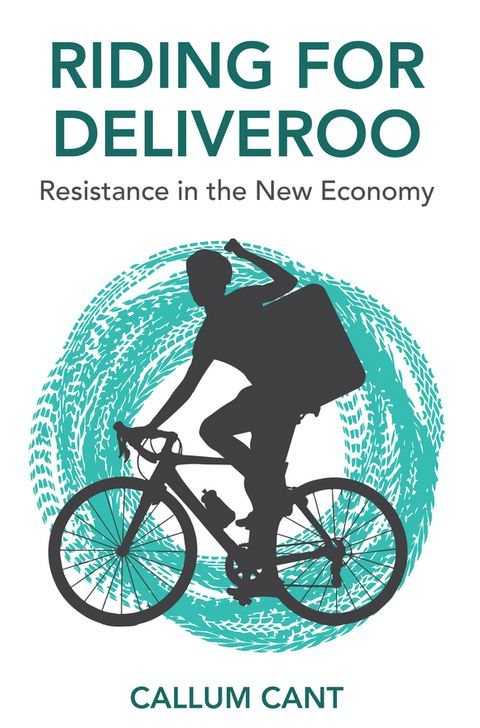
Riding for Deliveroo (eBook)
John Wiley & Sons (Verlag)
978-1-5095-3552-1 (ISBN)

His vivid account of the reality is grim. Workers are being tyrannised by algorithms and exploited for the profit of the few - but they are not taking it lying down. Cant reveals a transnational network of encrypted chats and informal groups which have given birth to a wave of strikes and protests. Far from being atomised individuals helpless in the face of massive tech companies, workers are tearing up the rulebook and taking back control. New developments in the workplace are combining to produce an explosive subterranean class struggle - where the stakes are high, and the risks are higher.
Riding for Deliveroo is the first portrait of a new generation of working class militants. Its mixture of compelling first-hand testimony and engaging analysis is essential for anyone wishing to understand class struggle in platform capitalism.
Callum Cant is a former Deliveroo delivery worker and PhD candidate at the University of West London
What is life like for workers in the gig economy? Is it a paradise of flexibility and individual freedom? Or is it a world of exploitation and conflict? Callum Cant took a job with one of the most prominent platforms, Deliveroo, to find out. His vivid account of the reality is grim. Workers are being tyrannised by algorithms and exploited for the profit of the few but they are not taking it lying down. Cant reveals a transnational network of encrypted chats and informal groups which have given birth to a wave of strikes and protests. Far from being atomised individuals helpless in the face of massive tech companies, workers are tearing up the rulebook and taking back control. New developments in the workplace are combining to produce an explosive subterranean class struggle where the stakes are high, and the risks are higher. Riding for Deliveroo is the first portrait of a new generation of working class militants. Its mixture of compelling first-hand testimony and engaging analysis is essential for anyone wishing to understand class struggle in platform capitalism.
Callum Cant is a former Deliveroo delivery worker and PhD candidate at the University of West London
Contents
Acknowledgements
Preface
1. Introduction
2. The Job
3. The System of Control
4. A Short History of Precarious Militants
5. The Workers
6. The Strikes
7. Looking Forward
8. A New Wave
9. Conclusion
"This is a timely and insightful discussion of the conditions faced by gig economy workers. Powerfully written and politically urgent, it should be essential reading for anybody looking to understand - and to challenge - precarity in the age of platform capitalism."
Helen Hester, University of West London
"Riding for Deliveroo is a must read for those interested in the gig economy, providing a powerful argument for how work can be transformed today."
Jamie Woodcock, Oxford Internet Institute, University of Oxford
"Riding for Deliveroo provides a compelling and insightful account of the labour struggles at the front lines of the gig economy, deftly weaving individual stories of worker resistance into a rigorous theoretical analysis of modern-day capitalism."
Wendy Liu
"Essential reading."
Morning Star
"interesting and encouraging"
Transfer: European Review of Labour and Research
2
The Job
In the summer of 2016, I watched the London Deliveroo strike from behind a desk. At 8.15 a.m., I would cycle the 3 miles to the University of Sussex campus from Brighton, lock up my bike and sit down for another day as a policy and research assistant at the students’ union. In my down time, flicking through social media, I saw friends sharing things about the strike. I saw a video, recorded on a worker’s phone, of a strike convoy of hundreds of mopeds snaking through the streets, horns blaring. I watched it over and over, waiting for the day to end.
Two weeks after the Deliveroo strikes had first exploded, UberEats workers decided to follow their example and strike for better conditions. One lunch break, towards the end of the month, I went outside to call Petros Elia, the general secretary of the United Voices of the World (UVW) union. The UVW, much like the IWGB, is a small militant union which supported the strikes. We spoke for about twenty minutes, and he described how the internal dynamics of the strike movement seemed to be very unorthodox. It wasn’t like standard trade unionism, there was something else going on. I wrote up our conversation in an article for Novara Media. I used one quote from Petros at the heart of it: ‘The totally spontaneous and autonomous nature of this action is what makes it so exciting. It’s not really organising as we know it – it’s something else entirely. They’re not following any of the strategic rules. They do what they want, and it works.’1 This dynamism was a theme I’d soon be seeing in practice.
For the time being, however, I left the sunshine and went back to my desk with one question: why hadn’t the strikes spread? I knew Deliveroo was in Brighton too, I saw mopeds with the trademark turquoise boxes passing below the windows of my flat every evening. If these conditions were national, why had they only caused a strike in London? It was impossible to tell without knowing what was actually going on in the city, and you couldn’t know what was going on from the outside. Part of what made these strikes so interesting was the impenetrability of the organizing processes that generated them. Marx wrote about the way that, in capitalist society, the market, where commodities are bought and sold, is a public sphere ruled over by the ideals of Freedom, Equality and Property. But the workplace, where value is actually produced, is more like a ‘hidden abode’, with an entirely different set of rules.2 That was how it felt to me, trying to understand Deliveroo: I could read all I wanted about these flexible market disruptors, but the reality of production was a mystery.
Searching for news on the strike had brought me to the attention of the algorithms. On every website I visited, I was now being served with adverts encouraging me to start working for Deliveroo. They showed me pictures of young people in colourful uniforms leaning on nice bicycles and promised me £12 an hour and total flexibility. They were inviting me into the hidden abode. Eventually, I took them up on the offer.
Getting the Job
I thought of working for Deliveroo as an experiment. It would let me understand what the work was actually like, see how I could support workers who decided to take action, and make some extra money at the same time. My students’ union paycheques weren’t that great, after all. I was working 8.30–5.30, but I was allowed to be flexible with my time, so if I could make up the hours elsewhere and left at 5, I reckoned I could get an evening shift in, a couple of days a week. So, in mid-September, I finally clicked on one of the ads, signed up, and got a call the same day. I arranged to do my ‘trial ride’ the next week.
The trial ride was not a great success. I wangled working from home so that I could be in the city at midday. We were meeting at the Level, a park in the centre of Brighton. I got there a little early and met another prospective worker. He was a student at the University of Sussex, new to the city, and looking to pick up some extra work. He reckoned starting with Deliveroo would be easier than trying to compete with the thousands of other students in the city looking for 15 hours a week at a pub or cafe. A few minutes later, the worker leading the trial showed up. He was just doing trial shifts to supplement his normal delivery work, and his role basically seemed to be to make sure we could cycle without falling off our bikes. The trial involved cycling from the Level down to a side street near the sea front. It all went okay until we got into the north Laine, an area of small streets with a complicated road system. We ended up about to ride the wrong way down a one-way street. Aware that there wasn’t any time limit to complete the trial, but that you probably couldn’t break the highway code and still get a job, we got off our bikes and walked part of the way there. When we got to the designated street, the trial leader demonstrated how the app functioned and gave us some advice on what hours were good to work. I was all set to start as soon as I completed some online training and picked up my kit. After the trial, I never saw either of them again.
The next step was to pick up my equipment at an ‘on-boarding session’. I was expecting to be invited to an office, but instead I was told to go to a storage unit one evening next week. The unit was part of a large warehouse, run by a chain. At a guess, I’d say the other units were mostly rented by landlords and small businesses. There I met three other recruits and waited for the closest thing to an actual manager that I ever met. We didn’t know where to go, so just stood in the small reception area, hoping we were in the right place. The almost-manager we were waiting for turned up ten minutes late, spilling out of an elevator filled to the brim with brightly coloured Deliveroo stuff. He promptly began to turn the reception into a distribution centre. He gave us a code we needed to install the app on our phone, and then began to hand out a huge load of kit: waterproof trousers and jacket, a t-shirt, a cycling jersey, a battery pack, a cheap phone mount, some even cheaper lights, a helmet, and finally the thermal backpack. For the privilege, we would have 50 per cent of our first £300 earned deducted to pay a £150 deposit. We were supposed to be able to get this back when we finished working for Deliveroo and gave the kit back. Most of the stuff he gave us would turn out to be useless, apart from the battery pack, backpack, and jacket.
Deliveroo, he explained, was split into zones, about 2.5 miles across. In some cities, you could have multiple zones, but in Brighton we just had one. The pay structure of Deliveroo varied from city to city, and for us it was a pure piece wage. We’d get £4 per delivery, with no hourly rate at all. We were told that, sometimes, when demand was high, we might get a ‘surge’ text, offering a variety of pay increases, ranging from an extra 50p or £1 per drop to a bonus £10 after you completed ten orders. Brighton was what was called a ‘free login zone’, meaning that there was no formal shift system. We could turn on the app and work at any time between 11.45 a.m. and 11 p.m. Monday to Thursday. and 9 a.m. to 11 p.m. Friday to Sunday. The almost-manager told us that we had to work a minimum of two weekends a month. I was confused – wasn’t Brighton a free login zone? I thought we could work whenever we wanted? Apparently not. He said we had to work for at least two shifts of 4 hours between Friday and Sunday twice a month or we would be deactivated. This rule was never written down, but the instructions were very clear. Flexibility, it seemed, had its limits.
The three other recruits were all students, two at university and one at college. We chatted a bit about why we were starting the job. All of them had been applying for other jobs in the city but had been unsuccessful. It was a real challenge getting part-time work, particularly in September. at the start of the academic year. I’d had the same experience as a Masters student at Sussex. I ended up working a few cash-in-hand shifts on a crepe stall until the owner finally gave up on teaching me how to flip pancakes. We had a laugh about it – hopefully I would be better at delivering food. We exchanged numbers and agreed to let each other know how the job went, but then after the on-boarding I never saw any of them again either. As I was cycling home, I wondered how representative these first four recruits I’d met were: all students on bicycles, all struggling to find work, three men and one woman. I’d later find out that I was in fact joining Deliveroo at the start of a massive wave of student recruitment.
An Average Shift
I was keen to get going and do my first shift. I decided I’d start work after my day job that Thursday. I got changed, pumped up my tyres, bolted down some food, filled up a water bottle, checked my phone was fully charged, and headed out. It was later than I intended, almost 6 p.m., but no matter. I clocked on and logged in to the app, then got my first order almost immediately. It was for a pizza restaurant, five minutes away.
The labour process at Deliveroo is simple and repetitive. You open the app, log in, and select ‘available for orders’. As soon as you do that, your location and availability begins to be factored into the order allocation...
| Erscheint lt. Verlag | 11.11.2019 |
|---|---|
| Sprache | englisch |
| Themenwelt | Sozialwissenschaften ► Soziologie ► Mikrosoziologie |
| Wirtschaft ► Volkswirtschaftslehre ► Makroökonomie | |
| Wirtschaft ► Volkswirtschaftslehre ► Wirtschaftspolitik | |
| Schlagworte | Applications • Apps • class conflict • Cultural Studies • Deliveroo • Digital Culture • Digital Culture & the Information Age • Digitale Kultur im Informationszeitalter • Economics • Exploitation • first-hand account • Gig economy • GrubHub • Information Age • Kulturwissenschaften • New Economy • Platform Capitalism • political economics • Politische Ökonomie • Postmates • Protest • Rebellion • resistance • Revolt • Society • Sociology • Sociology of Organizations & Work • Soziologie • Soziologie am Arbeitsplatz • Strike • Trade unions • UberEats • Volkswirtschaftslehre • Work • worker revolt |
| ISBN-10 | 1-5095-3552-7 / 1509535527 |
| ISBN-13 | 978-1-5095-3552-1 / 9781509535521 |
| Informationen gemäß Produktsicherheitsverordnung (GPSR) | |
| Haben Sie eine Frage zum Produkt? |
 EPUB (Adobe DRM)
Kopierschutz: Adobe-DRM
Adobe-DRM ist ein Kopierschutz, der das eBook vor Mißbrauch schützen soll. Dabei wird das eBook bereits beim Download auf Ihre persönliche Adobe-ID autorisiert. Lesen können Sie das eBook dann nur auf den Geräten, welche ebenfalls auf Ihre Adobe-ID registriert sind.
Details zum Adobe-DRM
Dateiformat: EPUB (Electronic Publication)
EPUB ist ein offener Standard für eBooks und eignet sich besonders zur Darstellung von Belletristik und Sachbüchern. Der Fließtext wird dynamisch an die Display- und Schriftgröße angepasst. Auch für mobile Lesegeräte ist EPUB daher gut geeignet.
Systemvoraussetzungen:
PC/Mac: Mit einem PC oder Mac können Sie dieses eBook lesen. Sie benötigen eine
eReader: Dieses eBook kann mit (fast) allen eBook-Readern gelesen werden. Mit dem amazon-Kindle ist es aber nicht kompatibel.
Smartphone/Tablet: Egal ob Apple oder Android, dieses eBook können Sie lesen. Sie benötigen eine
Geräteliste und zusätzliche Hinweise
Buying eBooks from abroad
For tax law reasons we can sell eBooks just within Germany and Switzerland. Regrettably we cannot fulfill eBook-orders from other countries.
aus dem Bereich


