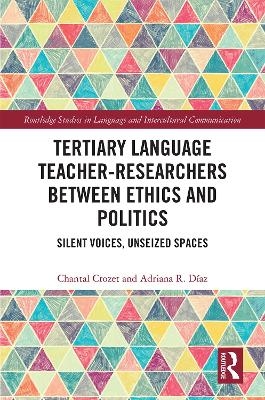
Tertiary Language Teacher-Researchers Between Ethics and Politics
Routledge (Verlag)
978-1-138-58455-6 (ISBN)
Chantal Crozet is a Language Teacher-Researcher in French Studies and Intercultural Communication in the School of Global, Urban and Social Studies at RMIT University, Australia. Her research interests focus on politics, ethics and knowledge of Self in language and intercultural studies. Adriana Díaz is a Language Teacher-Researcher in Spanish and Latin American Studies at the School of Languages and Cultures, University of Queensland, Australia. Her research centres on critical intercultural language learning and how insights from decolonial critique can help us un/re-learn the ways in which we engage with languages education.
TABLE OF CONTENTS
LIST OF FIGURES *
LIST OF ACRONYMS AND ABBREVIATIONS *
ACKNOWLEDGEMENTS *
PREFACE *
References *
Chapter 1 – Introduction *
1.1 Setting the scene: Australia, the monolingual Babel *
1.2 Methodological Considerations *
1.2.1 Methodological framework: Critical qualitative inquiry *
1.2.2 Participants – a.k.a. our peers and our(multiple)selves *
1.2.3 Pen portraits *
1.2.4 (Re)framing of semi-structured interviews *
1.2.5 Narrative Inquiry *
1.3 Engagement with the data through narrative knowledging *
1.4 Delimiting emerging knowledg-ing (in lieu of limitations) *
1.5 Overview of the book *
References *
Chapter 2 – Silent voices and unseized spaces *
2.1 Introduction *
2.2 Mise en scène: Setting the stage, casting the actors *
2.2.1 Language and culture education *
2.2.2 Language Teaching Theorists (LTTs) *
2.2.3 Language Teachers (LTs) – The practitioners *
2.2.4 ULTRs: Silent voices and unseized spaces *
2.3 Do LTTs, LTs and ULTRs relate and if so, how? *
2.3.1 LTTs and LTs *
2.3.2 ULTRs and LTTs *
2.3.3 ULTRs and LTs *
2.4 ULTRs in the Australian higher education context *
2.5 Concluding remarks *
References *
Chapter 3 – ULTRs’ professional identity and agency *
3.1 Introduction: Theoretical framings and orientations *
3.2 Moving beyond ‘identity’ towards ‘identity work’ *
3.2.1 A political approach to LTI as an analytical framework *
3.2.2 The substance of LTI in ULTRs *
3.2.3 The authority sources of ULTRs *
3.2.4 The self-practices of ULTRs *
3.2.5 The telos of ULTRs *
3.3 Agency *
3.4.1 Entanglement between identity and agency *
3.4.2 Individual agency and structure *
Conclusion *
References *
Chapter 4 – Goals, Politics and Ethics for tertiary LCE *
4.1 Introduction *
4.2 Rationale for increasing the politicisation and ethicalisation of tertiary LCE practice *
4.3 Tracing the goals, politics and ethics (GPE) nexus in tertiary LCE literature *
4.3.1 New ways of approaching language teaching *
4.3.2 New ways of approaching the teaching of culture *
4.4 Insights from Australian ULTRs on goals, politics and ethics (GPE) in tertiary LCE. *
4.4.1 - Q13: ‘What in your view should be the goals and aims of language and culture teaching at tertiary level in Australia?’ *
Finding 1: A big and hard question *
Finding 2: Political and ethical dimensions *
Finding 3: Language, communication, some culture *
Finding 4: Teaching culture matters *
Finding 5: Critical thinking *
4.4.2 - Q23: ‘Do you see your role as a language(-culture) teacher/researcher as having: a political dimension and an ethical dimension?’ *
Finding one: positively political and ethical dimension with nuances *
Finding two: the political dimension of LCE, unavoidable but challenging. *
Finding three: ethics in the act of teaching and as obligation *
4.4.3 Q16, 17 & 18: ‘Are you familiar with the concept of, and the literature on Intercultural Language Teaching? What does it mean to you? Can you name authors that have influenced your practice?’ *
4.5 Conclusion *
References *
Chapter 5 – Towards critical, intercultural and activist tertiary LCE *
5.1 Introduction *
5.2 ULTRs’ voices on culture and teaching practice *
5.2.1 Gaps between ideals and practice: lack of time, overcrowded classes & textbooks *
5.2.2 Definitions of culture and teaching culture *
5.3 Critical cultural knowledge as student empowerment *
5.4 Dissatisfaction and/or illegitimacy regarding culture teaching and cultural knowledge. *
5.5 Towards a critical, intercultural and activist tertiary LCE curricula and pedagogy *
References *
Chapter 6 – Conclusion *
6.1 Introduction *
6.2 Emerging knowledg-ing *
6.2.1 ‘Glocalising’ LCE: challenges for ULTRs *
6.2.2 Schizophrenic tensions between discourses and roles *
6.2.3 Political and ethical engagement as choice and responsibility for ULTRs *
6.3 Conclusion *
References *
AFTERWORD *
APPENDIX 1 – PARTICIPANTS *
APPENDIX 2 – Interview Protocol *
| Erscheinungsdatum | 24.02.2020 |
|---|---|
| Reihe/Serie | Routledge Studies in Language and Intercultural Communication |
| Zusatzinfo | 1 Tables, black and white; 2 Line drawings, black and white; 2 Illustrations, black and white |
| Verlagsort | London |
| Sprache | englisch |
| Maße | 152 x 229 mm |
| Gewicht | 390 g |
| Themenwelt | Schulbuch / Wörterbuch ► Wörterbuch / Fremdsprachen |
| Geisteswissenschaften ► Sprach- / Literaturwissenschaft ► Sprachwissenschaft | |
| Sozialwissenschaften ► Pädagogik ► Erwachsenenbildung | |
| ISBN-10 | 1-138-58455-X / 113858455X |
| ISBN-13 | 978-1-138-58455-6 / 9781138584556 |
| Zustand | Neuware |
| Informationen gemäß Produktsicherheitsverordnung (GPSR) | |
| Haben Sie eine Frage zum Produkt? |
aus dem Bereich