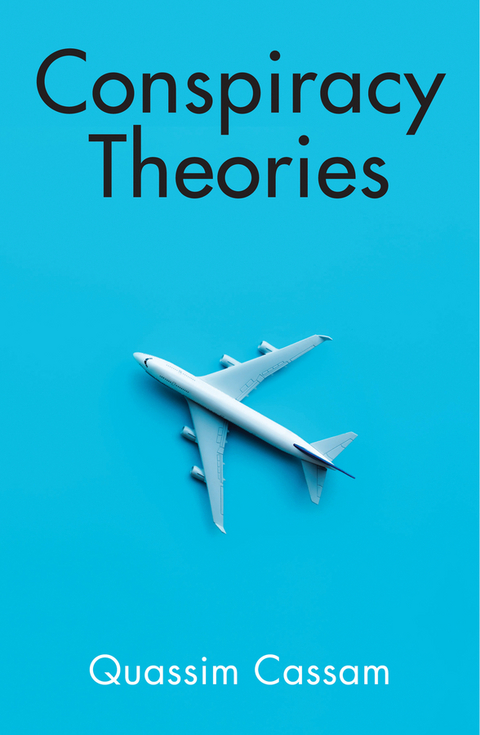
Conspiracy Theories (eBook)
John Wiley & Sons (Verlag)
978-1-5095-3584-2 (ISBN)
9/11 was an inside job. The Holocaust is a myth promoted to serve Jewish interests. The shootings at Sandy Hook Elementary School were a false flag operation. Climate change is a hoax perpetrated by the Chinese government.
These are all conspiracy theories. A glance online or at bestseller lists reveals how popular some of them are. Even if there is plenty of evidence to disprove them, people persist in propagating them. Why? Philosopher Quassim Cassam explains how conspiracy theories are different from ordinary theories about conspiracies. He argues that conspiracy theories are forms of propaganda and their function is to promote a political agenda. Although conspiracy theories are sometimes defended on the grounds that they uncover evidence of bad behaviour by political leaders, they do much more harm than good, with some resulting in the deaths of large numbers of people.
There can be no clearer indication that something has gone wrong with our intellectual and political culture than the fact that conspiracy theories have become mainstream. When they are dangerous, we cannot afford to ignore them. At the same time, refuting them by rational argument is difficult because conspiracy theorists discount or reject evidence that disproves their theories. As conspiracy theories are so often smokescreens for political ends, we need to come up with political as well as intellectual responses if we are to have any hope of defeating them.
Quassim Cassam is Professor of Philosophy at the University of Warwick.
9/11 was an inside job. The Holocaust is a myth promoted to serve Jewish interests. The shootings at Sandy Hook Elementary School were a false flag operation. Climate change is a hoax perpetrated by the Chinese government. These are all conspiracy theories. A glance online or at bestseller lists reveals how popular some of them are. Even if there is plenty of evidence to disprove them, people persist in propagating them. Why? Philosopher Quassim Cassam explains how conspiracy theories are different from ordinary theories about conspiracies. He argues that conspiracy theories are forms of propaganda and their function is to promote a political agenda. Although conspiracy theories are sometimes defended on the grounds that they uncover evidence of bad behaviour by political leaders, they do much more harm than good, with some resulting in the deaths of large numbers of people. There can be no clearer indication that something has gone wrong with our intellectual and political culture than the fact that conspiracy theories have become mainstream. When they are dangerous, we cannot afford to ignore them. At the same time, refuting them by rational argument is difficult because conspiracy theorists discount or reject evidence that disproves their theories. As conspiracy theories are so often smokescreens for political ends, we need to come up with political as well as intellectual responses if we are to have any hope of defeating them.
Quassim Cassam is Professor of Philosophy at the University of Warwick.
Preface
1 The (Real) Point of Conspiracy Theories
2 Why are Conspiracy Theories so Popular?
3 The Problem with Conspiracy Theories
4 How to Respond to Conspiracy Theories
Further Reading
"Quassim Cassam has done the world a great service. This short, bracing and easily accessible book is not only a compelling read - it is also a much-needed weapon in the war against lies and the battle for truth. Methodically, he takes apart the mindset of the conspiracy theorist and shows why such theories arise, why they appeal and why they cause real damage. Truth has taken a battering in recent years. Now, thanks to Cassam, the truth is hitting back."
Jonathan Freedland
"Those who engage in [conspiracy theory]... need to protect themselves against its corrupting effects. The philosopher Quassim Cassam is, I think, our wisest writer on this matter. I'd heartily recommend his work..."
Matthew Sweet, BBC Radio Presenter
"Interesting and informative"
Quest Magazine
"Beautifully clear, thoroughly researched, rigorous and wide-ranging."
Society
2
Why Are Conspiracy Theories So Popular?
Just how popular are Conspiracy Theories? It’s sometimes suggested that we are living in a ‘golden age’ of Conspiracy Theories, but it’s actually not clear that Conspiracy Theories are a hotter topic today than in the past. In their book American Conspiracy Theories, political scientists Joseph Uscinski and Joseph Parent describe the results of a fascinating study of conspiracy talk in letters sent to the New York Times between 1890 and 2010.1 Perhaps surprisingly, they found that discussion of conspiracy theories has diminished in the United States since 1890. At least as far as America is concerned, we don’t live in an age of conspiracy theories.
Conspiracy talk comes in several varieties. On the one hand, there is the conspiracy talk of people who invent Conspiracy Theories, usually in order to circulate them more widely and to get other people to buy into them. You might think of individuals who come up with Conspiracy Theories as Conspiracy Theory producers. On the other hand, if all you do is consume other people’s theories, then you are a Conspiracy Theory consumer rather than a producer. There are many different ways of ‘consuming’ a theory – any theory. For example, you can consume it by discussing it with friends, by posting something about it on Facebook or by retweeting it. All it takes to consume a Conspiracy Theory is to engage with it actively, one way or another.
Given the distinction between producing and consuming, the obvious next question is: why do producers produce Conspiracy Theories and why do consumers consume them? You might think that this obvious question has an equally obvious answer: producers produce and promote Conspiracy Theories because they believe their theories to be true. And the same goes for consumers of Conspiracy Theories: the theories they consume are ones that they believe in.
It doesn’t take long to work out that this can’t be right; there are plenty of reasons for producing or consuming Conspiracy Theories that have little or nothing to do with belief in their truth. For a start, it’s worth bearing in mind that Conspiracy Theories are big business and it wouldn’t be too surprising if that has something to do with the willingness of some individuals to produce and promote such theories. These individuals aren’t just Conspiracy Theory producers. They are also what Cass Sunstein calls conspiracy entrepreneurs, that is, conspiracy theorists who profit from promoting their theories.2
A good illustration of the business potential of Conspiracy Theories is the virtual store on Conspiracy Theorist Alex Jones’s website Infowars. The range of products for sale includes not only survival gear and other conspiracy-related products but also dietary supplements, ‘male vitality’ pills and toothpaste. The Conspiracy Theories for which Jones is famous (or infamous, depending on your point of view) are a marketing opportunity as well as a political statement.
The point is not that Conspiracy Theory producers don’t believe their own theories, though some of these are so outlandish that one has to wonder whether they are serious. Does Alex Jones mean what he says about Sandy Hook being a false flag? Probably. Is David Icke serious about the planet’s being ruled by shape-shifting reptilians? Who can say? But one thing is clear: there’s good money to be made by peddling such theories.
If this seems a little unfair on Conspiracy Theorists, perhaps it’s worth pointing out that one of their favourite questions is Cui bono? – that is, ‘Who benefits?’. For example, the theory that 9/11 was an inside job appeals to them partly because they think that the Bush administration benefited from the attacks. But if it’s fair to ask who benefits from events such as 9/11, then it’s also fair to ask who benefits from Conspiracy Theories about such events. And the answer in many cases appears to be: the very people who produce and promote these theories.
The benefits that Conspiracy Theories bring to their producers aren’t just financial. If, as I’ve suggested, Conspiracy Theories can be an effective way of promoting a political ideology or of achieving a political objective, then that’s another potential benefit. Belief in the literal truth of Conspiracy Theories needn’t come into it if they are a form of political propaganda. You don’t have to believe that Sandy Hook was a false flag in order to spread the story that it was, as a way of combating calls for greater gun control in the wake of the shooting. In much the same way, anti-Semitic Conspiracy Theorists have frequently invented and circulated anti-Semitic Conspiracy Theories that they knew to be false. It’s enough to think of whoever came up with the Protocols of the Elders of Zion.
It’s even more obvious that consumers of Conspiracy Theories don’t have to believe them. There are plenty of ways of actively engaging with a Conspiracy Theory you don’t endorse. One way is, of course, to argue against it, and people engaging in ‘conspiracy talk’ include both opponents and proponents of Conspiracy Theories. Some people talk about Conspiracy Theories because they find them intriguing or entertaining. Posting details of a Conspiracy Theory on Facebook is a way of engaging with it, but it’s not unusual – to put it mildly – for people to post things on social media that they don’t necessarily think are true. The extent to which people are agnostic about Conspiracy Theories is just as striking as the extent to which these theories are actively supported or opposed.
Still, there’s no denying that significant numbers of people – producers and consumers – do believe, or say they believe, at least one prominent Conspiracy Theory. A study five years after 9/11 found that more than a third of Americans believed that the government had either assisted in the attacks or knew about them in advance and did nothing to stop them. A more recent study found that 63 per cent of registered voters in the United States buy into at least one conspiracy theory (or, in my terminology, one Conspiracy Theory). And, of course, it isn’t just Americans who are into Conspiracy Theories. These are also prevalent in other parts of the world, and it’s often said that the Middle East is a particular hotspot for belief in Conspiracy Theories.
From a psychological perspective, the number of people who seemingly endorse one or more Conspiracy Theories calls for a psychological explanation. Hence the birth of a new field of study: the psychology of Conspiracy Theories. Needless to say, Conspiracy Theorists haven’t been keen on being studied by psychologists and it’s not difficult to understand their lack of enthusiasm. Their position is, of course, that their theories are based on evidence and that no psychological explanation is called for. If a person has good evidence that 9/11 was an inside job, then that is usually enough to explain why that person believes that 9/11 was an inside job. What has psychology got to do with it?
What Conspiracy Theorists who argue like this are picking up on is a strange feature of many discussions of Conspiracy Theories from a psychological viewpoint. These discussions often start by saying that they take no position as to the actual truth or falsity of Conspiracy Theories. The psychologist’s concern, they insist, is not whether these theories are true or false but why people believe them.
To see how odd this is, imagine a psychology of bananas. Specialists in this imaginary field say that they take no position on the actual existence of bananas. Their concern is not whether the widespread belief in the existence of bananas is true or false but only why people have this belief. However, the obvious explanation of a belief in the existence of bananas isn’t neutral as to their existence. The obvious explanation is that people believe that bananas exist because bananas do exist and most of us know perfectly well that they do. The implication of asking why people believe X is that there is something wrong with believing X. This implication doesn’t hold in a case where X stands for bananas, and that’s why the whole idea of a psychology of bananas is so weird.
Conspiracy Theories aren’t (literally) bananas, but asking why people believe them implies that those people are at fault for believing them. It implies, for example, that there is no legitimate reason to believe Conspiracy Theories. This is the implication that Conspiracy Theorists object to, and that many psychologists try to avoid. But there is no avoiding it. There is no neutral standpoint from which it makes sense to ask why people believe Conspiracy Theories. Either there is nothing wrong with believing them, in which case the question doesn’t arise, or the question does arise, in which case there is something wrong with believing them.
Given that Conspiracy Theories are unlikely to be true and a good number of them have been conclusively refuted, it’s reasonable to ask why people still believe them. Whether this reasonable question is one to which psychology gives a reasonable answer remains to be seen. It would be rash to deny that psychology has anything useful to say about this, but psychological...
| Erscheint lt. Verlag | 1.11.2019 |
|---|---|
| Reihe/Serie | THINK | THINK |
| Sprache | englisch |
| Themenwelt | Sozialwissenschaften ► Politik / Verwaltung ► Allgemeines / Lexika |
| Sozialwissenschaften ► Politik / Verwaltung ► Politische Theorie | |
| Schlagworte | 9/11 • alex jones • conspiracy • Conspiracy theories • Conspiracy Theories and the People who Believe Them • Conspiracy Theory • David Aaronovitch • David Icke • Donald Geoffries • Epistemology • Erkenntnistheorie • Hidden History • Infowars • Joseph E. Uscinski • Knights Templar • Philosophie • Philosophy • Philosophy Special Topics • Political Science • Politikwissenschaft • Spezialthemen Philosophie • Verschwörung • Voodoo Histories |
| ISBN-10 | 1-5095-3584-5 / 1509535845 |
| ISBN-13 | 978-1-5095-3584-2 / 9781509535842 |
| Informationen gemäß Produktsicherheitsverordnung (GPSR) | |
| Haben Sie eine Frage zum Produkt? |
 EPUB (Adobe DRM)
Kopierschutz: Adobe-DRM
Adobe-DRM ist ein Kopierschutz, der das eBook vor Mißbrauch schützen soll. Dabei wird das eBook bereits beim Download auf Ihre persönliche Adobe-ID autorisiert. Lesen können Sie das eBook dann nur auf den Geräten, welche ebenfalls auf Ihre Adobe-ID registriert sind.
Details zum Adobe-DRM
Dateiformat: EPUB (Electronic Publication)
EPUB ist ein offener Standard für eBooks und eignet sich besonders zur Darstellung von Belletristik und Sachbüchern. Der Fließtext wird dynamisch an die Display- und Schriftgröße angepasst. Auch für mobile Lesegeräte ist EPUB daher gut geeignet.
Systemvoraussetzungen:
PC/Mac: Mit einem PC oder Mac können Sie dieses eBook lesen. Sie benötigen eine
eReader: Dieses eBook kann mit (fast) allen eBook-Readern gelesen werden. Mit dem amazon-Kindle ist es aber nicht kompatibel.
Smartphone/Tablet: Egal ob Apple oder Android, dieses eBook können Sie lesen. Sie benötigen eine
Geräteliste und zusätzliche Hinweise
Buying eBooks from abroad
For tax law reasons we can sell eBooks just within Germany and Switzerland. Regrettably we cannot fulfill eBook-orders from other countries.
aus dem Bereich